
Vol. 12 No. 1 (2018)
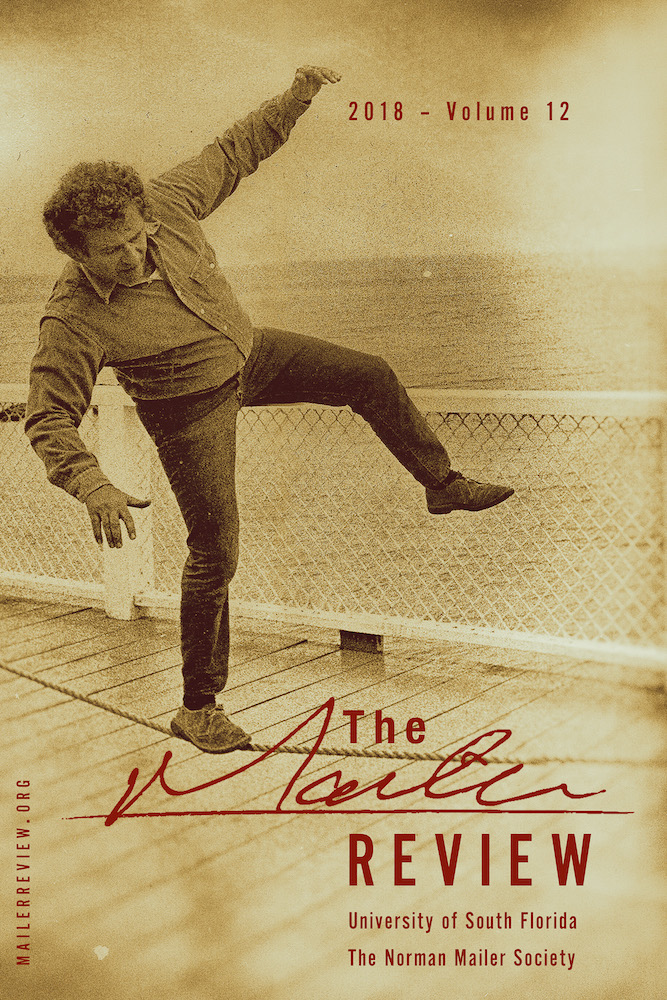
Volume 12 of The Mailer Review (Fall 2018) is shaped by a renewed emphasis on archival recovery, documentary scholarship, and the consolidation of Mailer studies as an international field. The volume is situated within a moment of expanding institutional recognition for Norman Mailer, most notably the inclusion of Mailer in the Library of America with The 1960s Collection, edited by J. Michael Lennon. Sipiora frames this milestone alongside the continued growth of scholarly resources, new editions, and archival projects that have reshaped the study of Mailer’s work in recent years.
That emphasis on primary materials is central to the volume. Volume 12 features “The Notebook,” a previously unpublished short work by Norman Mailer, presented both in facsimile images and in full transcription, underscoring the journal’s commitment to making archival materials accessible to scholars. The issue also includes essays and reflections by members of the Mailer family, including Susan Mailer and Danielle Mailer, offering personal and spatial perspectives on Mailer’s life and legacy.
Scholarly essays in the volume address a wide range of critical concerns, from Mailer’s engagement with quantum theory and Cold War science to political theory, gender, autobiography, and narrative experimentation. Contributions by Robert J. Begiebing, J. Michael Lennon, Raymond M. Vince, Victor Peppard, and others revisit central texts such as Lipton’s Journal, The Executioner’s Song, Harlot’s Ghost, and Advertisements for Myself, while situating Mailer within broader literary, philosophical, and historical contexts.
Volume 12 also reflects the journal’s expanding international and interdisciplinary reach, with essays addressing Mailer’s political thought, transatlantic literary affiliations, and ongoing relevance to contemporary critical debates. Taken together, the issue exemplifies The Mailer Review’s dual mission: to preserve and publish primary materials essential to Mailer scholarship while sustaining rigorous, historically informed critical inquiry into his work and legacy.