
Archives
-
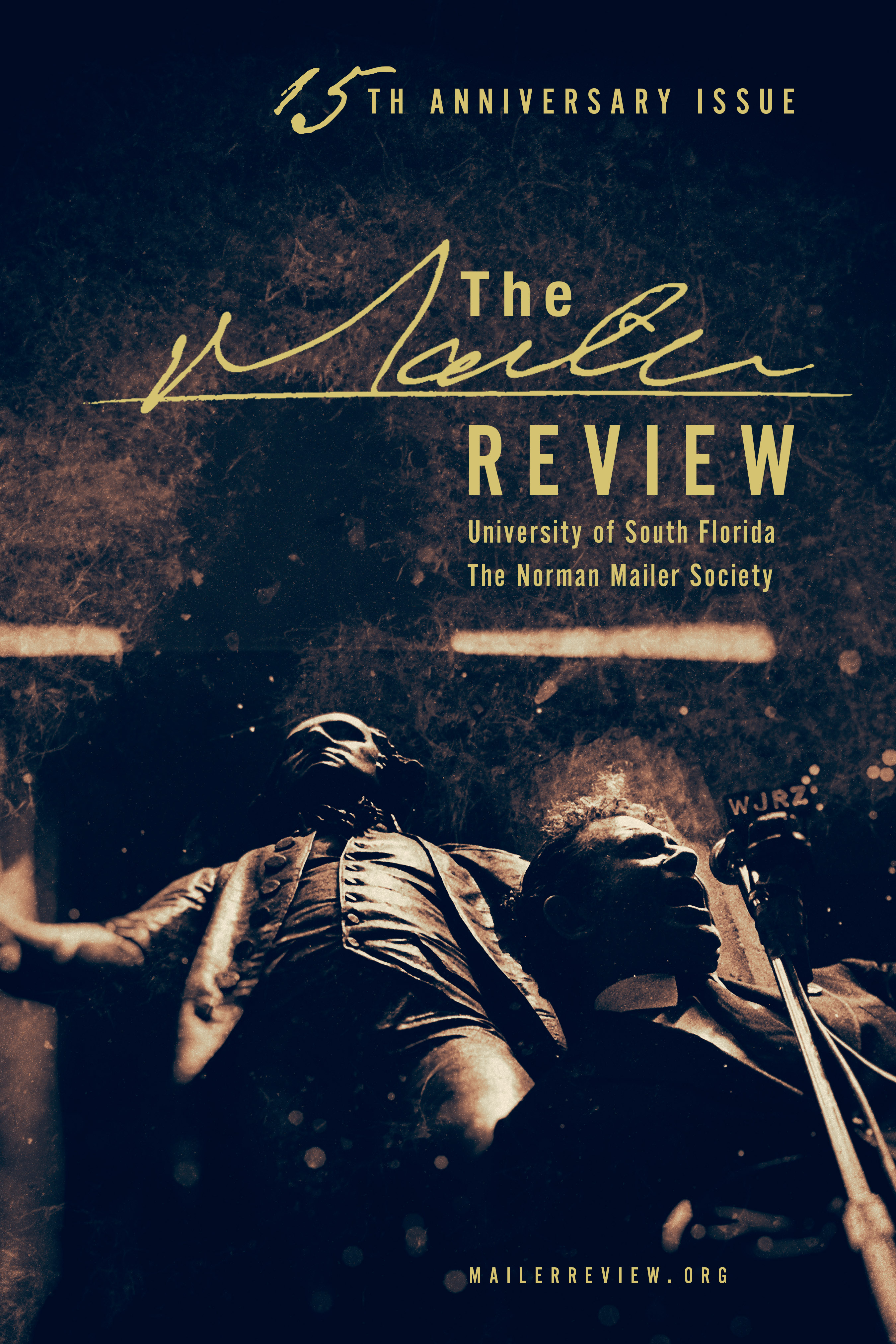
15th Anniversary Issue
Vol. 15 No. 1 (2021)Volume 15, Number 1 (Fall 2021) of The Mailer Review offers a rich collection of scholarly articles, personal memoirs, and creative works that explore the multifaceted legacy of Norman Mailer. Edited by Phillip Sipiora, this issue marks a significant moment in Mailer studies, coinciding with the publication of several major books on the author and looking forward to his 2023 centenary.
The volume features a diverse range of scholarly explorations and miscellany, including:
Literary Intersections: A previously unpublished 1988 interview with Mailer provides deep insights into his complex relationship and friendship with James Baldwin. Robert J. Begiebing presents a creative “interview” between Mailer and Walt Whitman on the tenets of American democracy, while Lawrence R. Broer compares the existential quests of Mailer and Jack Kerouac.
Thematic Analyses: Jason Mosser examines the evolution of the “White Negro” from Mailer’s hipsters to Hunter S. Thompson’s bikers, and Raymond M. Vince continues a study on the elusiveness of myth and skepticism in Mailer and Joseph Conrad.
Fictional Foundations: This issue provides a special focus on Mailer’s early work, with Phillip Sipiora analyzing early short fiction like “Love-Buds” and Gerald R. Lucas examining transitional stories from 1951–52 that acted as a proving ground for later subversive ideas.
Memoirs and Reflections: Barbara Mailer Wasserman shares a poignant excerpt from her memoir, Love of My Life, recounting a memorable dinner in Maine, and J. Michael Lennon offers a commentary on the contrasting romanticisms of Mailer and Joan Didion.
Creative and Dramatic Works: The collection includes “A Parley in Brooklyn,” a closet drama by Peter Lennon imagining a conversation between Mailer and Thomas Hardy, alongside an extensive selection of poetry and creative prose from twenty contributors.
In addition to its original articles, the volume serves as a critical resource through its comprehensive book review section, which covers new biographies of Philip Roth and James Baldwin, as well as works on cinema and trauma. It also contains a classic interpretation of The Executioner’s Song by Robert Merrill and the updated Norman Mailer bibliography for 2020.
-

Future Bound
Vol. 8 No. 1 (2014)Volume 8 of The Mailer Review (Fall 2014) reflects a phase of increasing depth and diversification within Mailer studies, as the journal continues to broaden its critical range while maintaining a strong commitment to archival and documentary scholarship. The volume brings together essays, interviews, primary materials, and reviews that collectively underscore the complexity and persistence of Norman Mailer’s literary and cultural presence.
The scholarly essays in this issue engage Mailer’s work across genres and periods, addressing questions of history, politics, masculinity, narrative form, and ethical provocation. Contributors examine both major texts and less frequently discussed works, emphasizing Mailer’s formal experimentation and his sustained engagement with American power, violence, and identity. Several essays situate Mailer within evolving critical conversations, demonstrating the adaptability of his work to new interpretive frameworks.
Volume 8 also sustains The Mailer Review’s characteristic integration of critical analysis with personal and documentary perspectives. Interviews, reflections, and archival features provide insight into Mailer’s professional life, collaborative relationships, and public interventions, offering valuable context for understanding how his work circulated and functioned within specific cultural and institutional settings.
With its combination of rigorous scholarship and historical documentation, Volume 8 further affirms The Mailer Review’s role as the central forum for Mailer studies. The issue reflects a field attentive not only to textual interpretation but also to reception, legacy, and literary labor, reinforcing the journal’s commitment to both critical inquiry and archival preservation.
-

A Double Life • Mind of an Outlaw
Vol. 7 No. 1 (2013)Volume 7 of The Mailer Review (Fall 2013) continues the journal’s sustained reassessment of Norman Mailer’s literary, political, and cultural legacy, reflecting a field that has fully entered a phase of mature scholarly engagement. The volume brings together critical essays, interviews, archival materials, and reviews that further refine the questions animating contemporary Mailer studies.
The scholarly contributions in this issue revisit central works while also expanding attention to lesser-studied texts, genres, and moments in Mailer’s career. Essays address Mailer’s negotiations with history, power, masculinity, narrative authority, and moral risk, emphasizing the formal and rhetorical strategies through which his writing engages political and cultural conflict. Several contributions situate Mailer within broader literary traditions and intellectual contexts, reinforcing his complex position within postwar American literature.
Volume 7 also maintains The Mailer Review’s characteristic integration of criticism with documentary and personal perspectives. Interviews, reflections, and archival features illuminate Mailer’s working life, professional relationships, and public presence, offering insight into the institutional and collaborative dimensions of his career. These materials complement the scholarly essays by foregrounding the conditions under which Mailer’s work was produced, circulated, and debated.
With its combination of rigorous analysis and historical documentation, Volume 7 further consolidates The Mailer Review’s role as the central forum for Mailer scholarship. The issue reflects a field attentive not only to interpretation but also to context, reception, and legacy, demonstrating the continuing vitality and complexity of Mailer studies.
-

Why Mailer Matters
Vol. 6 No. 1 (2012)Volume 6 of The Mailer Review (Fall 2012) is organized around the central argument about “Why Mailer Matters,” bringing together scholarship and reflection that directly confront Norman Mailer’s contested place in literary and cultural history. Rather than assuming Mailer’s importance, the volume asks contributors to articulate, defend, and complicate the grounds on which his work continues to demand attention in the twenty-first century.
The essays in this issue examine Mailer’s significance across multiple registers, including literary form, political engagement, historical imagination, and cultural provocation. Contributors reassess major works alongside less frequently discussed texts, addressing long-standing debates surrounding Mailer’s treatments of power, masculinity, violence, gender, and authorship. Several essays engage contemporary critical frameworks, demonstrating how Mailer’s writing both resists and invites feminist, ethical, and theoretical critique.
In addition to scholarly essays, Volume 6 includes interviews, reflections, and documentary materials that situate Mailer within the professional, institutional, and interpersonal contexts that shaped his career. These contributions provide first-hand perspectives on Mailer’s working methods and public presence, reinforcing the volume’s central concern with the mechanisms through which literary reputation is formed, challenged, and sustained.
By framing the issue around the question of Mailer’s continuing relevance, Volume 6 marks an important moment in the evolution of The Mailer Review. The volume exemplifies a field willing to interrogate its own premises, balancing critical rigor with historical awareness as it reassesses what it means for Norman Mailer to matter now.
-

Norris Mailer: A Life in Words
Vol. 5 No. 1 (2011)Volume 5 of The Mailer Review (Fall 2011) is a special issue dedicated to the life and work of Norris Church Mailer, honoring her literary achievements and cultural presence under the theme Norris Church Mailer: A Life in Words. The volume represents a significant expansion of the journal’s critical scope, turning sustained attention toward a figure long central to Norman Mailer’s later life and work, yet too often treated as peripheral in Mailer studies.
-

Literary Warriors
Vol. 4 No. 1 (2010)Volume 4 of The Mailer Review (Fall 2010), titled "Literary Warriors," brings together more than two dozen contributors to explore the rich connections between Norman Mailer and Ernest Hemingway — two writers who, a generation apart, each transformed the American literary landscape of their respective halves of the twentieth century. Both were cultural iconoclasts drawn to primal human struggles, "manly" sports, French culture, and the relentless interrogation of what it means to be human; both burst onto the scene with celebrated war novels at roughly the same age; and both forged bold new styles that pushed prose to what Sipiora calls "dizzying levels of sublimity." While Hemingway's influence on Mailer is well documented and examined here in several essays, the volume also probes subtler affinities between these two literary warriors who, remarkably, never met.
-

Beyond Fiction
Vol. 3 No. 1 (2009)Volume 3 of The Mailer Review (Fall 2009), titled "Beyond Fiction," is the journal's most ambitious issue to date — a nearly seven-hundred-page double volume emphasizing Mailer's creative nonfiction and his work in film. Contributors range widely across disciplines and backgrounds, including film directors, producers, actors, journalists, scholars, and memoirists, reflecting the journal's commitment to eclecticism. Alongside sustained critical essays, the volume features personal reflection and cultural commentary, continuing The Mailer Review's mission to serve both scholarly and general audiences as the central forum for Mailer studies.
-

In Memorium
Vol. 2 No. 1 (2008)Volume 2 of The Mailer Review (Fall 2008) is a landmark memorial issue published in the immediate aftermath of Norman Mailer’s death in November 2007. Centered on the Carnegie Hall celebration of Mailer’s life, the volume brings together tributes, reflections, and remarks by writers, critics, family members, and public figures including Don DeLillo, Günter Grass, William Kennedy, Tina Brown, and members of the Mailer family. Alongside this extensive commemorative section, the issue includes critical essays that reassess Mailer’s major works and political legacy, establishing The Mailer Review’s dual mission as both a scholarly forum and an enduring record of Mailer’s cultural significance.
-
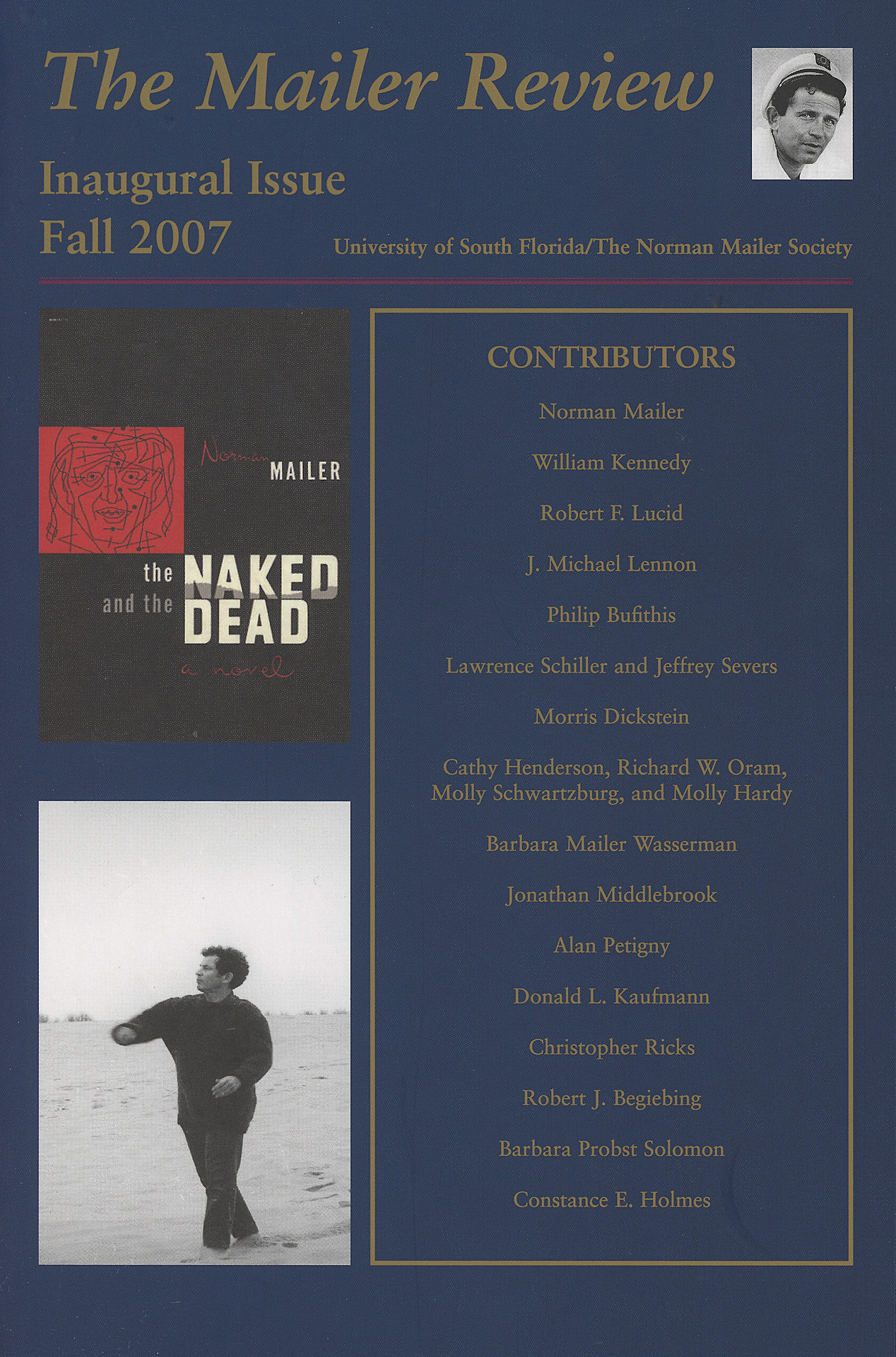
Inaugural Issue
Vol. 1 No. 1 (2007)Volume One (Fall 2007) of The Mailer Review inaugurates the journal as the central scholarly forum for the study of Norman Mailer’s life, work, and cultural legacy. Bringing together archival discoveries, critical essays, keynote reflections, review essays, and curated visual materials, the volume establishes the Review’s commitment to methodological range and intellectual seriousness. Highlights include Robert F. Lucid’s biographical essay on Mailer’s formative experience at Boston State Hospital, an unpublished 1942 dramatic excerpt related to The Naked and the Dead, major critical engagements with The Executioner’s Song and The Castle in the Forest, and essays drawing on the Harry Ransom Center’s Mailer archive. The volume concludes with a substantial supplemental bibliography, positioning Volume One not only as a landmark issue but as an indispensable foundation for future Mailer scholarship.