
Current Issue
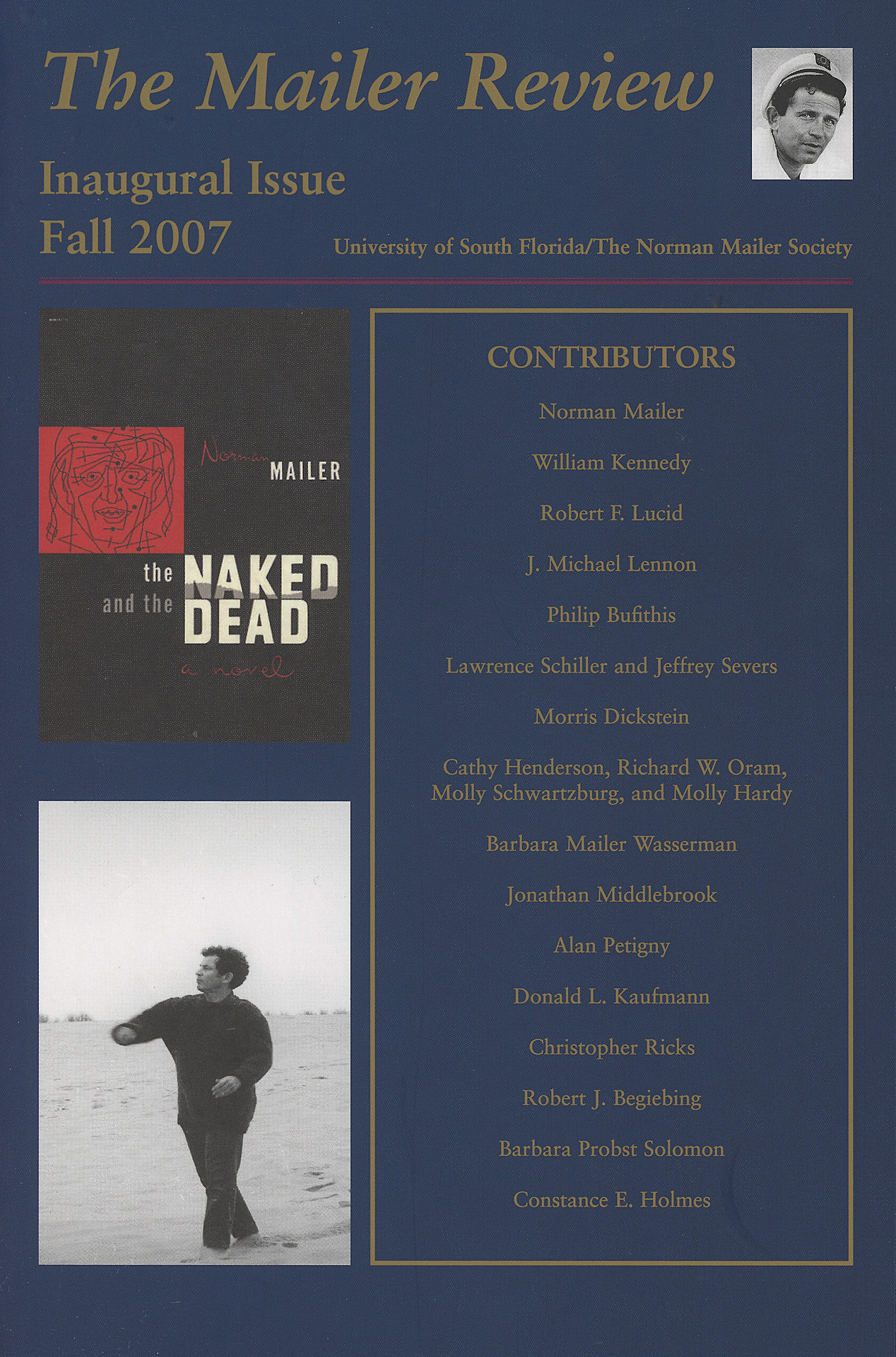
The inaugural volume of The Mailer Review establishes the journal as the central scholarly forum for the study of Norman Mailer’s life, work, and cultural legacy. Published in Fall 2007, this first issue announces its ambitions clearly: to combine rigorous literary scholarship with archival discovery, personal reflection, and sustained critical engagement across Mailer’s long and controversial career.
Volume 1 opens with a “Reflections” section that situates the journal’s founding within the broader work of the Norman Mailer Society and dedicates the issue to Robert F. Lucid (1930–2006), widely regarded as the dean of Mailer studies. Lucid’s presence is not merely ceremonial. His essay, “Boston State Hospital: The Summer of 1942,” offers a formative biographical account of Mailer’s early encounter with institutional power and fear, an experience Lucid persuasively links to Mailer’s lifelong preoccupation with authority, violence, and the administration of power.
The Articles section is both wide-ranging and foundational. Highlights include:
-
William Kennedy’s “Norman Mailer as Occasional Commentator in a Self-Interview and Memoir,” a personal and literary meditation by one of Mailer’s contemporaries, tracing Mailer’s development as a public intellectual and stylist.
-
A remarkable archival recovery: an excerpt from Mailer’s unpublished 1942 play, The Naked and the Dead, offering a rare glimpse of Mailer’s early dramatic imagination.
-
J. Michael Lennon’s edited presentation of Mailer’s letters on The Deer Park (1954–55), which documents in real time the creative, political, and publishing pressures surrounding one of Mailer’s most embattled novels.
-
Philip Bufithis’s and Jeffrey Severs’s paired contributions on The Executioner’s Song, including a substantial interview with Lawrence Schiller, Mailer’s collaborator on the book, that sheds new light on the ethical and formal challenges of Mailer’s nonfiction masterpiece.
-
Morris Dickstein’s influential essay, “How Mailer Became ‘Mailer,’” which frames Mailer as both a literary and public character, tracing the evolution of his self-fashioning across fiction, journalism, and cultural commentary.
Volume 1 also demonstrates an early commitment to archival scholarship. Essays on the Norman Mailer Archive and the Harry Ransom Center’s Mailer holdings are accompanied by images and contextual commentary, underscoring the journal’s role in connecting scholarship to primary materials.
The issue closes with a robust Classic Interpretation section, including Donald L. Kaufmann’s reading of An American Dream, and a substantial Book Review forum engaging Mailer’s then-recent novel The Castle in the Forest. Contributors such as Christopher Ricks, Barbara Probst Solomon, Robert J. Begiebing, and Phillip Sipiora bring a range of critical voices to bear on Mailer’s late style, moral imagination, and theological provocations.
Finally, Volume 1 culminates in a major scholarly resource: “Norman Mailer: Supplemental Bibliography Through 2006,” compiled by Constance E. Holmes and J. Michael Lennon. Extending Norman Mailer: Works and Days, this bibliography immediately positioned The Mailer Review as indispensable to Mailer research, offering the most comprehensive accounting to date of primary and secondary materials.
Taken together, Volume 1 is not merely an inaugural issue but a declaration of purpose. It defines The Mailer Review as a journal committed to archival depth, methodological range, and sustained critical seriousness, while remaining attentive to Mailer’s ongoing relevance as a literary, political, and cultural figure. For scholars, students, and serious readers of postwar American literature, Volume 1 remains a foundational text.