I do loathe cowardice and sloppy emotion.
—D.H. Lawrence, Letters
Never had a male novelist written more intimately about women—heart, contradiction, and soul.
—Norman Mailer, The Prisoner of Sex
Tragedy is lack of experience.
—D.H. Lawrence, Sun
Pleasure comes best to those that are brave.
—Norman Mailer, Advertisements for Myself
I
Although “Sun” justifiably is regarded as one of D.H. Lawrence’s finest short stories, critics have not sufficiently focused on its integrated structure, patterned repetition, and visionary implications. While significant attention centers on the key differences between the 1925 and 1928 published versions, as well as on invested opinions on the competing merit of each version, there remains little commentary about the art and ideology that infuse the work.1 There is also inadequate engagement with the story’s resonance within the arc of Lawrence’s turbulent life and artistic preoccupation that may bear upon his creation of this sensuous tale. More discussion is needed about the possible relevance of his embattled marriage to Frieda, deteriorating health, and waning sexual capacity. There does exist, however, a too-confident consensus about the character of Maurice as a simple case of static and sunless unmanliness, and about Juliet as a sympathetic embodiment of a frustrated and conflicted wife.2 Using the 1928 Black Sun Press version in its republished form in the Cambridge Edition, I will examine those standard perspectives on the story as well as elements of Lawrence’s fictional technique—including aspects of his craft that are further illuminated by relevant ideas about narration and sexuality in the work of Norman Mailer, Trigant Burrow, and Giovanni Verga.
“Sun” abruptly begins with an ironic statement of the inherent cynicism and solipsism of Juliet, described as a woman who “was skeptical of the sun” but—as a revealing qualifier—“permitted herself to be carried away with a child and a nurse, and her mother across the sea” (20, my italics). That oddly intrusive verb provides a quick index to the egotism of her attitude and behavior; she is already defined as a wealthy woman who is indulgently ill at ease with her mother, her son, her destination, and her home-city. Such an encompassing form of self-enclosure is addressed by Lawrence in an earlier polemical piece about an important book that has relevance for the story. Just a few months before Lawrence writes “Sun” in the early spring of 1928, he publishes an admiring review of Trigant Burrow’s study, The Social Basis of Consciousness; in it he enthusiastically agrees with the author’s admonishing perspective on the perverse nature “of the great image or idol which dominates our civilization, and which we worship with mad blindness. The idolatry of self ” (334). As a counterpoint to this destructive tendency, Lawrence builds on Burrow’s dialectic to insist that “the organic necessity of the human being should flow into spontaneous action and spontaneous awareness, consciousness” (334). Later in “Sun,” Juliet will confront a daring opportunity for such instinctual primacy, and she will be judged—within the complex moral framework of his fiction—on the decisions she makes about her new “awareness.”
Similarly, her less aggressive and abandoned husband is harshly depicted as anxious and simpering, meekly complaining to his wife that “these partings are no good,” a needy comment conveyed in an impotent tone “full of apprehension and misgiving” (19). Apparently she has left him on other occasions, and this time she has accepted the typical prescription in the 1920’s of a change-of-climate approach to alleviate her psychosomatic distress. In this contested marriage the angry irritations of the wife achieve easy victories over the vulnerable weakness of the husband. But no doubt he has his winning moments: “the stroke of power was hostile” and “like two engines running at variance, they shattered one another” (19). As the story develops with its explicitly sexual texture and decorous metaphors, these preliminary references to power strokes and broken selves will take on other nuances and more graphic tropes. For now Lawrence is content to satirize Maurice as a man who—in his childish fashion—“waved his hanky” as the boat departed from the pier (19).
Lawrence then introduces the lush landscape of Sicily that surrounds the area of Juliet’s residence. It is infused with a highly sexualized, female topography of interstices, clefts, and water; it comprises the only place in “Sun” where the impinging natural environment is imbued with a distinctly gynocentric texture. Just as in Conrad’s Lord Jim and the spectacular entrance to the land and flora of romantic and isolated Patusan, the vista embodies the perfect place for Juliet to refashion her body and soul. Like Conrad’s fantasy country, it is important for Lawrence to create a landscape that effectively blurs the line between the realistic and the mythic, as the echoes of the poetic prose coalesce the classical and geographical. While this country suits Juliet, it is also the habitat of the gods, as Patusan’s moon will become Sicily’s sun:
And though the Atlantic was gray as lava, they did come at last into the sun. Even she had a house about the bluest of seas, with a vast garden, or vineyard, all vines and olives, dropping steeply in terrace after terrace, to the strip of coast plain: and the garden full of secret places, deep groves of lemon far down in the cleft of the earth, and hidden, pure green reservoirs of water; then a spring issuing out of a little cavern, where the old Sicules had drunk before the Greeks came; and a grey goat bleating with niches empty. There was the secret of mimosa, and beyond, the snow of the volcano. (20)
The citified and tired Juliet initially regards this sensuous scenery as “soothing,” but it does little to ameliorate “all the anger and frustration inside her,” a complex of emotions that even extends to the problematic connection with her apparently charming and well-adjusted son, a little toddler who grates on her simply because she is “ghastly responsible for him” (20).
Juliet wants no contact with anyone, and this willful solipsism violates Lawrence’s affirmation of Burrow’s view that what human beings really want is “a sense of togetherness” with other people that “shall balance the secret but overmastering sense of separateness and aloneness which now dominates” the psyche of the modern mind (333). Lawrence’s own life provides a graphic case study here, as his voluminous letters consistently reveal his shifting and moody protestations between the need to be alone and unbothered and the contrary need for social interaction and friendly stimulation. In her opposition to the inevitable demands of interpersonal relationships, it makes emotional sense for Juliet to nurture the solitude of her attraction to quasi-mythic intercourse with an accessible, dominant, and distinctly unmortal sun god. At first the anthropomorphic deity is evoked as a potential imaginary lover, with a passage of erotic contemplation by Juliet that pictures herself as an enraptured and virginal voyeur, as a woman excited by the mental image of a gorgeous male body that emerges naked from a shower. The passion of this sustained gaze within the refracted narrative—as the female achieves her own brand of power—must also suggest the profound inadequacy of her very mortal but disconnected sex life with Maurice:
Again a morning when the sun lifted himself molten and sparkling naked over the sea’s rim. The house faced south-east. Juliet lay in her bed and watched him rise. It was as if she had never seen the sun rise before. She had never seen the naked sun stand up pure upon the sea-line, shaking the night off himself, like wetness. And he was full and naked. And she wanted to come to him. (20)
The reiterative phrases read as Lawrence’s initial foray in “Sun” into the hyper-metaphoric zone of abstract coitus; in its daring hybridity of texture—merging inflated personification with realistic location—it remains impressive both in the exactitude of the house’s surroundings and in the confident “mortalizing” of the solar-erotics. Juliet’s infatuation is meant to resemble an avid suitor contemplating the near prospect of sex: “the desire sprang secretly in her, to be naked to the sun,” and finally to “have intercourse with the sun” (20, 21).
II
The isolated hill that Juliet chooses to fulfill her secret desire replaces the feminized landscape near her house with an area of phallic prominence conducive to her developing fantasy and to the mythic ambiance of the tale:
But she found a place: a rocky bluff shoved out to sea, and overgrown with the large cactus called prickly pear. Out of this thicket of cactus rose one cypress tree, with a pallid, thick trunk, and tip that leaned over, flexible in the blue. It stood like a guardian looking to sea, or a candle whose huge flame was darkness against light; the long tongue of darkness looking up to the sky. (21)
The actual sexual offering of herself begins when she takes off her clothes and displays her “bosom to the sun” (21). Lawrence accompanies this solicitation with a revealing reference to the anti-social aversion in Juliet, discussed by Burrow, that defines her neurotic persona throughout the story: she feels disgust over “the cruelty of having to give herself: but exulting that at last it was no human lover” (21). Juliet intrinsically remains a taker, not a giver, and part of the onanistic excitement she feels about this “solar copulation” resides in its lack of any reciprocal demand on her. So it is the passive missionary position that suits her just fine. Note the increasing rhythm of the prose that concludes with the breathless iteration of body parts and then a defensive halt to her response:
She slid off all her clothes, and lay naked in the sun. And as she lay, she looked up through her fingers, at the central sun, his blue pulsing roundness, whose outer edges streamed brilliance. Pulsing with marvelous blue, and alive, and streaming white fire from his edges, the sun. He faced down to her, with blue body of fire, and enveloped her breasts and her face, her throat, her tired belly, her knees, her thighs, and her feet. She lay with shut eyes, the color of rosy flame through her lids. It was too much. (21)
The power of that non-human “he” resides in its profusion of blinding color and the assertion of enervating heat. The rhythm of ascending sexual intensity followed by restraint and/or resistance occurs frequently with Juliet in “Sun”; it reflects her inability to reach the “transcendent” connection to the Lawrencian unknown, which for him is the ultimate gauge of a renewing sexual experience. Her truncated response to the possibility of sexual passion reappears as part of the three relationships she establishes in the story: when she erotically engages the sun, lustily contemplates the peasant, and sensually reconsiders her husband after he arrives in Sicily. The incremental repetition amid Juliet’s rising excitement, in each case recapitulates the narrative strategy that Lawrence clarifies and defends in the Foreword to Women in Love. Such a seminal description of style and vision is related to his concept of the fourth dimension, a prose texture that embraces the repetitive sound and oscillating effect of a “frictive to and fro” leading to “culmination” (Foreword 486).3
But Juliet embodies a special case of entrenched frustration and conflicted desire, inevitably unable to avoid a debilitating mind consciousness that wars against her more daring instinctual response. Thus I note briefly below representative examples from “Sun” of her sexual excitation that cease abruptly before achieving the Lawrencian “culmination,” as her resistance breaks the pattern of her feeling of brief release. Whether it is, respectively, the resurgent tension in her womb, the intimation of fear, or the appearance of husband, she cannot sustain the potentially transformative emotion. I have noted the moments of such resistance within brackets always framed by the use of repetitive words and sensations of heat that for Lawrence signal the “frictive” sounds of the “passionate struggle” central to his fourth-dimensional prose (Foreword 486):
Juliet and the sun:
The dark tensions of her emotions began to give way, the cold dark clots of thoughts began to dissolve. . . . Her weary chilled heart was melting [resistance]. Only her womb remained tense and resistant, the eternal resistance. (21)
Juliet and the peasant:
And the flower of her womb radiated. It did not care about sentiment or possession. It wanted man-dew only, utterly improvident [resistance]. But her heart was clouded with fear. She dare not! She dare not! (37)
Juliet and Maurice:
She was standing erect and nude by the jutting rock, glistening with the sun and warm life. . . . Inside her, the lotus of her womb was wide open. . . . Juliet looked at the sleek, black-and-gray hair of the husband not a hair out of place [resistance]. . . . The cold shadow was over the flower of her womb again. (32, 34)
Juliet remains uncomfortably aware of her inability to sustain the sexual feeling, of her failure to break through the resistance prompted by the strait jacket of the self. Her own reiterated excuse for her inability to “dissolve” those “dark clots” of her thoughts is variously related to her anger at her ineffectual husband, to the burden of caring for their son, and to the “mindless at noon” (37) quality of the peasant. She will not permit herself to sustain nurturant and “freeing” moments with her son. When she briefly returns to the child after feeling some abatement of tension following the initial experience with the sun, she is stalled again by her tension concerning motherhood. “And she felt again the unyielding resistance of her womb against him and everything” (22). Even brief moments of enjoyment with the boy are compromised by sparks of anger, as her momentary satisfaction is cut short by the burden of her discontent: “’he shall not grow up like his father,’ she said to herself. ‘Like a worm that the sun has never seen’” (22).
Aspects of this repetitive pattern of rhythm, metaphor, and resistance may connect to another more contemporary essay by Lawrence on that subject. A few months before he completes the second version of “Sun” in 1928, during the same period that he writes the Burrow review, he also formulates a lengthy Translator’s Preface for a writer and novel that he esteems highly—Cavalleria Rusticana by Giovanni Verga. That work takes place not far from the area in which “Sun” occurs—the sun-lit Catania landscape of Verga’s native region of Sicily. Lawrence’s essay is replete with his characteristic acumen as critic and explicator, and it is notable for his empathy about Verga’s novelistic technique and about the Italian people who so memorably inhabit his fiction. A key to Lawrence’s praise of Verga’s craft resides in a seminal notion about behavioral psychology that functions as a central facet within the aesthetic vision of both writers. It is summarized in a single doctrinal assertion by Lawrence in that Preface which he believes resonates effectively throughout Cavalleria Rusticana: “Judging from all experience, past and present, one can only decide that human behavior is ultimately one of the natural phenomena, beyond all reason” (167).
“Beyond all reason,” is the crucial concept that he develops in the essay. In the process of further defining the limits of any “rational” grasp of experience, Lawrence isolates a technique Verga employs to illustrate such a fundamental insight about human behavior. He points to a stylistic emphasis in the Italian’s novel that attempts to duplicate the repetitive pattern of metaphors, verbal tics, and circularities that are engrained in the texture of inner consciousness. In Lawrence’s formulation it sounds again like a more elaborate version of the fourth-dimensional prose described in the Foreword to Women in Love. The explanation, of course, is written in the stylistic manner of the repetitive movements within consciousness that it describes:
Now the emotional mind, if we may be allowed to say so, it is not logical. It is a psychological fact, that when we are thinking emotionally or passionately, thinking and feeling at the same time, we do not think rationally: and therefore, and therefore, and therefore. Instead, the mind makes curious swoops and circles. It touches the point of pain or interest, then sweeps away again in a cycle, coils around, and approaches again the point of pain or interest. There is a curious spiral rhythm, and the mind approaches again and again the point of interest, repeats itself, goes back, destroys the time sequence entirely, so that time ceases to exist, as the mind stoops to the quarry, then leaves it without striking, soars, hovers, turns, swoops, stoops again, still does no strike, yet is nearer, nearer, reels away again, wheels off in the air, even forgets, quite forgets, yet again turns, bends, circles slowly, swoops and stoops again, until at last there is the closing in, and the clutch of a decision or a resolve. (172)
The most obvious examples of the spiral rhythm in “Sun” are in a series of passages about Juliet’s relation to the peasant; they reflect even more graphically than the restrained “resistance” passages previously noted, an intertwining pattern of sensual excitement leading to a pause and/or resistance, with the repetition of metaphors intrusively arranged in obsessive, “spiraling” colorations of blue. Emotion and reason remain in conflict here, and in each case the pause is occasioned by Juliet’s over-mentalized interference—knew, chagrin, knew, respectively—within the ascending rhythm of emotion. What Lawrence variously describes as a swooping, circling, and hovering within the three passages is always concerned with the recognizable “quarry” of the peasant; the “closing in” ceases just before the “clutch” of any decision to act on her desire. I have noted the pauses within the brackets:
Then his eyes met hers, and she felt the blue fire running through her limbs to her womb, which was spreading in the helpless ecstasy. Still they looked into each other’s eyes. And the fire flowed between them, like the blue streaming fire from the heart of the sun. [Pause] And she saw the phallus rise under his clothing, and knew he would come towards her. (29, my italics)
The sea was blue, very blue and soft and still-looking and her womb inside her was wide open, wide open like a lotus flower, or cactus flower, in a radiant sort of eagerness. She could feel it, and it dominated her consciousness. [Pause] And a biting chagrin burned in her breast, against the child, against the complication of frustration. (29, my italics)
She had many times watched him from the terrace of her house: watched him come with his ass, watched him trimming the olive trees, working alone, always alone and physically powerful, with a broad red face and a quiet self-possession. She had spoken to him once or twice, and met his big blue eyes, dark and Southern hot. [Pause] And she knew his sudden gestures, a little violent and over-generous. (29, my italics) The Preface to Cavalleria Rusticana provides an additional element in Lawrence’s critical perspective that is useful in anatomizing the structure and thematics of “Sun.” In one of Lawrence’s few complaints about Verga’s fictional technique, he maintains that the Sicilian’s transitions are too abrupt, that “we need an apparent formlessness”—that is, a subtle but integrated craft that requires “more easy transition from mood to mood and from deed to deed” (171). He then insists, as he builds on the value of such transition, that “a great deal of the meaning of life and art occurs in the apparently dull spaces, the pauses, the unimportant passages” (171). The significance of these moments in narrative fiction is that “they are truly passages, the places of passing over” (171). In effect, they may be read casually, almost inconspicuously and silently, as if in a moment of suspended motion, similar to a cinematic frame-freeze, or a painting that captures a complex scene in mid-movement. Thus the transition functions not as mere filler but as “true passage,” as an organic link to the more intense conflict that permeates the work.
III
There is an impressive “passage” that illustrates such “transition” in “Sun”; it occurs following Juliet’s initial meeting with Maurice after his unexpected arrival in Sicily. Before quoting the scene to document its special skill, it is helpful to consider the events that just precede it. That meeting with her husband occurs right after Juliet’s initial infatuation with the peasant, a sexual attraction that an insecure Maurice apparently anticipated. When he first accosts his wife, Lawrence reveals a key motivation of his trip: “furtively, purposely, he had taken her by surprise” (33). After this encounter Juliet, perhaps sufficiently aroused by earlier sexual thoughts of the sun and the peasant, now experiences some brief erotic excitement about the proximity of her husband, as she feels “in spite of herself, the cold shadow was lifting off the open flower of her womb, and every petal was thrilling again” (33). In their ensuing conversation, she defiantly asserts that she cannot go back to their old life in New York, and submissive Maurice, anxious to not lose Juliet, reluctantly acquiesces to her plan. She then further provokes him with a leading question that coyly suggests her desire that he accept the possibility of her undertaking extra-marital affairs: “And can I do anything I like” (35)? Maurice grants her that latitude and only adds the proviso that she must be discreet: “So long as you don’t make yourself unhappy, or the boy” (35).
With that last assertion by the husband, the story has reached the moment that Lawrence inserts the kind of transition he finds lacking in Vergas’s novel. To briefly review: at this livid point Juliet has a potential lover in the peasant, and she also entertains a fleeting new excitement about her husband. Now occur three paragraphs of “true passage” that must be regarded as one of the most carefully calibrated and quietly effective interludes in all of Lawrence’s fiction:
At table she watched her husband, his gray city face, his glued gray-black hair, his very precise table manners, and his extreme moderation in eating and drinking. Sometimes he glanced at her furtively, from under his black lashes. He had the uneasy, gold-grey eyes of a creature that has been caught young, and reared entirely in captivity, strange and cold, knowing no warm hopes. Only his black eye-brows and eye-lashes were nice. She did not take him in. She did not realise him. Being so sunned, she could not see him, his sunlessness was like nonentity. They went on to the balcony for coffee, under the rosy mass of the bougainvillea. Below, beyond, on the next podere, the peasant and his wife were sitting under the carob tree, near the tall green wheat, sitting facing one another across a little white cloth spread on the ground. There was still a huge piece of bread—but they had finished eating, and sat with dark wine in their glasses. The peasant looked up at the terrace, as soon as the American emerged. Juliet put her husband with his back to the scene. Then she sat down and looked back at the peasant. Until she saw his dark-visaged wife turn to look too. (36)
There are no kinetic parts in this vignette, so delicately balanced within the meaningful nuances and sexual tensions of two marriages. The paragraphs are integrated by the visual intricacies and unspoken discriminations among a litany of not quite synonymous verbs: “watched,” “glanced,” “looked up,” “looked back,” “saw,” and “turn to look.” The four participants are enacting a silent drama of observation, evasion, and desire. The narrative moves slowly from Juliet’s negative judgement of her husband in the first paragraph to a multi-tiered view in the middle paragraph that pans over the framing landscape and then zeroes in on the bread and glass of wine. The concluding paragraph resonates as a tour-de-force of conjoined perspective, as the peasant looks at Juliet, and she looks at him, while the peasant’s wife looks at both of them. It is only Maurice, deprived of awareness with his back to the unfolding scene, who serves as a passive player in this triangulation of longing and suspicion. It appears that Lawrence anticipates the Lacanian gaze in the use of the mirror effect in the scene: Juliet loses a crucial degree of autonomy in her realization that she is a visible object who is also being judged.
The Lawrences return to the Villa Mirenda in Sicily in the fall of 1927, where he will shortly finish the second version of “Sun” in the spring of 1928. But first Lawrence creates one of his favorite paintings, “Throwing Back the Apple.” It is based on his idea “to begin a painting of Adam and Eve pelting the Old Lord-God with apples and driving him out of paradise” (Letters VI 196; qtd in Paintings of D.H. Lawrence 76). Lawrence further describes the work with a witty comment about the tone and intent he wishes to achieve: “Get out of here, you righteous old bird” (Letters VI 190). The sense of irony and anger informs the painting, as will the short story in a few months. It also offers another example of the triangulation of the gaze that resembles the evocative scene from “Sun”. Again, the painting appears stopped in mid-motion, with its totality of meaning emerging from the cross-currents of visualization and interference that Lawrence captures in the tableau.
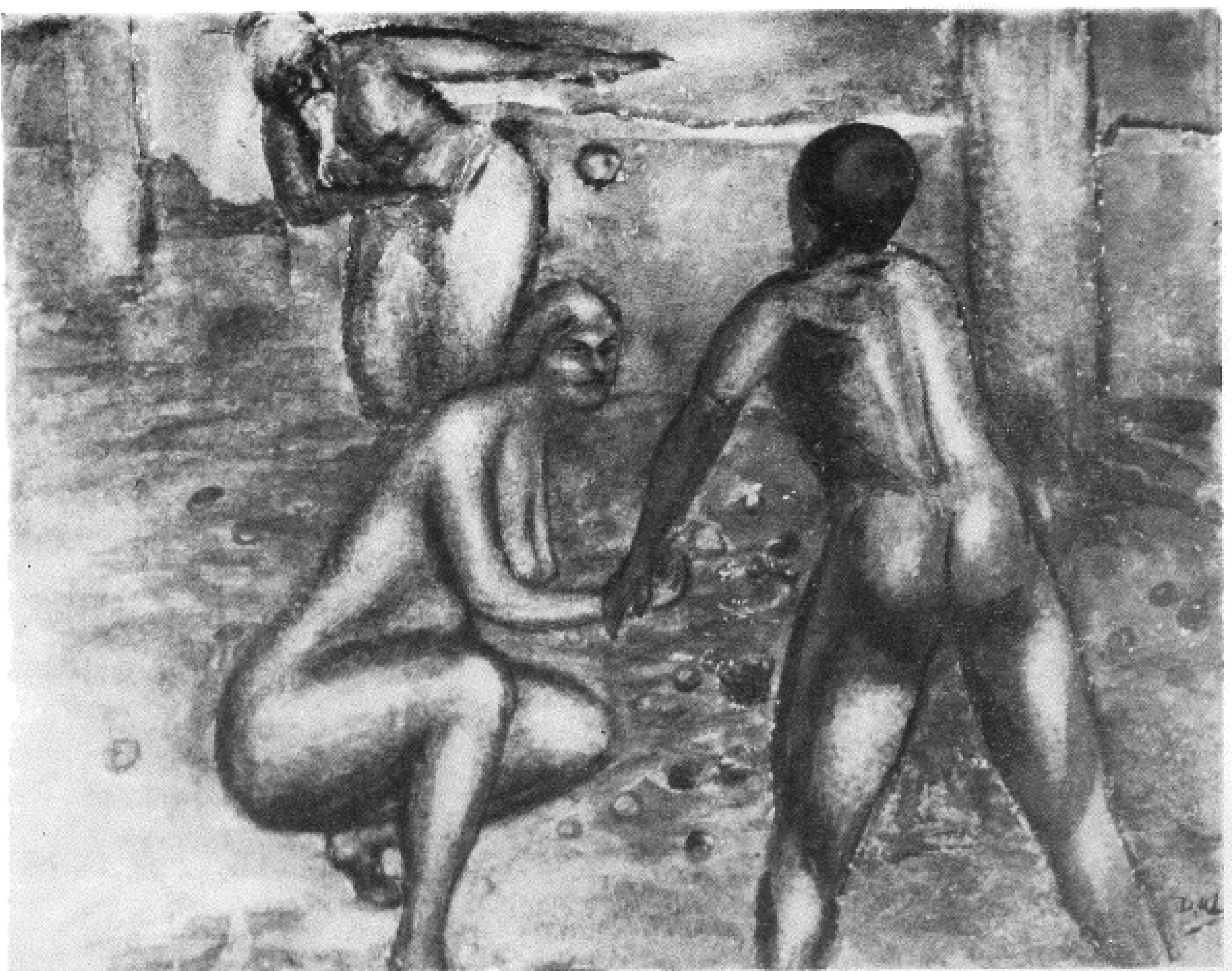
Here a stunned God looks at a disobedient Adam who returns the stare while the apple is frozen in mid-flight; a surprised and slightly amused Eve, with her mere trace of a smile, looks at Adam (as her protector?) and not at God. Thus the painting becomes a daring perspective on betrayal and courage, both themes also relevant for the prose passage of transition in “Sun”. Juliet’s conflicted sexual desire in that scene and the acerbic judgement she makes about her husband’s inadequacy, raise an issue that commentators on the story have not engaged. Put simply, perhaps critics have been too tolerant and empathetic about her actions and psychology, and also not sufficiently aware of a special quality in Maurice’s character that deserves admiration. Certainly this timorous and diminished husband is open to ridicule for his uptight demeanor and submissive relation to Juliet, and his status in her eyes is summarized in the scathing final lines of the story about “his little, frantic penis” (38).4 But to comprehend the essence of Juliet’s more assertive and demanding persona, it is important to emphasize the adamance of her self-involvement, a trait that even extends to her lack of committed care and nurturant protection of her toddling child. As Lawrence insists in his incisive reading of Burrow, “what must be broken is the egocentric absolute of the individual” (333). Distracted by her intense involvement with the sun, she is unforgivingly unaware of the proximity of snakes in the area where her son plays, and predictably he has a dangerous encounter with the deadly red snake from which he is lucky to escape unharmed. Juliet feels no sense of transcendence in her selfish relation to the sun, her son, Maurice, or even the peasant. As Lawrence completes the second version of “Sun” so soon after writing the Introduction to Burrow’s book, his essay precisely anticipates a central aspect of Juliet’s inability to get beyond herself: “But today all is mere consciousness. Sex does not exist, there is only sexuality. And sexuality is merely greedy, blind self-seeking. Self-seeking is the real motive of sexuality” (335).
IV
The more crucial indictment of Juliet, and a clue to a revisionist look at Maurice, must point to a crucial lack of a character trait that Lawrence references several times in the tale. When her infatuation with the peasant increases to the extent that “her womb was open to him,” Lawrence adds that “she had not the courage to go down to him” (30). As her sexual desire builds so that “the open lotus blossom had come upon her,” the same pattern continues, as “she had not the courage to take the steps across the gully” (30). On the last page of “Sun,” when she directly confronts the possibility of an affair, “she had not enough courage, she was not free enough” (38). Compare Juliet’s responses to the peasant to Maurice’s newly invigorated reaction to Juliet’s sexual presence in Sicily. Yes, he remains a beaten-down and abandoned husband still in love with his conflicted wife; his is still the man who is obsessively concerned with the crease in his pants after his arrival. But he quickly responds with the mandate of “spontaneous awareness” that Lawrence highlights in the Burrow essay (334). No matter the history of their fading sex life and decreasing passion, he now feels “a new desire in his life,” as he accepts—even after providing his wife with the “permission” she demands—“the desire stirring in him for the limbs and sunwrapped flesh of the woman” (33).
By the last page of “Sun,” his resurgent feeling is reflected in an evocative Lawrencian intrusion that refers to the “gleam in his eyes, a desperate kind of courage of desire” (38). He finally confronts and accepts Juliet as the “other,” an achievement for the male in Lawrencian fiction that is crucial for their growth and maturity. His new perspective especially recalls Tom and Lydia Brangwen, as Maurice “was dazed with admiration, but also at a deadly loss. He was used to her as a person. And this was no longer a person, but a fleet sun-strong body, soulless and alluring as a nymph, twinkling its haunches” (33). He seems to recognize the crucial change in himself: “He was terrified, and he felt he might give a wild whoop of triumph, and jump toward that woman of tanned flesh” (33). Might that painful metaphor in the story’s final line of the “fixed wheel of circumstance” serve more as a reflection of Juliet’s lack of courage and imagination than an accurate depiction of “the little etiolated body of her husband” (38)? Is the equation of their marriage quite so “fixed” as he believes?
Thus it is important not to underestimate that “courage of desire” in citified and repressed Maurice. Lawrence acknowledges that this “new desire in his life” includes the pain of uncomfortable change in his very being, for “it hurt him,” even as he accepts “the strange thrills that shot through his loins and legs” (33). I suspect that his “little penis” may experience a species of resurrection and perhaps will surprises the gloomy expectations of his wife. As I have noted in my previous books and essays, one of the finest pieces of psychobiography on Lawrence’s art and life is by Norman Mailer in The Prisoner of Sex.5 In that embattled and lyrical book, there is a pithy assertion that seems poignantly applicable to Maurice’s special achievement and new outlook in Sicily: “A firm erection on a delicate fellow is an adventurous juncture of ego and courage” (44–45). Juliet appears content to continue the previous pattern of their married life; in a casual and uncommitted manner she anoints Maurice as the father of another child they will conceive in the coming months. Mailer again is instructive here, with stirring words I have used elsewhere in relation to Lady Chatterley’s Lover, but now seem singularly appropriate for the frustrated wife in “Sun.” It is an axiom that Juliet might keep in mind as she contemplates what sounds like an eminently repetitive and untranscendent future: “There was that law of life so cruel and yet so just that demanded that one must grow or else pay more for remaining the same” (Deer Park 346).
But there remains a seductive counter-argument here, and it requires some caution about the above speculations on Maurice and Juliet and the stage they have reached in their marriage. Events in Lawrence’s life may be instructive, and particularly in relation to his own cuckolding in the years between the two versions of the short story. In December 1925 Lawrence mails the first version of “Sun” to Dorothy Brett, the same month in which he and Frieda each write a separate section of a long and friendly letter to her. It is likely that each will have read the other’s contribution to the letter. In Frieda’s section, and with her typical unselfconsciousness about her emotions, and perhaps in a manner geared to be pondered by her husband amid his declining sexual potency, she writes coquettishly about Angelo Ravagli, whom she has recently met at the Lawrences’ residence at the Villa Bernarda in Spotorno: “We have a nice little Bersaglieri officer to whom the villa belongs. I am thrilled by his cockfeathers he is almost as nice as the feathers” (Letters V 350)!
As Michael L. Ross has noted in an insightful comparison of the two versions, the earlier text is not nearly as sexually explicit, with less emphasis on the peasant and on the barriers separating him and Juliet. Lawrence is well aware of the freedom that Frieda occasionally gives herself to satisfy her sexual desire outside of their marriage. With his recent suspicions about her relation to J.M. Murry, and the memoir of the confession of her infidelity that he recounts in Mr Noon, Lawrence might have correctly sensed the possible denouement of Frieda’s physical attraction evident in the letter. By early spring 1926, David Ellis, the esteemed biographer for this period in Lawrence’s life, believes “it seems likely that the affair begins in earnest during a period of physical and emotional estrangement between Lawrence and Frieda in late winter or early spring of 1926” (Ellis 290). While she is with Ravagli during their separation, Lawrence is in Ravello, where he endures (and precipitates) that well-chronicled and unconsummated sexual experience with Brett. Accounts differ on what precisely occurred, but there is little doubt that it was a disaster for them both.
In March of 1927 Frieda sees Ravagli again, and by February the next year Ellis believes it is then “generally accepted” (401) by Lawrence and Frieda that she visits Ravagli. It is the same month that Lawrence completes the second version of “Sun” and sends it to Harry Crosby to finalize their “trade” agreement. Thus version one of this story is completed on the edge of Lawrence’s keen intuition about Ravagli in 1925, and version two in 1928 is completed in all probability with his knowledge of his wife’s affair. Perhaps that unusual tolerance by Maurice for his wife’s desire for extra-marital satisfaction offers a different perspective on the ethos of the story: that Maurice’s courage is not only to act on his own newly-discovered desire but also to provide her with “the permission” that she requests. Could it be, in the marital arena of compromise and adjustment, that the real courage for them in “Sun” is the decision to adapt to the circumstances as best they can?
Lawrence may offer a clue to the mindset that will create the second version of “Sun.” It emerges from the aftermath of that March 1926 fiasco between him and Brett, a failure that no doubt wounded the sexual confidence of these two close friends. Within a few days Lawrence writes two letters to her, the first of which anticipates the mindset that he begins to nourish in himself as he attempts in his last years to face the reality of his relationship with Frieda: “One has just to forget, and accept what is good. We can’t help being more or less damaged. What we have to do is to stick to the good part of ourselves, and of each other, and continue an understanding on that” (Letters V 406). It is a hint of the outlook embodied in a very different married couple at the end of “Sun.” Could their perspective function as a form of the “growth” demanded by Mailer and the courage expected by Lawrence? Have Maurice and Juliet, as well as Lawrence and Frieda, reached past the “courage of desire” to an even more crucial and evasive achievement? In a follow-up letter to Brett a few days later Lawrence writes: “The greatest virtue in life is real courage, that knows to face facts and live beyond them” (Letters V 4080).6
Harris spends several pages (197–202) asserting that the earlier and less explicit version of “Sun” is superior because of its brevity and focus. In a more persuasive essay that precedes Harris’s argument, Ross outlines the many attributes of the lengthier revised story (1–18), emphasizing the significant value of its fourth section, a crucial addition that is missing from the 1925 text.↩︎
Ruderman employs post-Freudian theories of child development and “parental authority” (158) to strangely argue that Juliet learns in Sicily not to be a “smothering mother,” as she capably—in Ruderman’s reading—puts the incident with the snake “in perspective” (178) by giving her son room to grow and learn. As I maintain later in the essay, such praise for Juliet is misplaced and dangerous. Harris is even more empathetic about Juliet, connecting her erotic experience with the sun to the “joy of female arousal and orgasm” (200) when there is little sustained joy in Juliet’s response and no evidence of orgasm. Ross relates Juliet to Lawrence’s essential theme of the “reawakening of a woman’s vital self ” (4) without noting sufficiently the circumstances that inform the erosion of that vitality. He also asserts that the story reveals a “precarious growth and maturation in Juliet” (7), yet never illustrates the impinging issues that retard such emergence in her. In terms of characterizing the moral ethos of Maurice, Harris regards him as a “failure” (199) as a man, and Ross continues that negativity by describing Lawrence’s comments on Maurice’s “embarrassed self-consciousness” as “devastating’” (12). My view of Maurice in this essay is more sanguine than the evaluations of Harris and Ross.↩︎
See my book, D.H. Lawrence and the Marriage Matrix, and especially chapter seven, for a more in-depth analysis of Lawrence’s notions about the fourth dimension in fiction.↩︎
Spilka remains the only critic to speculate, however briefly, on the relation of “Sun” to Lawrence’s psychobiography. He refers to the description of Maurice’s “futile little penis” as both provocative and enlightening, “given the greater futility of [Lawrence’s] own little penis at the time” (89). See Cowan for more pertinent references to several issues concerning the “anatomical context” (79) of “Sun”.↩︎
See further discussion of the connection between these writers throughout The Phallic Imagination and The Marriage Matrix.↩︎
Ellis wisely supplies some necessary caution about the too common and reductive assumption that Lawrence bases the portrait of Maurice on his impression of Martin Secker and his wife after their visit to Spotorno from late 1925 to early 1926: “Given the many transpositions in this story, both he and his wife could have told themselves with some justification that Lawrence had merely used them as a starting point,” and that “he had allowed his imagination to play around the fundamentals of this situation with consequences, which, in the end, had no real bearing on it” (283).↩︎
Works Cited
Balbert, Peter. D.H. Lawrence and the Marriage Matrix: Intertextual Adventures in Conflict, Renewal, and Transcendence. Cambridge Scholars, 2016.
——— . D.H. Lawrence and the Phallic Imagination: Essays on Sexual Identity and Feminist Misreading. St. Martin’s, 1989.
Cowan, James C. D.H. Lawrence: Self and Sexuality. Ohio State UP, 1998.
Ellis, David. D.H. Lawrence: Dying Game, 1922–1930. Cambridge UP, 1998.
Harris, Janice Hubbard. The Short Fiction D.H. Lawrence. Rutgers UP, 1984.
Lawrence, D.H. Foreword to Women in Love. Ed. David Farmer, Lindeth Vasey and John Worthen. Cambridge UP, 1987. 485–86.
——— . The Letters of D.H. Lawrence, V, 1924–27. Ed. James T. Boulton and Lindeth Vasey. Cambridge UP, 1989.
——— . The Letters of D.H. Lawrence, VI, 1927–28. Ed. James T. Boulton and Lindeth Vasey. Cambridge UP, 1989.
——— . Paintings of D.H. Lawrence. Coy, Adams, and Mackay Ltd., 1964.
——— . “Review of the Social Basis of Consciousness, by Trigant Burrow.” Introductions and ____. Reviews. Ed. N.H. Reeve and John Worthen. Cambridge UP, 2005, pp. 329–336.
——— . “Sun”. The Woman Who Rode Away and Other Stories. Ed. Dieter Mehl and Christa Jansohn. Cambridge UP, 1995, pp. 19–38.
——— . “Translator’s Preface to Cavalleria Rusticana, by Giovanni Verga.” Introduction and
Reviews. 161–173. Mailer, Norman. Advertisements for Myself. NG.P. Putnam’s Sons, 1959.
——— . The Deer Park. G.P Putnam’s Sons, 1955.
——— . The Prisoner of Sex. Little Brown, 1971.
Ross, Michael L. “Lawrence’s Second ‘Sun.’” D.H. Lawrence Review vol. 8, 1975, pp. 1–18.
Ruderman, Judith. D.H. Lawrence and the Devouring Mother: The Search for a Patriarchal Ideal of Leadership. Duke UP, 1984.
Spilka, Mark. Renewing the Normative D.H. Lawrence. U of Missouri P, 1992.