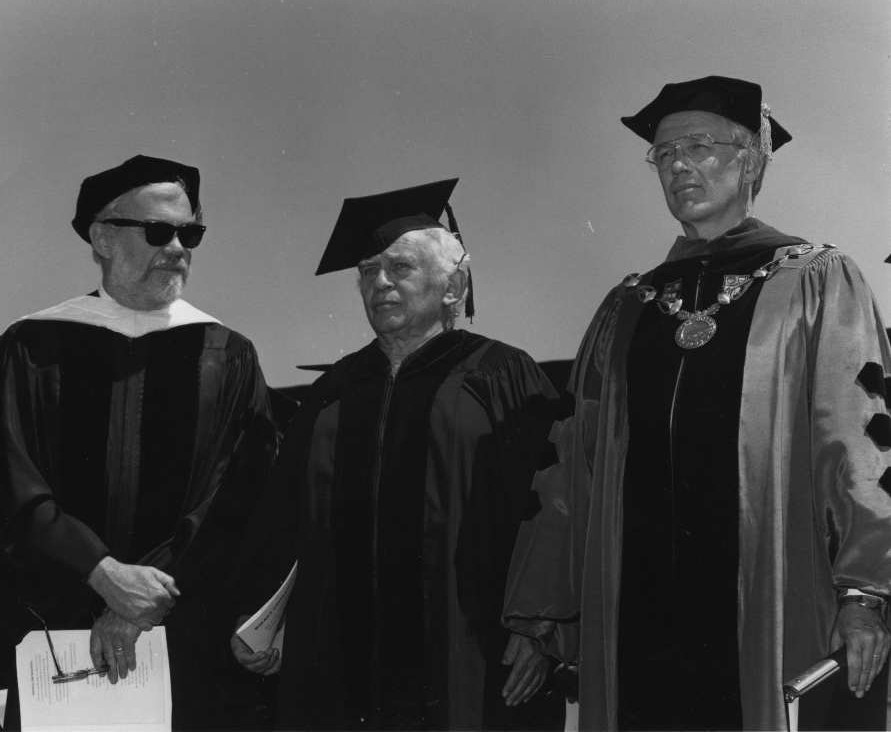
On May 27, 1995, Mailer gave the commencement address at Wilkes University, Wilkes-Barre, Pennsylvania, and was awarded an honorary Doctor of Humane Letters degree. At that time, I was the University’s Vice President for Academic Affairs, and charged with the task of writing the degree citation, which is followed by his brief address.
—J. Michael Lennon
Commencement, May 27, 1995
Citation for the Honorary Degree of
Doctor of Humane Letters
Norman Mailer
By aspiration, achievement and accolade, your deepest identity is novelist. And as novelist, your deepest urge has been to explore American identity and American society, the twin obsessions of your writer’s life. In so doing, you have illumined our dreams and our nightmares and given us the courage to wrestle with both. Your urgent utterances on the American psyche have led you to breach the walls between literary genres and, more than any writer of this century, enlarge the definition of the word novelist. While refusing to relinquish your first identity, you have nevertheless become a connoisseur of literary forms and styles and won countless awards, including two Pulitzer Prizes, a National Book Award, and an Emmy nomination. The sum of your achievements in biography, literary criticism, poetry, history, drama, essays of every kind, political analysis, sports reportage, newspaper and magazine columns, the philosophical dialogue and, of course, the novel is without equal. This amazing list gives no hint of the ways you have joined and refurbished these forms, nor of the dazzling range of rhetorical approaches and voices you have employed.
In more than forty books over fifty years, from your 1948 novel, The Naked and the Dead, based on your experience as a rifleman in World War II, through your chronicle of the moon shot, Of A Fire on the Moon (1970), to your biographical studies of Marilyn Monroe, Muhammad Ali and Gary Gilmore, to your just-published study of the Kennedy assassination, Oswald’s Tale: An American Mystery, you have, as one critic stated, tried “to position yourself so as to stand face to face with the true identity of our time, our time in America.” Your works are as brilliant and varied as the postwar American culture you have chronicled, criticized and helped create.
Your career has not been a slow and steady ascent to the higher reaches of eminence. Elected in 1984 to the 50-member American Academy of Arts and Letters and appointed State Author of New York in 1991, your career still resembles a Stendhal novel, that is, dramatic gains canceled out by ironic reversals and sharp defeats. Often when you have had a literary success, you have doubled the stakes and flung your winnings on the gambling tables of still greater achievement. Your risk-taking as a writer has kept you in our public eye and kept your books in our libraries and hearts. Your motto is “Repetition kills the Soul.”
It has been said that if we could combine the literary sensibilities of D. H. Lawrence, Andre Malraux, Herman Melville and Henry James, we would have another you. Kin to these writers you are, but there is only one, singular, unprecedented, irreplaceable Norman Mailer. Romantic quester, artificer, shapeshifter and storyteller of the American Century, we salute Norman Mailer!
By the power vested in me by the Board of Trustees of Wilkes University and the Commonwealth of Pennsylvania, I hereby bestow upon you, Norman Mailer, the degree Doctor of Humane Letters, Honoris Causa, with all the rights and privileges appertaining thereto.
Address by Norman Mailer
Well, I graduated from college in 1943, so it has taken me 52 years to become a Doctor. I thank you.
It is most agreeable to talk to you today because I feel, oddly enough, an identity with many of you, since I came from a family where almost no one had gone to college before me, and I owe an enormous amount to my parents to go to school, to go to college, and I understand the special intensity of such an education.
What adds to my pleasure is that I have been to many graduations. In fact, I could say to all you good friends and family who are in the bleachers on either side that since I have nine children, and all but eight have finished their education, I have been to so many graduations that if some of you fall asleep while I am speaking, I will be the last to judge.
And with due respect for the torpor of waiting until your child or your friend receives their diploma, I will do my best, although it goes counter to my reputation, to keep my remarks short.
I will, however, indulge myself to tell one joke:
On a day very different from this, on a cold rainy day in North Dakota, two buffalo were shivering in a little valley and over a flat ridge came a cowboy dressed in black with silver accoutrements, and his horse had a silver bridle, silver reins. And the cowboy came and he circled these two buffalo, huddled together like these two microphones, and the cowboy said: Look at the two of you. You’re awful. Your horns are splintered, your hoofs are splayed, your hide is tatty. You two are a sorry bunch. And he rode around and took off. And one of the buffalo leaned into the other and said: “Well, I guess we just heard our first discouraging words.”
Now, the one thing you do not do at graduation is talk about depressing matters, unless you feel that something larger is at stake. I am going to dare to break my own notion of how you speak to students on a happy day in their lives by saying that you are going out into an extraordinary world, a world different, vastly different from the world even of ten years ago and certainly different from the world of forty years ago. You are going out into a world where all the sign posts have become weather vanes and people are no longer certain of which route they can take.
We had the dubious benefit from 1946 on, 50 years ago virtually, we had the dubious benefit of a Cold War which established all the signs. It was very easy, looking back on it now, for us to function as a nation. We had an enemy and they were Godless and materialistic, which God knows we are not, and they were determined to destroy us. And so it was very simple for ninety-five, ninety-eight percent of Americans to find their way in a social structure.
Looking back on it, we were like magnetic filings in the power of a huge electromagnet, the Cold War, and almost all of us pointed in the same direction. When the Cold War ended, it was as if the great switch on this huge electromagnet was released and now all the fragments went in all directions. Filings were scattered, and being so scattered we discovered that the anger and the rage that we had been able to channel toward the Soviet Union was now being directed toward ourselves in every way. And we had become a nation—we were always famous for being contumacious with each other as Americans—but now we have become a nation in which there is more acrimony and more dislike between groups and enclaves than any time I can recall. And that is the depressing side of the situation into which you go.
But, the promising side is that you will not have to face what 50 years of students graduating from college had to go into, which is that they were going into a structured world in which their rise was going to be slow because everything was understood. The world had a shape, and we had an enemy, and so it was as if you were all going off into a vast social army and starting at the bottom.
Now, that no longer exists. The people of my generation and the people who came after me for the next 40 years who built their understanding of the world, society, and even of the hereafter on the firm foundation of the Cold War are now superannuated; myself, among the others. We no longer know how things are going to turn out. We don’t have a clear sense of the future. And you will go forth on the rare position of being—in the spiritual sense—of being pioneers because you are going into a new and undiscovered frontier. It is the frontier of the last of this century, and the 21st century to come where all the guide rules of the 19th and 20th century have been used up.
And so for those of you who are bold and intelligent, which I suspect is the majority of this class, you have a great and exciting world to go into if you do not despair. If you like the idea that the world is free again, then perhaps we can regain that dream on which this country was founded.
The idea—and it was unique in world history when it arrived on the scale with which America was created—the idea that if you take the mass of human beings and if you believe that there is more good than evil in the sum of humanity, then democracy can prevail. For if that’s not true, we must live in an oppressive system and live under authority. But, if it is true, as a totality, as a sum we have more good in us than evil, then we can begin again to create and amplify that extraordinary dream of democracy.
And so I salute you as a class and wish, and I don’t even have to wish it for you, you are going to have it, I beg you to anticipate the glorious, and exciting, and fearful, and incredible days and years that await you.
Thank you.