Post-Einsteinian science and the writings of Norman Mailer appear to inhabit parallel universes. References to major scientists in Mailer’s work range from rare to absent. The relationship between Mailer and quantum theory—a topic suggested to me by Phillip Sipiora, possibly as a joke—seems as non-existent as the unicorn. Joke or not, I accepted his challenge, writing on the intersection of Mailer & quantum theory. I use his Moonfire: The Epic Journey of Apollo 11 (2009) as my primary focus. First, I discuss the significance of Mailer’s vision in Moonfire. Second, I outline the development and impact of quantum theory. Third, I examine the debate about meaning and measurement. Fourth, I look at some interactions between quantum theory and contemporary literature. Finally, I ask what might be the relationship between the task of the artist and the task of the physicist.1 Of Mailer’s works, one has science at its center, namely Of A Fire on the Moon (1971). Nominated for the National Book Award in the science category, it began existence as three Life magazine articles in 1969–70, around the time of the 20 July 1969 moon landing.2 It was republished by Tashen in 2009 as Moonfire. Conceived by Larry Schiller, it included Mailer’s 1971 text edited by Michael Lennon, an Introduction by Colum McCann, a short biography, and amazing images bearing on Apollo 11 from NASA and elsewhere. So Mailer’s moon book exists in three distinct textual forms: the Life articles, the 1971 book, and the weighty 2009 edition. Since for Fathers’ Day 2018 my wife Jeanne Vince bought me the Taschen volume, I will cite that edition here.
1. Mailer’s Moonfire (2009): “A Vision Sought” (Bufitis)
On Moonfire and its predecessors, there are two useful articles in The Mailer Review, one in 2012 by Nicole DePolo called “A Philosophical Launch” and one in 2015 by Michael Glenday entitled “Fly Boys and Angels.” Glenday reminds us that the late Don Kaufmann ranked Of a Fire on the Moon as #1 among all of Mailer’s works, for it,
. . . surmounted traditional creativity by linking world-historical and literary history. Imagine, a global event being communicated by a seminal literary presence—Columbus with Cervantes on board, Jamestown bringing Shakespeare on shore, the Puritans landing near Provincetown, with Milton as witness—then why not Mailer lighting a “fire” on the moon? (333).
Indeed, why not? As Colum McCann points out, “Mailer was at the top of his game. . . . the most celebrated and possibly the most feared author in America” (Moonfire, 12). Norman never avoided a challenge—whether it be the hard questions of American Literature or an invitation to a bar-room brawl. The 1969 moon landing could be, in McCann’s words, “the story of the century” (14).
Small wonder that when Life called Mailer accepted. In McCann’s words, “So Mailer swallowed his pride, checked his bank balance, and surrendered himself to history” (14). However, unlike Kaufmann’s dream, reality would not approach “Columbus with Cervantes on board” (333). Mailer could not accompany Armstrong, Aldrin, and Collins on Apollo 11. Lawyers for the astronauts would not even permit Mailer to interview them. The Editor of Life reports that NASA feared that Mailer would show them “as silly fly boys and ridicule their language” (Mills qtd. Glenday 119). Mailer was an observer, one of many. As McCann wryly observed, “The fact that the powers that be didn’t send a writer, that they didn’t even think about it, was metaphor enough: American letters was losing its oxygen fast” (14).
Mailer humbly faces reality in the first chapter, titled “A Loss of Ego,” writing “Norman on this occasion wonders if he may call himself Aquarius. Born January 31, he is entitled to the name, but he thinks it is a fine irony that we now enter the Age of Aquarius since he has never had less sense of possessing the age” (Moonfire, 20). Why Aquarius? Was it a nod to late 1960s pop culture: the musical Hair and the song “The Age of Aquarius.”3 Perhaps so, but Philip Bufitis goes deeper,
Abandoning “the reporter” persona of Miami and the Siege of Chicago, Mailer assumes a new persona, “Aquarius,” the sign of the truth-seeker. The chief characteristic of the Aquarius type is breadth of vision. Yet, despite the vibrancy of Mailer’s descriptions, the impression one gets is of a vision sought rather than found. (101–102)
A “vision sought rather than found” seems appropriate, but what emerges from Moonfire is still a multifaceted narrative that only Mailer could tell.
There are several strands to the story. First, never in recorded history had two human beings left Earth and walked upon the Moon. Second is the cultural history. At the height of the Cold War, amid the strife of the late 1960s, here is this impressive achievement of Big Science. Third is the question of significance: what did the Moon landing mean in the world of the late 1960s? Mailer recognized the historic achievement but also the darker side.
The historical significance of stepping on the Moon, the first part, is well described. In the chapter “The Greatest Week,” Mailer writes, “So one got ready for the climax of the greatest week since Christ was born” (233). He wrote,
There was a man on the moon. There were two men on the moon. It was a new feeling, absolutely without focus for him . . . . he had been dislocated as profoundly by the experience as the moment he learned in the fathers’ waiting room at the hospital that his first child had indeed and actually just been born. (236)
The analogy of human birth—maybe T. S. Eliot’s objective correlative—is an interesting choice. For many, becoming a parent might be their peak human moment. But Mailer’s analogy suggests also a dislocation, a shift in consciousness—whether we call it the Age of Aquarius or the Space Age. If America was the New World, could Space be the new frontier? President Kennedy’s Message to Congress on the 25th May 1961, part of which serves as the epigraph, expressed this hope.4 The addition of the amazing set of photographs to Mailer’s text, plus the carefully selected captions, make Moonfire a worthy addition to the Mailer canon. To us, the photographs speak volumes—shaped as we are by image and myth. DePolo sums up, “Forty years later, Taschen, Schiller, and Lennon had the wisdom to compile Moonfire as a celebration not only of the anniversary of the moonshot but also as the kind of literary and imagistic union the original Life series represented” (286).
The second part of Mailer’s Moonfire story is the technological achievement of Apollo 11. Here there is impressive breadth, although DePolo points out that it was the long middle part of On A Fire on the Moon that was most cut by Michael Lennon for Moonfire. Lennon says,
The middle was Mailer’s explications of basic physics, weightlessness, gravity, thrust, and so forth, and the mysteries of the moon… I cut out some of the stuff that’s in the middle—that Mailer believed in and I loved—but I think it was the part of the book that a lot of readers had trouble getting through—like the cetology chapters of Moby-Dick . . . You know he had that engineering degree at Harvard. (Lennon qtd. Depolo 279)
Mailer wore many hats—novelist, new journalist, and social critic. But, as Lennon reminds us, he had “that engineering degree.” Indeed he had, but Mailer is perceptive about the differences between physics and engineering. In the chapter “The Ride Down,” he writes,
So it is with physics and engineering. Physics is the church, and engineering the most devout sinner. Physics is the domain of beauty, law, order, awe and mystery of the purest sort; engineering is partial observance of the laws, and puttering with machines that never work quite as they should . . . . So bridges were built long before men could perform the mathematics of the bending moment. (Moonfire, 197)
Mailer had explored some of his ideas three years earlier in Cannibals and Christians (1966), part of which is reprinted as “Our Argument as Last Presented” in Mind of an Outlaw.
Consider: science began with the poetic impulse to treat metaphor as equal to equation…. science still remained attached to poetic vision, and scientific insight derived from culture—it was not the original desire of science to convert nature, rather to reveal it. (Mind of an Outlaw, 215)
By the time of Apollo 11, it was obvious that metaphor and “poetic vision” had no place in NASA’s vocabulary. Control of nature was the mission, not any revelation of mysteries. Mailer writes, “The heart of astronaut talk, like the heart of all bureaucratic talk, was a jargon that could be easily translated to computer programming, like Fortran or Cobol or Algol” (Moonfire, 36). Existential Angst is a marker of 20th century literary culture, but NASA’s bureaucratic language was its mirror image. Mailer makes this explicit, “Anti-dread formulations were the center of it, as if words like pills were there to suppress emotional symptoms” (36). For a great writer, such language must appear as a denial of humanity.
The third part of Mailer’s story in Moonfire is the wider significance of the moon landing. Here we are aware of the darker side of the narrative. As Glenday says, “Fire is both celebration and critique” (128). Philip Bufitus speaks of a tension in the book, asking if the Apollo-Saturn rocket is an instrument of the Devil or God (102).5 Mailer reveals these more ominous aspects: Werner von Braun and the Nazis, powerful American corporations, the cultural ambiguities of the 1960s, and lurking Cold War rivalries. We might well hope that Armstrong had taken “one giant leap for mankind,” but in the context of Cold War politics it was also very much an American leap.6 Mailer beautifully combines this tension in his chapter, “The Iron of Astronauts,”
It was rather that the astronauts were the core of some magnetic human force called Americanism, patriotism or Waspitude, and if they were finally the men of all the men on earth to take the first step on the way to the stars, who was to say it was not the first step back to the stars, first step back to joining that mysterious interior material of the stars, that iron of communion with cosmic origins? (Moonfire, 66)
Mailer’s perspective is cultural and cosmic, skillfully fusing the cultural neologism “Waspitude” with the scientific and poetic insight that the iron in our bloodstream was created in the core of the stars.7 As the 1970 album Déjà vu proclaimed, “We are stardust.” For a brief moment, astrophysics informed by quantum theory appeared to be on the same page as Joni Mitchell’s Rock anthem “Woodstock.”8
The role of Werner von Braun is discussed by Mailer at some length in Moonfire (98–131), perhaps because the ambiguity of Moonfire comes to its sharpest focus in von Braun. He was an uncomfortable juxtaposition of unmentionable Nazi roots with an idealistic vision of America leading “a new age of discovery” (125). Even the acronym NASA, suggests Mailer, was “an unhappy sound,” for “[d]eep in the unconscious” there seem to be disturbing echoes of that Nazi past.9 Nevertheless, Mailer finds that von Braun, while obsessive, had an “air of magic” (116) about him. “He was a rocketeer. . . . Immediate reflection must tell you that a man who wishes to reach heavenly bodies is an agent of the Lord or Mephisto” (116). There is another factor, a kind of metonymy. The ambiguity of von Braun seems related to a greater ambiguity in modern physics, a thought to which we shall return later.
The ending of Moonfire, Part IV, I find somewhat disappointing. There is a sense of anti-climax that Mailer—maybe many Americans—felt after Apollo 11. Man was on the moon: what could follow such an event: back to work, pick up the kids, pay my bills? We remember Bufitus’ phrase, “a vision sought rather than found” (102). In his “Age of Aquarius,” Mailer takes us back to a crucial source of NASA—indeed of the immense revival of science in western societies—the traumatic year of 1957, the year of Sputnik.
Was the voyage of Apollo 11 the noblest expression of a technological age, or the best evidence of its insanity? It was the question that would dog Aquarius into the tenderest roots of his brain…. Are we witness to grandeur or madness? So the mind casts back to the sources of Project Apollo and the birth of NASA, back into the warlock’s pot of high politics in that hour after American prestige drooped in the eyes of the world because the Russians had put Sputnik into orbit and Soviet technology was in some ways at least superior to American. (Moonfire 301)
Today, we inhabit a world shaped less by NASA and more by Apple, Amazon, and Google. We forget that much of our science since 1957 was driven by post-Sputnik funding. Technologically, the world has never been more connected. Culturally, politically, and empathetically, our world feels disconnected, estranged from meaning. Nevertheless, we can still understand Mailer’s question: “grandeur or madness?” Mailer ends his book positively, acknowledging that “we may have to go out into space until the mystery of new discovery would force us to regard the world once again as poets, behold it as savages who knew that if the universe was a lock, its key was metaphor rather than measure” (Moonfire 339). The alliterative contrast sums up Mailer’s approach to the space program—and maybe to much more. I hesitated to enter the mysteries of quantum theory. While I have some background in science, it is limited, especially on the math side.10 I read over a dozen books and articles on quantum theory.11 Some I even understood. But I have a good friend, Tim Groves, with a PhD in Physics from Chicago and a bunch of science patents, who has actually taught quantum theory. Back in May, we discussed these ideas, and I gained much from his encouragement and guidance. I shall quote Tim a little later. But, as one says in these situations, any remaining mistakes are my own blame!
2. Quantum Theory: Development and Impact
Where do we start? The physics of the twentieth century is marked by two great theories, relativity and quantum theory. Relativity is the product of one enormously creative mind, Albert Einstein. When I first encountered it, relativity seemed to me the more revolutionary.12 Quantum theory I had studied as part of chemistry in the early 1960s, but it seemed prosaic compared to relativity. How wrong I was! Most physicists agree with J. C. Polkinghorne that quantum theory is “much the more revolutionary of the two” (ix). John Wheeler—who coined the term black hole—said, “Quantum theory is the deepest part of our knowledge of nature and the biggest mystery . . .” (32). Brian Cox and Jeff Forshaw give this perspective,
Quantum theory is perhaps the prime example of the infinitely esoteric becoming the profoundly useful. Esoteric, because it describes a world in which a particle really can be in several places at once and moves from one place to another by exploring the entire Universe simultaneously. Useful, because understanding the behavior of the smallest building blocks of the Universe underpins our understanding of everything else. (2)
So what—in the very simplest terms—is quantum theory? To me, five elements seem important. First are quantized properties, a concept dating back to Planck in 1900 and Einstein in 1905. Instead of a smooth, continuous spectrum, certain properties like energy comes in discrete chunks, multiples of some basic unit, called quanta. This explained two phenomena that classical physics could not: black-body radiation and the photo-electric effect.
Second is wave-particle duality. Classical physics saw a clear distinction between a particle—like a billiard ball with a definite position and momentum, and a wave—a strange undulation in a medium like water, air, or the aether.13 Quantum theory, on the other hand, agreed with Louis de Broglie in 1924, regarding particles as associated with waves and waves associated with particles. Yet, we can never—it seems—measure both simultaneously. One experiment shows a phenomenon to be a wave, whereas another experiment reveals a particle.
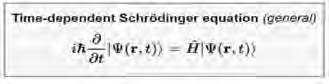
Third, dating from 1926, is the Schrödinger wave equation, a mysterious partial differential equation giving not the position of an electron or other entity but the probability of our finding it. Prior to our measurement, we cannot say where it is—even what it is. Heisenberg used phrases like “a possibility for being” or “a potentiality.”14 When we make our measurement, the smoothly changing wavefunction, Schrödinger’s beautiful equation, disappears. Something happens, called the collapse of the wavefunction. A great deal of the debate about quantum theory is connected with this strange phenomenon.
Fourth is the uncertainty principle, developed by Heisenberg in 1927.15 Baggott writes, “quantum mechanics places a fundamental limit on the precision with which both position and momentum can be jointly determined in any laboratory experiment. In an entirely classical world… no such constraint exists” (91). The uncertainty is not because of the inaccuracy of our measuring instruments: it appears as part of “reality.”
The fifth element—to me the most baffling of all—is quantum entanglement. It is linked to Einstein’s EPR critique, to John Bell from Belfast, and to a 1982 experiment conducted by Frenchman Alain Aspect. Bell’s theorem has been described as “the most profound discovery in science in the last half of the twentieth century” (Rosenblum and Kuttner 173).16 John Barrow described it thus,
The new facet of the laws of Nature this experiment reveals is that the inevitable effect of the act of observation can be nonlocal; that is, it has effects upon events that are far away, in the sense of being outside the influence of light signals, and hence any means of information transfer. (147)
This is what Einstein called “spooky action at a distance,” and he did not like it one bit. But it does seem to be part of our world as quantum theory describes it.
In summary, we have these five characteristics: quantized properties, wave-particle duality, the Schrödinger wave equation, the uncertainty principle, and quantum entanglement. Indeed, a strange and spooky brew. It is not surprising that John Wheeler called quantum theory “the deepest part of our knowledge of nature” (32). Quantum theory has been developing for well over a century now, from 1896 to the present day.17 But what is its impact upon our society? In a word, it is profound. Cox and Forshaw say it “has immense predictive and explanatory powers, spanning a vast range of phenomena from silicon chips to stars” (4). Another claims that “one-third of our economy involves products based on quantum mechanics” (Rosenblum and Kuttner 116).18 In a 2015 article in Forbes magazine, Chad Orzel writes that quantum physics is “absolutely essential to modern life” (Quantum Mechanics).19
There is another dimension to the story, however. Jim Baggot, in his book The Quantum Story (2016), calls World War II “The First War of Physics” (159-167).20 On both sides, physicists went to war, as was expected. In 1939, FDR received a letter from Einstein, warning that Germany might develop an atomic bomb. Eventually, that led to the Manhattan Project—the largest scientific project in history. In August 1945, two nuclear bombs were dropped on Japan, ending the War in the Pacific, the backcloth for Mailer’s first novel, The Naked and the Dead (1948). In two brief instants, the equivalence of mass and energy was manifested, and fifty years of theory was transformed into a horrific reality. Albert Einstein’s 1905 equation E=mc2 may be the best known equation of physics, but forever it will be linked to Hiroshima and Nagasaki.
There was a serious fear that German physics might be first to develop an atomic bomb. In 1938, two German physicists, Otto Hahn and Fritz Strass-mann, had split the Uranium nucleus (Bernstein 49). Many physicists were German: some such as Lenard, Jordan, and Stark definitely were Nazis.21 Heisenberg had made “a dangerous Faustian bargain” (166) says Baggott. Becker writes, “While Heisenberg was not a Nazi, he left very little doubt about the depths of his loyalty to Germany, no matter who was leading the country” (74). The consensus today is that the Nazis were not close to an atomic bomb. There are multiple reasons for this: Jeremy Bernstein suggests “simple incompetence” (50).
It was believed that a final invasion of Japan could result in a million casualties. Plausibly, Mailer, serving in the Pacific, could have been one of those casualties. In the end, the atomic bomb made the invasion unnecessary as Japan had surrendered. But in August 1945, we irrevocably entered the nuclear age. Twelve years after Hiroshima, in 1957, Mailer in “The White Negro” wrote these words,
Probably, we will never be able to determine the psychic havoc of the concentration camp and the atom bomb upon the unconscious mind of almost everyone alive in these years. . . . The Second World War presented a mirror to the human condition which blinded anyone who looked into it. (Mind of an Outlaw, 42)
Mailer’s “psychic havoc” phrase powerfully describes our postwar consciousness. Just twelve years later, in 1969, Armstrong and Aldrin step upon the moon. Quantum theory may well be “the most successful theory of physics ever devised” (Baggott xiii), but it is hard to forget that it also brought us the atomic bomb. Neither the mind-blowing NASA photographs in Moonfire, nor Armstrong’s famous “giant leap,” can totally erase that reality. Baggott concludes with words that seem to echo Mailer’s,
The bombing of Hiroshima and Nagasaki in August 1945 . . . brought to an end a long and profoundly immoral war with such an exclamation that it burned into the consciousness of all who lived then, and all who have lived since. But in ending the war the physicists had unleashed a primordial force upon the world, the threat of which would endure long after the perpetrators of evil were gone. (Baggott 167) Quantum theory is both incredibly accurate in its calculations and successful in its application. That much is agreed. But the issue of its meaning—how we interpret its claims concerning “reality” and measurement—has provoked major battles. According to Polkinghorne, “The problems of interpretation cluster around two issues: the nature of reality and the nature of measurement” (1). Are we dealing with objective knowledge, or are we locked into our own “cognitive ghetto?”22 Philosophically, this is a close relative to arguments between realism and positivism. Einstein began as a positivist influenced by Ernst Mach: he later became a realist. In 1938, he wrote this,
3. Quantum Theory: Meaning & Measurement
Without the belief that it is possible to grasp the reality with our theoretical constructions, without the belief on the inner harmony of our world, there could be no science. This belief is and always will remain the fundamental motive for all scientific creation. (Einstein and Infeld 296)
On the positivist side were Niels Bohr and Werner Heisenberg. To Bohr is credited the claim, “There is no quantum world. There is only an abstract physical description. It is wrong to think that the task of physics is to find out how nature is. Physics concerns what we can say about nature” (Bohr qtd. Baggott 110). This view was shared by Heisenberg, who wrote in the 1950s,
This again emphasizes a subjective element in the description of atomic events, since the measuring device has been constructed by the observer, and we have to remember that what we observe is not nature in itself but nature exposed to our method of questioning. (Heiseberg qtd. Baggott 109)
The view championed by Bohr, Heisenberg, and others became the mainstream view in physics, known as the Copenhagen interpretation. In 1927, Bohr introduced the concept of complementarity, regarding this as another break with classical physics.23 Complementarity gives equal validity to mutually exclusive perspectives. It is often linked with the famous and mysterious double-slit experiments. In Copenhagen’s view, we cannot get beyond our measurements, for according to Bohr there is “no quantum world” (Baggott 110). Copenhagen instructs us to abandon any deeper search for reality. In the playful words of one physicist, we should “shut up and calculate.”24 In the Cold War era, Big Science as funded by the military agreed. Dissent was not, shall we say, encouraged.
Adam Becker, however, in his book What is Real, profoundly disagrees: this battle, he says, is at the heart of physics. John Barrow recognizes that meaning and measurement are, at the very least, “awkward problems” (154).25 Michio Kaku, in his book Beyond Einstein, writes this,
However, the quantum physicists—basing their statements on mathematical formulas that are valid and resoundingly successful—take a philosophical leap and state that reality does not exist without a measurement taking place. In other words, the observation process creates the reality. (46-47)
Copenhagen had taken a “philosophical leap.” Claiming objectivity—as the Vienna Circle had earlier—it seemed blind to human bias. Yet, as Becker points out, the “history of quantum foundation is soaked in personalities…. So many of the key events were driven by political or social or inter-personal interactions, not by scientific considerations” (277). Suggesting a reversal to Copernicus, Becker claims,
Copenhagen puts humans, indeed the self, at the very center of the universe, more important than anything else, just as the ancients had it, with everything else revolving around us. This is why quantum physics has such appeal in “alternative” circles. (282)
What is the task of science? Becker describes it as “a combination of experiment, mathematical and logical reasoning, unifying explanations, and biases that scientists bring to the table from their own lives and the cultures they live in” (279). Each of us perceives the world in a slightly different way: overcoming that, says Adam Rogers, is “the central problem of being human.”26 Contemporary science is a highly complex human enterprise. Some magnify the human element: some ignore it. Baggott has this perceptive overview,
The last century was defined by physics. From the minds of the world’s leading physicists there flowed a river of ideas that would transport mankind to the very pinnacle of wonder and to the very depths of despair. This was a century that began with the certainties of absolute knowledge and ended with the knowledge of absolute uncertainty. It was a century in which physicists developed theories that would deny us the possibility that we can ever comprehend the nature of physical reality. It was also a century in which they built weapons with the capacity utterly to destroy this reality. (xiii) There are a number of interesting articles exploring literature and quantum theory. Robert Schaible examines quantum mechanics and Walt Whitman’s “Song of Myself,” writing,
4. Quantum Theory: Interactions with Literature
It is generally agreed that poetry delights in the proliferation and play of ambiguities, while science is determined to sort them out into as few clarities and definites as possible. This is true enough and helps one understand the gulf between Snow’s two cultures. And yet, Heisenberg and Bohr were willing to ask questions where clarities and finalities are hard to come by…. were willing to risk error and ask metaphysical questions about the deeper reality of the physical world. (44)
True enough about the nature of ambiguity and our two cultures, although—following Becker—I think that Heisenberg and Bohr more often evaded the “metaphysical questions.” A poet or literary critic, one must admit, would find Copenhagen more congenial. As Becker suggested, “Copenhagen puts humans, indeed the self, at the very center of the universe” (282). But finding the subjectivity of Copenhagen a plausible analogy to the subjectivity of a poem—while understandable—could be just wrong. Copenhagen seems to substitute our consciousness for some kind of “reality” beyond ourselves. Yet quantum theory has not replaced the 1543 Revolution of Copernicus, nor Kant’s 18th century “Copernican Revolution,” although certainly it modified his categories.27 With Ernest Gellner, I still trust—mostly—in the reliability of empirical evidence as the “ultimate, crucial” judge of our beliefs and theories (109).28
A more nuanced view is given in Paul Brown’s article on relativity, quantum physics and Virginia Woolf ’s To the Lighthouse. Brown describes the search for reality as a search for some kind of “underlying pattern” in life, a pattern that is perceived by the human consciousness, but not—I would argue—created by that consciousness. He concludes with this summary,
For Woolf, a unifying pattern exists behind the arbitrary divisions associated with subjects and objects, which suggests some kind of unification in the whole. As evidenced by her novels, the underlying pattern that makes this possible is a form of ubiquitous consciousness. To the Lighthouse presents a complex world defined in part by the principles of relativity and in part by the discoveries of quantum physicists. It is further complicated by seemingly “irrational” emotional and mental connections between characters, and between characters and their environment. (55)
There are other useful articles in this area. Bruce Bond, in “The Limits of Metaphor,” shows how metaphor is present in both poetry and physics but plays a different role in each. He writes, “Whereas science seeks to tell us about our world, poetry seeks to complicate just what we mean by world” (39). Tim Maudlin examines the unfortunate barrier that has developed today between physicists and philosophers, not the case in earlier days of quantum theory. He writes that “excellent physicists can miss the point of an argument and the form of an interpretative challenge” (68). Indeed they can.
Perhaps to me the most perceptive article is “Knowing Quanta: The Ambiguous Metaphors of Popular Physics” by Elizabeth Leane. She rightly castigates much New Age science, found in books like Capra’s The Tao of Physics (1975) and Zukav’s The Dancing Wu Li Masters (1979). These books, she says, indulge in “the conflation of metaphor and metonymy” (430), moving too glibly from analogy to actual causation. She also discusses contemporary literature that is more informed in its appropriation of quantum theory. But on science popularizations, Leane gives this warning,
Metaphor and analogy, then, carry a heavy load in popularizations of quantum mechanics, as in the absence of mathematics these are the only means to explain its concepts to the non-scientist, and these concepts do not always have a literal non-mathematical interpretation. (420)
In the search for meaning, Copenhagen is not the only game in town. The critiques of Einstein, Popper, Bohm, Everett, and others were often marginalized by the science establishment for non-scientific reasons, including Cold War fears. Einstein to the end believed that “reality” existed apart from our observations. That he argued, in his “Reply to Criticism,” was the aim of physics.29 Quantum theory, of course, is still developing, with the Higgs Boson, quantum entanglement, string theory, gravitational waves, and the search for quantum gravity. Quantum theory and literature will, I think, continue to be a fertile area, but we should be cautious, appreciating the two very different disciplines. How do we relate Mailer’s task as an artist with the role of the physicist, especially in this realm of quantum theory? To some extent, socially we still live in the two cultures described by novelist and chemist C. P. Snow in his 1959 Rede Lecture, although the debate has obviously changed in sixty years. The realm of quantum theory is not simply that of subatomic particles and waves, even if physicists first become aware of it at that level. All agree that there can be no clear boundary between the “classical” world and the “quantum” world. For good or ill—quark or human being, electron or classical measuring device—we all live in the same universe. However, to be strictly accurate, some quantum interpretations disagree with this statement, speaking of “many worlds” or parallel universes.30
5. The Task of the Artist & the Task of the Physicist
What kind of world is being described in the works of Norman Mailer? First, it is one that is observed and “measured” from an American point of view. Norman was a passionate American writer, whereas quantum theory has always been far more international. We ask again, what kind of world is he writing about? In his review of Mailer’s Oswald’s Tale (1995), the novelist D. M. Thomas has this interesting observation,
The mystery of John F. Kennedy’s assassination belongs to the world of quantum physics, in which nothing is as it seems or even as it is. Paradox is at its heart. Einstein had faith in the relativity theory because the mathematics was so simple; Niels Bohr and Wolfgang Pauli, debating a proposed quantum law before a Danish audience, had an opposite criterion: Bohr interrupting Pauli with the cry, “It’s not crazy enough—it can’t be right!” Pauli retorting, “It is crazy enough!” The problem with the assassination likewise is that any credible solution has to be both crazy and simple. (Thomas)
Thomas articulates what many feel, and not only with the mystery surrounding Kennedy’s assassination. We sense that “nothing is as it seems or even as it is” (Thomas). The subtitle to Oswald’s Tale was An American Mystery. Mailer had described the “psychic havoc” of the atomic bomb and concentration camp, but quantum theory describes a strangely paradoxical world, where entanglement revises the Kantian categories of causality and locality, where an inherent uncertainty replaces classical determinism. No wonder that John Wheeler describes quantum theory as “the biggest mystery” (32).
Do Mailer and quantum theory overlap, or do they indeed inhabit parallel universes? I must admit that direct overlap remains as elusive as the unicorn. But if, for example, we take four, arguably representative works of Mailer, namely Oswald’s Tale (1995), Harlot’s Ghost (1991), An American Dream (1964), and The Castle in the Forest (2007), we find that they inhabit a world characterized—respectively—by mystery, by secrecy and spies, by dreams and nightmares, by “both the lie and the truth” (The Castle in the Forest, 78). Do not these four themes describe the cultural matrix in which quantum theory has developed and matured? I believe they do, and I suspect other Mailer works also could illustrate this. There is no detailed study, as yet, of these particular themes in Mailer and any possible relationship to quantum theory. But, at the very least, they seem suggestive analogies. Back in June, my physicist friend Tim Groves wrote to me,
Reading your abstract, it occurs to me that Mailer’s writing and quantum theory are analogous. They both strive to make sense of what is observed or hypothesized, but not yet understood. They share a common thread—that theory and measurement must ultimately agree in order for meaning to exist. Theory and measurement differ greatly in the two cases. That is why Mailer and quantum theory can never be more than analogous. Neither is preferable to the other, hence the labeling of parallel universes. (Groves)
Careful words, which I appreciate. I have argued here for greater realism in quantum theory—a quest for meaning. Tim said, “. . . theory and measurement must ultimately agree for meaning to exist.” I am convinced his ten words to be true, but alas I find every word to be problematic. What is theory, measurement, meaning? What does to exist imply? Good grief, even the modal verb must conceals interesting philosophical questions, as does our innocent-looking adverb ultimately. Yes, measurement and observation must test our theory, absolutely: modern science grew when it systematically employed such “conjectures and refutations.31
And yet—as Einstein said in his argument with Heisenberg—“It is the theory that decides what we can observe . . . observation is a very complicated process” (Baggott 90). So called “crucial experiments” that might falsify a theory are often ambiguous. All observations to some extent are “theory-laden.” This is well illustrated by the different deductions made from the anomalies in the orbits of Uranus and Mercury.32 In quantum theory—and perhaps elsewhere—neither naïve realism nor naïve falsification will do. Strange and paradoxical phenomena like the two-slit experiment and quantum entanglement certainly indicate that. So, again I suggest that theory and measurement—while fundamental—remain problematic: their relationship is enormously complex. Both physicist and novelist deal in fictions, but John Bell suggested that the physicist thinks, “maybe the story might be true” (Gribbin 221). So it might. My belief is that this ongoing quest for “reality” is a noble search and a worthy research program.
The quest for meaning is not simply literary or scientific, it is human. That was Mailer’s task as a writer. But the world does not yield its secrets easily, whether in quantum theory or literature, or in any realm. The physics and the epistemology of the twentieth century showed us that in spades.33 Baggott reminds us, “This was a century that began with the certainties of absolute knowledge and ended with the knowledge of absolute uncertainty” (xiii). Max Born, who won the 1954 Nobel Prize in Physics for “fundamental research in quantum mechanics,” wrote, “We have sought for firm ground and found none. The deeper we penetrate, the more restless becomes the universe, and the vaguer and cloudier” (277). Psychologically, we may desire certainty, but the universe has proved to be uncertain, paradoxical, “cloudy,” unbelievably strange. That—as artists or physicists—we may agree on. Norman Mailer, in The Spooky Art, wrote this, “In line with Picasso, what I find most interesting in writing at this point is to keep making a new attack on the nature of reality. It’s as if reality has some subtle desire to protect itself ” (156). A “subtle desire”—I think Einstein would have agreed!
Thirty-five years ago, I read Postscript, one of the last works of the philosopher of science, Sir Karl Popper. There I found his poignant defense of realism,
I have argued in favour of realism in various places. My arguments are partly rational, partly ad hominem, and partly ethical. It seems to me that the attack on realism . . . is quite unacceptable, especially after two world wars and the real suffering—avoidable suffering—that was wantonly produced by them; and that any argument against realism which is based on modern atomic theory—on quantum mechanics—ought to be silenced by the memory of the reality of the events of Hiroshima and Nagasaki. (20)34
Can quantum theory reveal reality as it really is? Baggott said, “we can only reveal aspects of an empirical reality that depend on the nature of the instruments we use and the questions we ask” (xvii). On the other hand, Becker argued, “If we are to have any hope of understanding the universe, we must dare to imagine a world that is not bounded by our limited perspective” (282). I believe that somehow, somewhere, in the space between those two statements, we may find a place to stand.
Ironically, many features of quantum theory—uncertainty, complementarity, entanglement, the crucial role of our questions—seem compatible with Mailer’s overall literary approach. In Phil Sipiora’s words, Mailer was “an interrogative intellectual for whom the cast of a question was even more important than the reach of its answer” (Mind of an Outlaw, xxi). I do think that Mailer’s “interrogative” approach has parallels to quantum theory’s “aspects of an empirical reality” related to “the instruments we use and the questions we ask,” as Baggott put it (xvii).
Mailer, we must admit, was often very suspicious about science, even paranoid—as are many today. That paranoia, however, is a function not only of science but of a fragmented culture and divisive politics. That is another topic, and another can of worms! Mailer, however, concludes Moonfire on a positive note, “—yes, we may have to go out into space until the mystery of new discovery would force us to regard the world once again as poets, behold it as savages who knew that if the universe was a lock, its key was metaphor rather than measure” (Moonfire 339).
Finally, whether artist or physicist is asking the questions, the restless universe does not give up its secrets easily, without a fight. For Norman Mailer, in Phil Sipiora’s words, “the cast of a question” was paramount (xxi). Along with the well-formulated question, Mailer believed that metaphor was the key to the cosmic lock. So, Mailer’s Moonfire—marked assuredly by ambiguity, metaphor, and irony—seems to encapsulate his approach to the space program, implicitly to the claims of quantum theory, to the poetry of life—and to his task as an American writer.
A shorter version of this paper was presented at the Sixteenth Annual Norman Mailer Conference in Macon, GA, October 25–27, 2018.↩︎
The three Life articles appeared in August and November 1969 and January 1970 and were “later incorporated with much reordering into Of a Fire on the Moon” (Lennon and Lennon 75).↩︎
The Age of Aquarius became popular through Hair and the song, “The Age of Aquarius/Let the Sun Shine in”. Hair opened in April 1968, running on Broadway for over four years (Genzlinger 35).↩︎
“I believe that this nation should commit itself to achieving the goal, before this decade is out, of landing a man on the moon and returning him safely to the earth” (JFK, Epigraph, Moonfire, 10).↩︎
“Is the Apollo-Saturn rocket an instrument of the Devil? Or is it a symbol of the will of God, a God who has enjoined man to help Him effect a fuller actualization of His power in the universe? These questions reverberate throughout the book and comprise its philosophical tension. But they are questions Mailer finds himself unable to answer” (Bufitus 102).↩︎
There is much debate about Armstrong’s actual words as he stepped upon the moon. Armstrong claimed soon after Apollo 11 that he said a man, but static had obscured the indefinite article. A 2006 computer analysis seems to corroborate Armstrong’s view. (Daily Mail, “That’s one small step for ‘a man’”).↩︎
“After the hydrogen in the star’s core is exhausted, the star can burn helium to form progressively heavier elements, carbon and oxygen and so on, until iron and nickel are formed. . . . Supernova explosions result when the cores of massive stars have exhausted their fuel supplies and burned everything into iron and nickel” (NASA. “Nucleosynthesis”).↩︎
The words “We are stardust, we are golden / We are billion year old carbon / And we got to get ourselves back to the garden” are from the track “Woodstock” on the album Déjà Vu (Atlantic, 1970), performed by Crosby, Stills, Nash & Young.↩︎
“It was an unhappy sound. Just think of NASA-ism. NASA would have no deliberate relation whatsoever to Nazi. But we are not a schizophrenic land for nothing. Deep in the unconscious where each sound leaves first its murmur and then its roar at combustion of hitherto unrelated meanings, NASA had to stand for something. You bet” (Moonfire, 131).↩︎
Science has been an interest since 1957, the year of Sputnik. From 1963 to 1966, I worked as a technician in chemical research. From 1975 to 1978, I took evening courses in the history, philosophy & sociology of science. From 1980–83, I studied at the London School of Economics, receiving a MSc degree in Logic & Scientific Method.↩︎
I found the books by Becker, Baggott, Cox & Forshaw, Gribbin, Polkinghorne, Popper, Schilp, and Rosenblum & Kuttner helpful, and also the articles by Barr, Brown, Bond, Leane, Maudlin, Rogers, Schaible, and Wheeler.↩︎
I became interested in relativity around 1976, avidly reading Kaufmann’s short paperback Relativity and Cosmology (1973). It is still on my shelf and is well-worn.↩︎
Einstein went further in 1905, claiming that light was a wave in empty space. There was no aether, no invisible material permeating the universe, no medium other than space itself.↩︎
According to Heisenberg, then, the unmeasured quantum is, as he variously called it, a “tendency for something,” “a possibility for being,” “a tendency for being,” “an objective tendency or possibility,” or “a potentiality” (Physics and Philosophy, 1958), qtd. Scheible 36–37).↩︎
“Heisenberg had discovered the uncertainty principle: the product of the ‘uncertainties’ in position and momentum cannot be smaller that Planck’s constant h” (Baggott 91).↩︎
This claim is attributed to physicist Henry Stapp.↩︎
“Ernest Rutherford cited 1896 as the beginning of the quantum revolution because this was the year Henri Becquerel, working in his laboratory in Paris, discovered radioactivity” (Cox and Forshaw, 7).↩︎
The five largest corporations by market value are Apple, Amazon, Alphabet, Microsoft, and Face-book, all part of the new economy to which quantum theory is fundamental.↩︎
“So, while it may sometimes seem like quantum physics is arcane and remote from everyday experience … in fact it is absolutely essential to modern life. Semiconductor electronics, lasers, atomic clocks, and magnetic resonance scanners all fundamentally depend on our understanding of the quantum nature of light and matter. But, you know, other than computers, smartphones, the Internet, GPS, and MRI, what has quantum physics ever done for us?” (Orzel, Quantum Mechanics).↩︎
Before Baggott, Stephen & Hilary Rose had described World War II as “the Physicists’ War” and World War I as “the Chemists’ War” in their 1969 book Science and Society.↩︎
“But Einstein’s theory was attacked on racial grounds…. It was orchestrated by two Nobel laureates in physics, who devised a full-blown thesis (it can’t be dignified by calling it a theory) on how stereotypical racial features are exhibited in scientific thinking. They were Philipp Lenard and Johannes Stark, and they wanted to become the new Führers of German physics” (Ball, n.p.).↩︎
My thesis for the Master of Science degree at LSE, awarded in 1983, was entitled “Objective Knowledge or Cognitive Ghetto,” examining epistemology in modern physics and Christian theology.↩︎
“The very nature of quantum theory thus forces us to regard the space-time co-ordination and the claim of causality… as complementary but exclusive features of the description, symbolizing the idealization of observation and definition respectively” (Bohr qtd. Baggott 105).↩︎
“Physics is about the world around us. It aims to understand the fundamental constituents of the universe and how they behave…. Yet, when it comes to quantum physics, the majority of physicists are perfectly willing to abandon the quest and stead merely “shut up and calculate,” in the words of physicist David Mermin” (Becker 6).↩︎
“The creation of reality by the act of measurement has produced two awkward problems: what is a measurement, and how does the dispersed wave function collapse instantaneously to produce a single definite location when the position of the particle is measured?” (Barrow 154).↩︎
“There is a world that exists—an uncountable number of differently-flavored quarks bouncing up against each other. There is a world that we perceive—a hallucination generated by about a pound and a half of electrified meat encased by our skulls. Connecting the two, or conveying accurately our own personal hallucination to someone else, is the central problem of being human. Everyone’s brain makes a little world out of sensory input, and everyone’s world is just a little bit different” (Rogers).↩︎
“We owe to Kant the first great attempt to combine a realistic interpretation of natural science with the insight that our scientific theories are not simply the result of a description of nature—of ‘reading the book of nature’ without ‘prejudice’—but that they are, rather, the products of the human mind.” (Popper, Quantum Theory 3).↩︎
“The empiricist identification of experience as the ultimate, crucial, and in the end perhaps unique judge, is of some importance. This judge is less corruptible than the others, less liable to be secretly in the pay of this vision or that, even if we do not accept the myth of his total purity” (Gellner 109)↩︎
Einstein argued, “that which appears to me to be the programmatic aim of all physics: the complete description of any (individual) real situation (as it supposedly exists irrespective of any act of observation or substantiation)” (“Reply to Criticism,” 667).↩︎
One interpretation that differs from the Copenhagen view is the Many Worlds interpretation of Hugh Everett (1957). This had some literary impact on Philip K. Dick’s alternative-history novel, The Man in the High Castle (1962). In chapter 14, Mr. Tagomi appears to slip briefly into a parallel universe: “Distortion of my optic perception of particularly sinister nature. A disturbance affecting my sense of space.” (231).↩︎
The phrase alludes to Karl Popper’s famous work, Conjectures and Refutations: The Growth of Scientific Knowledge.↩︎
When Uranus was discovered by Hershel in 1781, “anomalies in Uranus’s motion” (Becker 262) were found. It was theorized that an unseen planet was causing these anomalies. Sure enough, Neptune was discovered in 1846 and “Newtonian gravity lived to fight another day (262–263). But when anomalies were also measured in Mercury’s orbit, the predicted planet, named Vulcan, could not be found. Finally, in 1915, Einstein’s “new theory of general relativity explained the motion of Mercury, without invoking a new planet” (263). At that point Einstein’s new theory displaced Newton’s. The decision to accept a theory as corroborated or reject it as falsified is rarely a simple one. Observations are theory laden.↩︎
Epistemology in the twentieth century begins in 1905 with Einstein.↩︎
However, Popper went on to say, “(I say this full of admiration for modern atomic theory and quantum mechanics, and of the scientists who have worked and are now working in this field) (2).↩︎
Works Cited
Baggott, Jim. The Quantum Story: A History in 40 Moments. 2nd Ed. New York: Oxford, 2016. Print.
Ball, Philip. “How 2 Pro-Nazi Nobelists Attacked Einstein’s ‘Jewish Science.’” Scientific American, 13 Feb 2015. Web, 24 July 2018.
Barrow, John D. The World within the World. Oxford: Oxford UP, 1990. Print.
Becker, Adam. What is Real? The Unfinished Quest for the Meaning of Quantum Physics. New York: Basic Books, 2018. Print.
Bernstein, Jeremy. “Building Hitler’s Bomb.” Commentary 1 May 1999. Web, 24 July 2018.
Becker, Adam. What is Real? The Unfinished Quest for the Meaning of Quantum Physics. New York: Basic Books, 2018. Print.
Bond, Bruce. “The Limits of Metaphor.” Western Humanities Review 69.1 (Winter 2015): 39–50. Web, 30 Apr 2018.
Born, Max, The Restless Universe. New York: Dover, 1951. Print.
Brown, Paul Tolliver. “Relativity. Quantum Physics, and Consciousness in Virginia Woolf ’s To the Lighthouse.” Journal of Modern Literature 32.3 (Spring 2009): 36–62. Web, 19 June 2018.
Bufithis, Philip H. Norman Mailer. New York: Frederick Ungar, 1978. Print.
Cox, Brian, and Jeff Forshaw. The Quantum Universe: (And Why Anything that Can Happen, Does). Boston: DaCapo Press, 2011. Print.
Crosby, Stills, Nash & Young. “Woodstock,” written by Joni Mitchell. Déjà Vu . Atlantic Records, 1970.
Daily Mail, The. “That’s one small step for ‘a man’: Armstrong claimed his famous mankind speech was misquoted.” Daily Mail.com 25 Aug 2012. Web, 24 July 2018.
DePolo, Nicole. “A Philosophical Launch Of A Fire on the Moon Ignites into Moonfire.” The Mailer Review 6.1 (2012): 275–287. Print.
Einstein, Albert. “Reply to Criticism.” Albert Einstein: Philosopher-Scientist. Ed. Paul Arthur Schilpp. 3rd Ed. Vol. Two. The Library of Living Philosophers, La Salle: Open Court, 1970. 665–688. Print.
Einstein, Albert, and Leopold Infeld. The Evolution of Physics: The Growth of Ideas from Early Concepts to Relativity and Quanta (1938). 2nd Edition. Cambridge: Cambridge UP, 1961. Print.
Gellner, Ernest. Legitimation of Belief. Cambridge: Cambridge UP, 1974. Print.
Genzlinger, Neil. “The Age of Aquarius.” Opera News (August 2014): 32–35. Web, 18 July 2018.
Glenday, Michael K. “Fly Boys and Angels: Mailer on the Moon.” The Mailer Review 9.1 (2015): 119–132. Print.
Gribbin, John. Schrödinger’s Kittens and the Search for Reality: Solving the Quantum Mysteries. New York: Back Bay, 1995. Print.
Groves, Timothy. E-mail communication. 9 June 2018.
Kaku, Michio, and Jennifer Thompson. Beyond Einstein: The Cosmic Quest for the Theory of the Universe. New York: Anchor, 1995. Print.
Kaufmann, Donald L. Norman Mailer: Legacy and Literary Americana. Saarbrücken, Germany: Scholars Press, 2014. Print.
Leane, Elizabeth. “Knowing Quanta: The Ambiguous Metaphors of Popular Physics.” The Review of English Studies 52.207 (Aug 2001):411–431. Web, 30 Apr 2018.
Lennon, J. Michael and Donna Pedro Lennon. Norman Mailer: Works and Days. Shavertown, PA: Sligo, 2000. Print.
Mailer, Norman. Harlot’s Ghost. New York: Random House, 1991. Print.
——— . Moonfire: The Epic Journey of Apollo 11. Introduction by Colum McCann. Conceived by Lawrence Schiller. Cologne, Germany: Taschen, 2009. Print.
——— . The Naked and the Dead. New York: Rinehart, 1948. Print.
——— . Of a Fire on the Moon. New York: Little, Brown, 1971. Print.
——— . Oswald’s Tale: An American Mystery. New York: Random House, 1991. Print.
——— . The Spooky Art: Thoughts on Writing. New York: Random House, 2003. Print.
——— . “The White Negro.” Dissent, 1957. Republished in Mind of an Outlaw: Selected Essays. Ed. Phillip Sipiora. New York: Random House, 2013. 41–65. Print.
Maudlin, Tim. “Physics, philosophy and the nature of Reality.” Annals of the New York Academy of Sciences 1361 (2015): 63–68. Web, 25 July 2018.
McCann, Colum. Introduction. Moonfire: The Epic Journey of Apollo 11, by Norman Mailer. Cologne, Germany: Taschen, 2009. 12–16. Print.
NASA. “Nucleosynthesis” Heliophysics Science Division at NASA’s Goddard Space Flight Center. NASA. https://helios.gsfc.nasa.gov/nucleo.html Web, 24 July 2018
Orzel, Chad. “What Has Quantum Mechanics Ever Done For Us? Forbes 13 Aug 2015. Web, 4 Aug 2018.
Polkinghorne. The Quantum World. Princeton: Princeton UP, 1984. Print.
Popper, Karl R. Conjectures and Refutations: The Growth of Scientific Knowledge. Fifth Ed. New York: Routledge, 1963, 1989. Print.
——— . Quantum Theory and the Schism in Physics. Ed. W. W. Bartley, III. Vol III of The Postscript to the Logic of Scientific Discovery. London: Hutchinson, 1982. Print.
Rogers, Adam. “The Fundamental Nihilism of Yanny vs. Laurel.” Wired. 16 May 2018. Web, 17 May 2018.
Rose, Stephen and Hilary. Science and Society. Harmondsworth, Middlesex: Penguin, 1969. Print.
Rosenblum, Bruce, and Fred Kuttner. Quantum Enigma: Physics Encounters Consciousness. 2nd Ed. New York: Oxford, 2011. Print.
Schaible, Robert M. “Quantum Mechanics and “Song of Myself ’: Getting a Grip on Reality.” Zygon 38.1 (March 2003): 25–47. Web, 19 June 2018.
Schilpp, Paul Arthur (ed.) Albert Einstein: Philosopher-Scientist. 3rd Ed. Vol. 2. The Library of Living Philosophers, La Salle: Open Court, 1970. Print.
Thomas, D. M. “Open File: Was Oswald’s shot luck, conspiracy, fate or fiction?” Rev. Oswald’s Tale by Norman Mailer (1995). LA Times 4 June 2004. Web, 12 June 2018.
Vince, Raymond M. “Objective Knowledge or Cognitive Ghetto: Scientific Rationality and Christian Theology in a Situation of Epistemological Pluralism.” Unpublished Thesis for a Master of Science degree. London School of Economics and Political Science, July 1983.
Wheeler, John. “Quantum Theory Poses Reality’s Deepest Mystery.” Science News 173.17 (24 May 2008): 32. Web, 25 July 2018.