(Paris: Albin Michel, 1950. Translated by Jean Malaquais.) Preface by André Maurois
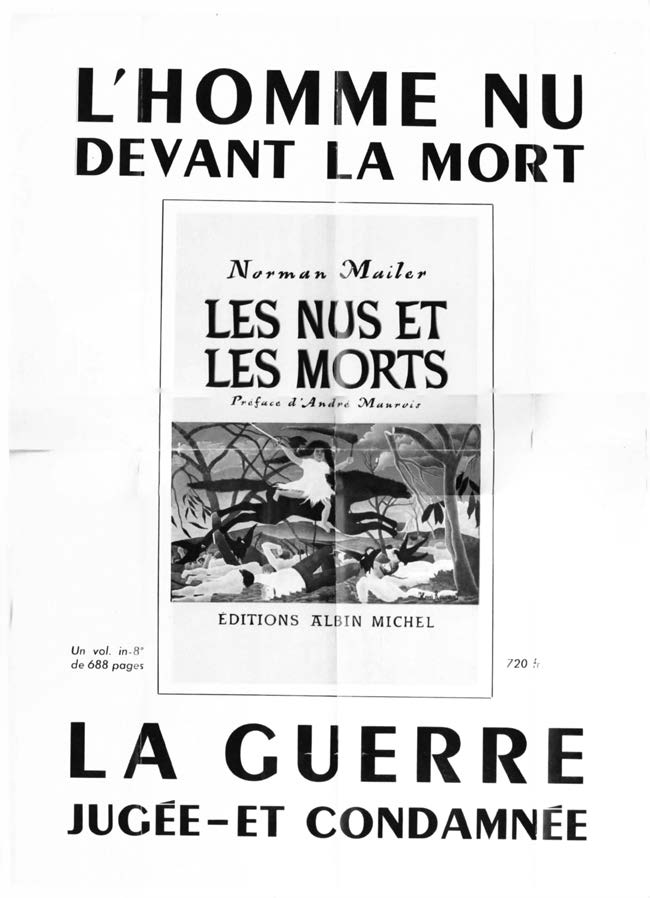
Here is a difficult, unpleasant, sometimes irritating, but unforgettable book. An imperfect book, but a great one. American critics think that this novel by Norman Mailer is the best one that has been written about the second great world war. When reviewing The Naked and the Dead, they have also spoken of War and Peace and Verdun by Jules Romain. That says that the work is important. That the concerns of Mailer’s characters were brutal and obscene was inevitable. The American soldiers from that war spoke a language that resembles the way French soldiers spoke in Weekend in Zuydcoote.1 One could say that Norman Mailer delighted in retaining the crudest language. But his decision is the right of the artist. When the novel was published in England, some legions of decency were alarmed and demanded that the book be banned. The Attorney General refused their demands. The intention to corrupt was absent and the quality of the work justified its tone.
Born in 1923, the author was only twenty-seven years old at the time of publication. [Mailer’s age when the French translation was published; he was twenty-five when it appeared in the U.S.]. He lived his entire youth in Brooklyn, that borough of New York which is at once Belleville,2 Ménilmontant,3 and the most international part of the Marais.4 “A Brooklyn boy,” these words evoke thoughts of populist strength, independence, and even revolt. Going from Brooklyn to Harvard, as he did, is like going from the rue des Francs-Bourgeois5 to the Ecole normale supérieure.6 Norman Mailer had entered a great university near Boston to work on a degree in aeronautical engineering. In fact, he did little learning but made many friends. At eighteen, he was awarded the annual prize from a literary magazine, Story, for the best short story written by a student. From this period of his life many unedited novels remain and perhaps even some of Jewish life in Brooklyn.
In 1944, he was drafted. From a young, arrogant intellectual, too sure of himself, the army made a G.I., an ordinary soldier in a squad of twelve men. This was both a shock and a revelation. Very soon, he felt the need to write a war novel. Sent to the Philippines, he was the company’s telephone operator and interpreter of aerial photographs, but these positions far from the front lines did not afford the opportunity to observe men in combat. So, he volunteered for the Luzon campaign and was transferred to an Intelligence and Reconnaissance Unit. There he had a ring-side seat. He saw much and saw it well. Every week he wrote five or six letters to his wife; this was his method of taking notes. From 1946 to 1947, using the notes, he composed his novel. The latter appeared in 1948 and remained at the top of the best-seller list for a long while, receiving both public acclaim and the admiration of experts.
Norman Mailer lived several months in Paris with his wife, taking courses at the Sorbonne and enjoying the always admirable Parisian freedom: “It’s wonderful”—he wrote—“In Paris you forget your troubles and contemplate the grey sky. Here, in New York, man is in a Roman arena. He goes in circles, like a rat, or like a character in a Kafka nightmare. . . .” At the time of the presidential election, Norman Mailer joined the Wallace campaign7 and he spoke often on Wallace’s behalf. His political opinions are transparent in the novel, but they were not at all his theme nor were his characters distorted to accommodate them. He refrained from transmitting a “message” in his book. Rather the novel displays the horrors of war because it is impossible to speak the truth about war without showing its horror, its futility and its vanity. Norman Mailer paints a war without dignity because modern war is without dignity.
The subject is a simple one. A reconnaissance platoon embarks for an island in the Pacific, Anopopei, with a corps of six thousand men, under the command of General Cummings. The Japanese have taken the island and have constructed a fortified line there. The invasion, the long battle, the thoughts of the men and the officers, their individual destinies—this is the book. The construction of the book is very skillful, with seeming negligence. Above all, it is important to breathe life into the squad and let the reader get to know each of the heroes. This is very well done, for quite quickly we know Sergeant Croft and his men. For each of them, a short chapter recalls their civilian past, a monotone past: quarrels with family, first sexual experiences, marriage, occupation. From time to time, a chorus of soldiers interrupts the narrative with a collective lament.
At the same time, the author breathes life into the characters with higher rank: General Cummings (an excellent portrait of an ambitious, intelligent, cynical and cruel person); Major Dalleson (a mediocre officer); Lieutenant Hearn, a Stendhalian character who tries to murder the general but who will end up being killed, a victim of the hate of both Cummings and Sergeant Croft. For at the core of the war against the Japanese, another war is raging among the combatants in the same army. Anti-Semitic soldiers make life difficult for a Jewish soldier, Goldstein, who is deeply unhappy because he feels constantly betrayed and who, nevertheless, continues to hope for friendship because he is sensitive and defenseless.
Not all the feelings expressed in the novel are negative, far from it. Norman Mailer’s man is neither angel nor beast. A beautiful solidarity exists among the men in the squad, partly from authentic shared sorrow, partly through their attachment to their unity, their esprit de corps. The soldiers respect a brave officer who knows his job, all the while fearing him and on the lookout for his weaknesses. They have a confused feeling of defending a democratic ideal, but these flashes of grandeur are fugitive. The bottom of their hearts is bitter. And how could it not be so? They are there, period, in a jungle infested with snakes and mosquitoes; they know that many of them will die trying to recapture that inhuman island, where nothing can hope to survive; they intuit vaguely that a promotion for General Cummings is the main objective of their campaign and that they will be sacrificed for his lofty ambition; in addition, almost all of them think that across the ocean their wives are cheating on them because they have seen how easily they themselves, in the course of their travels, have seduced the wives of others. All of it adds up to a world that is absurd, sinister, and odious.
The climax of the book is the odyssey of a small group of men sent in small boats, with Lieutenant Hearn, to penetrate the Japanese lines and explore behind them. Suddenly this patrol finds itself in a fantastic landscape. Burning sun, giant grasses that completely cover a man, and in the distance Mont-Anaka, the lavender-blue peak that dominates the island. The patrol clashes with the Japanese holding the pass. What can a handful of men do? Nothing. But complex games of hate and prestige determine the movement of the troops. Lieutenant Hearn does not want to give up in front of the general; Sergeant Croft wants to rid himself of the Lieutenant. They are not waging war but saving face. For these bitter vanities men will die, suffering atrociously. The entire episode is admirable and poignant.
Then, suddenly, the campaign is won and the island conquered. A day when, General Cummings, being absent, Major Dalleson gave an unreasonable order, a stupid initiative, that causes a rupture in the lines. The Japanese give up the fight. The general returns in time to write up the report; he will have, in the eyes of headquarters, the benefit of the victory. The doomed patrol was unnecessary. Clean up operations following General Cummings has scarcely recovered from the shock of the failure of his strategy and the unmerited success of Major Dalleson. He knows well that the victory of Anopopei is due to dumb luck; he also knows that by assigning Lieutenant Hearn to a hopeless mission, he killed him, but he quickly forgets that death. He is already imagining future opportunities to distinguish himself, but “with all his enemies in headquarters he didn’t have much chance of wangling another star before the Philippines, in which case all hope would not be lost of obtaining command of an army before the end of the war. . . .”
Certain American critics called this “a realistic nightmare.”
“No” the author replied. “A symbol.”
A symbol—that is images used as signs for an idea. And what idea? The conflict between the human beast, whose first reaction is to kill, and the small light of charity, of affection, which from time to time glows weakly in somber hearts. Or the contrast between the poor dead in uniform and the horrid, naked ambition for which they were sacrificed. The author does not say and he is right not to. Once again, a novel is not a message. But, I believe, in the end, that the emotion inspired by the novel is healthy. Mars or War Judged was a title from Alain.8 Here war is judged . . . and condemned.
André Maurois de l’Académie Française9
A novel by French writer Robert Merle (1908–2004). Prix Goncourt 1948. Made into a film, Weekend in Dunkirk (1964) with Jean-Paul Belmondo. Zuydcoote is a village on the English Channel east of Dunkirk. Merle was recruited by the French to act as interpreter for the British in the evacuation of Dunkirk.↩︎
Belleville is a working-class area of Paris (20th arrondissement) inhabited by thousands of immigrants: Jews, Russians, Poles, North Africans, Turks, and most recently Asians. Edith Piaf was born there.↩︎
Ménilmontant was originally a hamlet in Belleville. A hilly area inhabited mainly by working-class people and bohemians. Maurice Chevalier was born there.↩︎
The Marais (4th arrondissement) was an aristocratic area before the Revolution of 1789. It became a famous Jewish quarter, has many winding streets and is inhabited by immigrants, artisans, and artists. Most recently, it is a favorite area for gays in Paris.↩︎
La rue des Francs-Bourgeois is one of the longer and more interesting streets in the Marais (3rd and 4th arrondissements). Originally named because of the number of poor who lived there and did not pay taxes.↩︎
One of the most prestigious academic institutions in France (more or less the equivalent of Harvard, Yale, and Princeton). It is outside the framework of the public university system and students are accepted only by competitive exam. Among its illustrious graduates are Henri Bergson, Jean Giraudoux, Jean-Paul Sartre, Simone Weil, Simone de Beauvoir, Maurice Merleau-Ponty, Emile Durkheim, Raymond Aron, and most recently, Michel Foucault and Jacques Derrida.↩︎
Henry A. Wallace (1888–1965) was the 33rd Vice-President of the United States (1940–1944) under President Franklin Delano Roosevelt. He was also the Secretary of Agriculture (1933–1940) and the Secretary of Commerce (1945–1946). He was the founder of the Progressive Party and ran for President of the United States on its ticket in 1948. He was defeated by Harry S. Truman on the Democratic ticket.↩︎
Alain is the pen name of Emile-Auguste Chartier (1868–1951), French philosopher, professor, pacifist and graduate of the Ecole normale supérieure. He had an immense influence on his students, among them Simone Weil, Simone de Beauvoir, and André Maurois.↩︎
André Maurois, the pen name of Emile Salomon Wilhelm Herzog, was a prolific French biographer, novelist, historian, and essayist. Born into a wealthy Jewish family of textile manufacturers, he was conflicted from a young age about following the family path into business or pursuing an artistic and intellectual route. He recounts this struggle in his novel Bernard Quesnay (1928). Maurois served France in both World War I and World War II. His first literary success came with Les silences du colonel Bramble (1918), translated into English as The Silence of Colonel Bramble, a humorous treatment of his experiences as interpreter and liaison officer with the British army in World War I. In World War II, he served in both the French army and with the Free French Forces. His many biographies have been singled out by critics for the author’s clear and graceful prose, his penetrating analysis of each subject, and his ability to sustain a novelistic narrative in this genre. Among these works are Ariel (1923), the life of Shelley, Byron (1930), Olympio (1954), the life of Victor Hugo, Lélia (1952), the life of George Sand, Prométhée (1965), the life of Balzac, and A la recherche de Marcel Proust (1949). Maurois was elected to the Académie Française in 1938. He married a Polish-Russian aristocrat, Jeanne-Marie Wanda de Szymkiewicz, who had attended Oxford University, and they had two sons and a daughter. After her death in 1924, he married Simone de Caillavet. In 1947, he changed his name legally to his pen name. —Jeanne Fuchs↩︎