Nothing is more delightful than to confuse and upset people.
Tristan Tzara
Beyond the Law (1968) is film director and performer Norman Mailer’s reflexive rendering of urban criminals and cops, set during the violent space and time of the late 1960s. Beyond the Law documents one night in the lives of the socially disparate and disordered inside the police precinct. My study interprets Mailer’s film as a uniquely layered series of generic citations from post-war American police films and television culture and suggests that Mailer’s initial foray into the criminal maelstrom, the experimental film Wild 90 (1968), might be read as the first half of a unique whole completed by Beyond the Law: “not the facts, ma’am,” but a play at improvised possibilities.
In an interview with New York Times critic Vincent Canby, Mailer succinctly concluded about his second film production: “Beyond the Law is, in effect, a documentary fiction film, a feature-length improvisation about one night in a Manhattan precinct station. . . . It’s a series of terrifying and funny confrontations with wife-murderers, gamblers, perverts, prostitutes, pimps and innocents” (142). Mailer’s Beyond the Law, “shot in four nights, producing eleven hours of film” (142), leading to “six months [of] editing” (141), was produced for well under $75,000 and, like Wild 90, was essentially Warholian: an aesthetically complex, contradictory, and unconventional film narrative. Mailer stated, “I learned a lot from Warhol . . . [he] made every director brave enough to make a slow scene without trying to speed it up”1 (141), as well as encouraging non-cinematic, eccentric, yet vital performances. Mailer himself notes Beyond the Law’s frenetic, spontaneous quality, which according to Canby possesses a unique dynamic: “its own reality, like someone who lurches through a subway car wearing a fur coat in August” (139). Yet this film’s stylistic verve belongs to the experimental fervor of the 1960s independent American film. In Jonas Mekas’s assaultive pseudo documentary, The Brig (1964), the audience experiences the daily routines of the brutalized imprisoned soldiers, which is conducted with the full cooperation of the authorities. Mailer‘s Beyond the Law focuses on the heated and frequently politically ugly activities of one night in two confined spaces—a bar-restaurant and the local police precinct—and the film artfully exposes oppressive racial and gender relations, their endemic brutalities. Beyond the Law, when categorized as a “part two” to Mailer’s Wild 90, is another vastly underappreciated, experimental film from the 1960s. Mailer’s second film examines the unremitting rituals of two types of the male beast: those with power, and those who confound and reject such power, which does include some suspect female characters. Within Mailer’s unscripted small talk and interrogations, from the restaurant table to the police precinct, distilled spirits and manipulative confrontations extract and expose human relations in one foul evening.
To achieve this, in a claustrophobically composed series of close-up and medium shots, director Mailer produces a vision of the urban, fringe inhabitants of the underworld ensnared within the police culture of the late 1960s. Beginning and ending in the bar-restaurant frame narrative featuring cops with 1960s hot dates or wives, the narrative shifts, nearly rupturing the audience’s focus, as it cuts to the interiors of the local precinct, featuring cops and assorted criminal types: an assemblage of perversely fascinating mid-life crises, cretins, and brooding lowlifes. This is the precinct of the director’s imagination, with trope requisites such as protracted entrances-introductions of various suspects, a veritable, racially diverse marketplace of the accused, lineups, mug shots, and recurrently violent interrogations, which are frequently depicted as exercises in humiliation. It is just another night in the city-as-jungle.
Cinematographer D.A. Pennebaker exploits the visually experimental design associated with 1960s film narrative he helped to establish in his career. After the initial setting in the bar, with its flaccid conversation, the shot cuts to the precinct, there is a hand-held, frenetic “you are (really not) there” pre-reality television feeling as apprehended bodies and detached voices blend into an assemblage of rapidly edited and mixed set shots capturing the procedures of the inquiring police and reactive respondents. These multiple shot sequences form an oddly coherent and comedic near-sociological survey of intersecting power relations. In Beyond the Law, a pervasive mood of controlled chaos reigns, thematically and visually. Disbelief never retreats from the audience’s immediate perception of events. There is a non-suspension of reality; the actors are interpreting ideas generated that moment, declaiming unscripted dialogue, in their extemporaneous “documentary” idea of crime. Dennis Broe’s article, “Genre Regression and the New Cold War: The Return of the Police Procedural,” notes the historical significance of this dynamic process in flux: “By 1950, the crime film dominant had changed. In place of the fugitive working or middle class outsider, this new dominant centered on either the working class cop or the middle class plain-clothes detective in films that purported to show the inner workings of police and federal law enforcement agencies” (84).
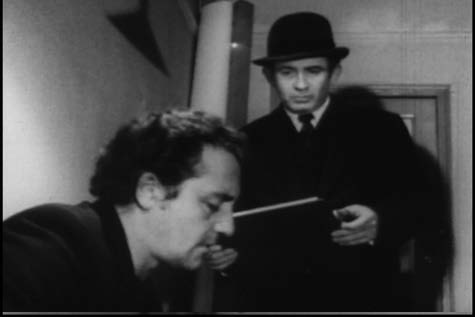
Beyond the Law is Mailer’s credible replica, rendered by its feigned existentially haphazard cinematic technique and improvisational acting style, as the film portrays procedural moments of unbridled caginess in claustrophobically tight framing. This stylistic design creates a charged space for Mailer’s generic re-vision of the evasive small talk of idiots and misfits, in Pennebaker’s controlling close-up and medium shots, which are frequently reverse and two shots. Beyond the Law is Mailer’s experimental revision of the crime genre and a parody of police culture; the narrative fluctuates between the comical and serious while unmasking the behavior and procedures of criminal-suspects and policemen, provocatively revealing a discomforting realism.
Mailer likened the process of directing Beyond the Law in a reflective, flamboyant, yet martial tone to be a “military operation . . . we make a raid. We attack a terrain,” since, “in Beyond the Law, what I was attacking was the old terrain of the Warner Bros. gangster and cop movies. I loved that kind of film and I wanted to see what you could do if you shot them in a more realistic vein” (Gelmis 173). What Mailer was attempting to recreate, in this spontaneous and politically charged crime drama, was a “second improvised documentary feature” (Canby 139), the stylized experience of a sole night in a (then) contemporary New York City police station, but this is really a site of the imagination as it presumptively documents perceived personal and investigative moments. For the audience, it seems like peering through a window in the bar or the police station after one has had too much to drink; one affectively “sees.” Mailer acknowledged this: “What I was trying to do in Beyond the Law was to create the reality, if you will, below the reality, beneath the reality, within the reality of an evening in the police station” (Gelmis 160). The operational phrase is “below”; Mailer achieves this by accessing and reformulating narrative and generic tropes familiar to the popular media saturated audience.
Dennis Broe comments on the emerging presence of “documentary style realism“ in post-war American crime films, and he links this with the European neo-realist cinema, in which “the crime film served as the generic site where these techniques could be interpolated into dominant modes of representation” (84). This is a notable observation, for Mailer traverses established generic parameters of the crime-police film narrative to reinvent them in parodic strokes; in Beyond the Law, all men seem creepily and comically equal. R. Barton Palmer’s “’The story you are about to see is true’: Dragnet, Film Noir, and Postwar Realism,” discusses neorealism and the American television crime show production, Dragnet2, suggesting hypotextual implications for Beyond the Law’s technical and thematic standards:
Neorealist films were generally shot on location and with available light; they addressed topical subjects, often focusing on the experiences of those in the lower orders; plots were simple, emphasizing everyday events and avoiding both melodrama and spectacle; and unglamorous or non-professional actors were cast in featured roles, making an important connection between real and film words. (69)
Palmer also specifically notes the cinematic and measured compositional design of the famous American television production, Dragnet; I am suggesting the aforementioned criteria provide a complementary context to read Mailer’s Beyond the Law: “the characteristic Dragnet scene is not physical action, such as a car chase, but conversation: sometimes the interrogation of either witnesses or suspects, sometimes a discussion among the policemen themselves about how to proceed,” with Palmer later adding how “the frequent use of close-ups [fills] up the small screen” (70). These closeup, near-affect shots compel the audience to look further inside the characters; the police, the criminals, and also the women at the bar are creatures barely controlling inner tensions, desires, and calculating statements, indicating “below the surface” interiorized states of repressed identity in proximity to the surface of the frame. This is most evident in the behavior of police Lt. Francis Xavier Pope, auteur Norman Mailer.
We spend our lives acting.
Norman Mailer
Specifically linking the events in Mailer’s precinct’s space and characters—its class and gender biased interrogations of Blacks, Latinos, and “working” women, and the frequently humiliating physical and verbal assaults some experience—is the figure of the stereotypical Irish detective, Norman Mailer, in his attractive, fulminating self-conscious performance. This portrayal most effectively recalls the culture of the police squad room of the 1950s and 1960s American film and television narratives. Some critically representative film productions featuring the imposing, and recurrently imperfect, male authority figure include Touch of Evil (Welles 1958); Madigan (Siegel 1968); Bullitt (Yates 1968); and from American television, The Untouchables (1959–1963); and M Squad (1957–1960).3
While cinematographer D.A. Pennebaker’s documentary practice of following the action with moving-panning camera placements in tightly composed medium shots, recalls his signature style in Wild 90, there is an added intensity, a feeling of energizing and unique familiarity, namely, Mailer as “parodic presence”; his directorial visual and dramatic compositional strategy suggests a generic intertextuality with procedural and rhetorical practices from both the television and film culture of crime-police narratives established in the post-war American popular media culture; in particular, two films, Wyler’s Detective Story (1951) and Douglas’s The Detective (1968), as well the television series, Dragnet (1951–1959: 1967–1970) all are plausibly informing intertexts. I am suggesting that Mailer’s Beyond the Law, if read as an experimental, documentary-fiction film, displays a historically based intertextuality with the aforementioned, which “does not imply a confused and mysterious accumulation of influences, but a work of transformation and assimilation of several texts” (Jenny 36). Linda Hutcheon has commented on the role of parody in film culture in A Theory of Adaptation, and she concludes that there are three types of adaptations; the second type provides an overview of Mailer’s aesthetic conception of Beyond the Law: “[the film is a] creative and an interpretive act of appropriation/salvaging” (Hutcheon and O’Flynn 1) from previous and related generic texts. Mailer’s parody cites as covert sources the multi-media staple of the crime-police genre, and his film also anticipates a generic metamorphosis in later media expressions. I will focus on the trope of the imperfect detective mired in police procedures and practices in related past and contemporary narratives, to suggest a pervasive standard, and examine Mailer’s parodic performance as the abusive-engaging detective at work in Beyond the Law.
William Wyler’s Detective Story (1951) was based on the dramatic work by Sidney Kingsley, which had a successful run in New York’s Broadway only a few years earlier. Kingsley’s police drama, set entirely in the police station, is a site which features both the violent and the victim, but it is frequently hard to distinguish between them at critical moments. When Detective Dakis, a sympathetic, post-war ethnic stereotype exclaims, “There are two kinds of people in this precinct—the crumbs and the eelite [sic]; and the eelite [sic] are crumbs,” he sets margins of class and character representation in perspective (117). On any given day, anybody in a dress, work clothes or tailored suit can become a fingerprinted suspect.
In Wyler’s film adaptation, somewhere in post-war New York City, the fictional 21st precinct, the unbilled “star” of the film, provides the setting which documents multiple police-crime tales in the larger narrative of personal decline and discovery of one explosive yet sympathetic figure, Detective McLeod (Kirk Douglas), who uncovers the truth about his wife in this bowdlerized version of the drama, as the critical issue shifts from illegal medical abortions to pre-marital sexual relations and the black market in unwanted children.4 Mailer’s film, like Wyler’s film, makes the confining physical space and time of the one night in a precinct an essential generic trope, a site for festering tension and revelations. In Douglas’ performance, his acting style telegraphs his decline as the greater “truth” unfolds during the procedures of fingerprinting, taking mug shots, filling out forms, droning or paroxysmal conversations, and generally, ponderous waiting in wooden seats. In contrast to this, Mailer’s performance, seemingly near the edge of self-conscious excess, as if he were attempting to control himself from smiling or cursing at others or into the camera, works like a whole surrounding the parts. In the Weegee crime scene photo of the recalled imagination, Mailer’s detective is seconds away from staring into the camera.
Likewise, Gordon Douglas’ The Detective (1968) was a film adaptation set in (then) contemporary New York City and frequently shot inside the typical police precinct; it features the “hard boiled” yet oddly vulnerable—he has serious marital troubles and guilt issues— Detective Joe Leland (Frank Sinatra), who is in search of the murderer of a successful male homosexual in the pre-Stonewall, closeted era. Detective Leland discovers and bemoans government conspiratorial intrigues and human suffering, which he avoids inflicting whenever possible. Inside the confines of the precinct, Leland objects to and even interferes with the excessive grilling of suspects, and he strangely relates to the perceived world of lonely misfits; this contrasts with Mailer’s vastly confrontational declamations against all types—guilty or not—inside his closed off environment.
In one compelling and ironic shot sequence in Douglas’ film, an elderly White male suspect is stripped naked and fiercely questioned by a Black detective who recalls seeing such procedures in old film strips of Nazi interrogation methods.5 Detective Leland interrupts this mishandling of power and fiercely addresses the abuser. Mailer’s crime film depicts several interrogations, mostly ugly and abusive as each detective invokes his sense of gender and racial prerogatives of authority when useful. “Popcorn” (Rip Torn) and “Grahr” (Michael McClure), the criminal-performers, portray “lowlife” hoodlum types, like Wyler’s station house psychotic thieves Charley and Lewis, and seem to erupt from the frame with expressions of combustible, leering violence. Beyond the Law traverses the familiar fictions of regulated police engagements and procedures, suggesting a hyper-realistic view of abnormality. The audience might consider which performance is more “real” for them, Frank Sinatra and Kirk Douglas’ acting on scripted cues, or Norman Mailer spontaneously performing a parody of the conflicted detective?
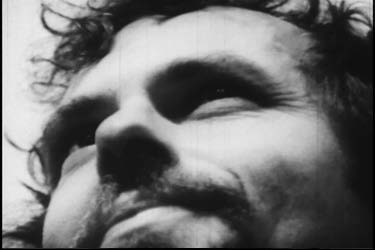
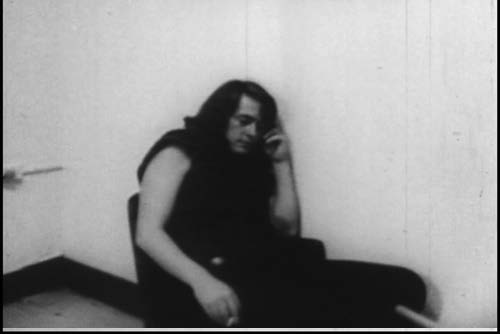
Beyond the Law may be read as a fictional “avant-doc.” According to Scott Macdonald, “The idea of the ‘avant-doc’ suggests that what, in earlier decades, may have seemed a set of intermittent and unrelated crossovers within the relatively distinct histories of documentary and avant-garde film can be understood as an evolving tradition” (57). Mailer anticipates and offsets the fatuous reality of the American television culture of past and future police-criminal shows, either capturing the present “live,” or re-enacting the past as present. In Beyond the Law, we witness a simulated realism unfolding in imaginary space and time.
Mailer’s spatial and temporal framing device, from the barroom’s besotted small talk to the precinct house—in the lineup and interrogation sequences—seem to be real but the audience is never wholly taken in by this experimental ruse. As it is applicable to Beyond the Law, Macdonald further states:
One of the advantages of the term ‘avant-doc’ is that it not only assists us in coming to terms with much recent work, but also allows for valuable perspectives on the ways in which these two histories have intersected over the years. To reflect upon these intersections refreshes a sense of both the documentary and the avant-garde filmmaking . . . as alternative practices to commercial and narrative cinema. And at the same time it provides a useful framework for thinking about a number of new filmmaking documentary developments. (50)
As a performer, Mailer playfully channels hypotextual ethnic stereotypes of brutish detectives at work pitted against urban types of undesirables, in performance styles that are simultaneously humorous and violent, to establish Beyond the Law’s slightly askew crime genre parameters: an experimental pseudo documentary. Mailer himself stated, “We’ve passed the point in civilization where we can ever look at anything as an art work. There is always our knowledge of it and the making of it” (Canby 144). Set in the precinct, Beyond the Law is arguably Mailer’s carnivalesque conception of class, gender, and racial mingling, where identities, especially his own, are frayed, revealed, deconstructed or obfuscated by viciousness, sexual longing, and other expressions of anxiety, and are frequently abetted by drugs, alcohol and unknowable personal demons. Mailer, the auteur, documents types of people in ignoble circumstances, with performances of layered generic citations: the gang member, the “druggie,” the pervert, the sex-worker, the murderer, and those one might expect to meet on an especially busy night, if arrested.
Mailer’s self-conscious performance in this visually cramped landscape never seems to take itself too seriously; it is a realistic fake. For the audience, Mailer was already a well-known “star” in his own right, an intellectual social commodity. Philip Drake has commented on the presence of this star phenomenon in popular culture:
One of the major functions of star performance is to make a particular kind of narrative economy possible . . . [an] extratextual signification he or she brings to it . . . The intertextuality of star performance is often directly acknowledged within texts . . . Such meanings are found, not in the performance but in the inter-text—the collusion of performance, subsidiary texts, and audience knowledge. (88)
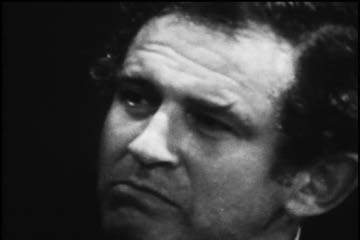
Beyond the Law anticipates the reality television and celebrity, star-culture of the contemporary broadcast era in which “cop shows” invite the audience to witness the proceedings and anticipate the already established outcome, but Mailer’s film defuses and exposes procedural violence and the lack of moral distinctions to be inferred among all parties. Apparently, nobody is Beyond the Law, whether the fluid laws of experimental cinema or performance art, and we celebrate that realization in Mailer’s second film.
Ironically, Mailer considered Warhol to be an influential but poor filmmaker. I also discuss the connections between Warhol and Mailer’s film aesthetic sensibility in my article, “Performing Norman/Norman Performing: Wild 90 as Disruptive Narrative,” The Mailer Review, 2016.↩︎
Dragnet was first produced as a crime-detective procedural investigative radio show but was then brought to television by one of the medium’s initial and famous auteurs, Jack Webb, for two series runs, from 1951–1959, and then 1967–1970.↩︎
This survey is only a small sample of film and television productions from that era that did feature critically significant police procedural sequences.↩︎
In addition to this, the characters of the two criminals-buffoons, Charley and Lewis, were originally portrayed as homosexuals in the drama but are rendered safely heterosexual, albeit leeringly violent, and in the film, it is Charley who kills McLeod in a precinct shootout.↩︎
The Detective (Directed by Gordon Douglas, Twentieth Century Fox, 1968) merits another critical turn as an underappreciated “almost getting it right” studio film, considering the then controversial subject matter.↩︎
Works Cited
Beyond the Law. Directed by Norman Mailer, Cinemalta, 1968.
Broe, Dennis. “Genre Regression and the New Cold War: The Return of the Police Procedural.” Framework: The Journal of Cinema and Media, vol. 45, no. 2, Fall 2004, pp. 81–101.
Canby, Vincent. “When Irish Eyes Are Smiling, It’s Norman Mailer.” Conversations with Norman Mailer, edited by J. Michael Lennon, University Press of Mississippi, 1988, pp. 139–144. Reprinted from The New York Times, 27 October 1968, sec. 2, 15.
The Detective. Directed by Gordon Douglas, Twentieth Century Fox, 1968.
Detective Story. Directed by William Wyler, Paramount Studios, 1951.
Drake, Philip. “Reconceptualizing Screen Performance.” Journal of Film and Video, vol. 58, nos. 1–2, Spring/Summer 2006, pp. 84–94.
Gelmis, Joseph. “Norman Mailer.” Conversations with Norman Mailer, edited by J. Michael Lennon, University Press of Mississippi, 1988, pp. 155–175. Reprinted from The Film Director as Superstar. Doubleday, 1970, pp. 43–63. Print.
Hutcheon, Linda, and Siobhan O’Flynn. A Theory of Adaptation. 2nd ed., Routledge, 2013. Print.
Iampolski, Mikhail. The Memory of Tiresias: Intertextuality and Film. Translated by Harsah Ram, University of California Press, 1995. Print.
Kingsley, Sidney. Detective Story. Random House, 1949. Print.
MacDonald, Scott. “Avant-Doc: Eight Intersections.” Film Quarterly, vol. 64, no. 2, Winter 2010, pp. 50–57. Print.
Palmer, R. Barton. “’The story you are about to see is true’: Dragnet, Film Noir, and Postwar Realism.” Television and Criticism, edited by Solange Davin and Rhona Jackson, Intellect, 2008, pp. 61–74. Print.