“Whichever flame flames in your manhood, that is you, for the time being.”
D.H. Lawrence, “The Novel”
“The realization of impotence, of one’s own inability to love, in consequence of mental or physical disorder, has an exceedingly lowering effect upon self-regard.”
Sigmund Freud, “On Narcissism: An Introduction”
“L. is asleep—the worst was the emotional depression and the nerves, it drove one to despair—it was as if he couldn’t or wouldn’t live on.”
Frieda Lawrence
“And only in the novel are all things given full play.”
D.H. Lawrence, “Why the Novel Matters”
“Without transcendence, my friend, there’s no great literature.”
Norman Mailer to Jack Henry Abbott
A shorter version of this essay was first published in Papers on Language and Literature 29 (1993): 395–416. Permission to reprint has been granted by the author and Papers on Language and Literature. An expanded version of this essay was published in Balbert’s recently published book, D.H. Lawrence and the Marriage Matrix: Intertextual Adventures in Conflict, Renewal, and Transcendence. Permission to reprint has been granted by the author and Cambridge Scholars Publishing Ltd.
Since its posthumous publication in 1930, it remains the long-established and oddly qualified opinion that The Virgin and the Gipsy is one of Lawrence’s most successful albeit minor works of fiction. Admiration for the novella’s achievement often is tinged with a grudging note of reservation, as if the assigned status as distinctly unmajor must somehow temper the praise for its impressive artistic integrity. Representative praise of the work ranges from the early enthusiasm of F. R. Leavis, who deems it “one of Lawrence’s finest things,” to the more balanced and generally approving considerations of Carol Siegel and John Turner, and finally to the recent foray into ethnicity and cultural studies by Judith Ruderman.1 The various approaches of these critics all emphasize, in quite different ways, the work’s anticipatory evocation of several coordinate patterns and preoccupations in Lady Chatterley’s Lover. Certainly the conspicuous continuities between these works deserve ample consideration; yet it remains unfortunate that the notable sexual explicitness of the later novel, with its well-chronicled history of legalistic problems and scandalous publicity, has dwarfed in many way the more innovative treatment of comparable themes in The Virgin and the Gipsy.
I
In this shorter fiction’s portrait of a temperamentally cautious, silently charismatic, but distinctly isolate male, a frustrated and vulnerable female, as well as an instinctual connection between them that crosses the boundaries of class and culture—in such crucial correspondence there is much to ponder in the consistent development of Lawrence’s doctrine and technique during the last years of his life. With a similar inclination to link the novella to the more celebrated novel, Julian Moynahan—in one of the earliest lengthy treatments of the work—explains how The Virgin and the Gipsy reflects Lawrence’s view of the “aetiology of the diseased condition of life” (215). In a more recent close reading of the metaphoric design in the fiction, John Humma further elaborates on the relevant themes of social pathology and existential malaise by isolating the trope of “inside and outside” (78) in the work—a metaphoric counterpoint used by Lawrence to chart an integrated syndrome of maladjustment, repression, and failure that inhabits the claustrophobic Saywell home and the more sprawling anterooms of the decorous Chatterley estate.2
But even in this context of abundant affirmative criticism, the tone of hesitancy persists through the decades about the novella’s purportedly minor status—that is, about its relative lack of complexity, bulk, and interest next to the major novels in Lawrence’s career, and about that alleged function as mere prelude to issues explored more comprehensively in Lady Chatterley’s Lover. During the height of Lawrence’s reputation from the 1950’s through the 1980’s, the work failed to attract much critical praise or sustained discussion. Indeed, during that early, formative period, Harry T. Moore, a pioneering Lawrence biographer and critic, set an unfortunate tone by rating it as “among the lowest of Lawrence’s fictional achievements,” as a distinctly unimportant work that merely recalls “The Horse Dealer’s Daughter” and provides “another variation on the Sleeping Beauty motif ” that is prelude to Lady Chatterley’s Lover (333, 416). Similarly, another influential and early Lawrence scholar, Graham Hough, dismisses the work entirely with the condescending evaluation that often appears in later decades; while he briefly compliments the novella for its focus and consistency, he finally rates it as “no more than a preliminary working over of Lady Chatterley material” (188). Even in the most sustained and admiring of three of the first book-length commentaries on Lawrence—by Mark Spilka, Frank Kermode, and H.M. Daleski—the pattern of disregard and underrating continues. Spilka and Kermode strangely do not even mention the work in the text or notes, and Daleski adds in a short paragraph that the gipsy simply functions as “the prototype of Mellors” (280). In the wide-range of studies on Lawrence today, there remains a demonstrably minimal concern by most critics with in-depth consideration of the work, and sustained and sequential examination of the development of its plot, symbolism, and doctrine are virtually nonexistent. Text-centered analysis of The Virgin and the Gipsy seem constrained by the lingering effect of that early and perpetuated judgment about the novel’s uncomplex resonance—what Siegel calls its “reassuring simplicity” (175).
It is certainly true that The Virgin and the Gipsy, viewed as either a short novel or long tale, must lack the scope and ambition of Lawrence’s more substantial novels. It is also clear that this “limited” literary terrain provides a more unembroidered and less intense treatment of several themes and metaphors that have central importance throughout Lawrence’s career. But the work’s significance requires this focused attention, more responsive close reading; it is precisely such unusual transparency of artistic technique and reiterative simplicity of structure that contribute to its crucial role in the writer’s canon. The revelatory nature of this important fiction needs more attention. This novella’s qualities of an accessible, intrusive doctrine melded to an elemental narrative design offer provocative clues from 1925 about Lawrence’s physical and spiritual condition, sexual health and creative confidence as he begins the last five years of his life. My argument is less about the legitimate excellence of the novella than it is about the innovative resonance and effective simplicity of the artifice and vision in the work. There is no other extended fiction by Lawrence (and I include the more poetic and mythic The Escaped Cock) in which the prose is so bare, the plot ambitions so uncomplex, and the supporting doctrine and symbology so recognizably reflective of typologies and perspectives long associated with this writer. While critics, as noted, often admire the work, they often are disinclined to discuss its unusual contribution to Lawrence’s growth as an artist. They prefer to argue that is derivative, anticipatory, and self-explanatory. To be sure, the work reflects those aspects, but it also remains special in the inimitable way that those very qualities operate synchronistically to enhance the novel’s meaning, intention, and timing in Lawrence’s career. This notion of timing involves more than mere biographical relevance. Lawrence uses the patterned structure and intrusive narration to undermine the conventional movement of time in fiction. Before examining this temporal element in the novella’s design and ideology, some discussion is necessary on its intriguing positioning in the turbulent life and art of the writer. Considerations of the marriage matrix preoccupation in this work also must begin with a summary of his health and outlook as he begins The Virgin and the Gipsy. In June of 1925 D. H. Lawrence continues his slow recovery in New Mexico from his near fatal and recent attack in Mexico of a pernicious amalgam of influenza, malaria, and tuberculosis. He also begins to write the first of eleven essays that he will compose through November; five of those essays justly rank among his most important statements on the art and philosophy of the genre of the novel: “Art and Morality,” “Morality and the Novel,” “The Novel” (all written in June), and “Why the Novel Matters” and “The Novel and the Feelings” (both written in November).3 This six-month spurt of non-fictional prose—which includes “Reflections on the Death of a Porcupine”)—represents Lawrence’s most sustained writing accomplishment since the onset of his dangerous illness at the end of January. After he completes several of these essays in New Mexico, he travels in late summer and early fall first to New York and then to England; in the process he finishes some necessary busy work and derivative writing projects, including proof corrections, drafts of short stories, manuscript revisions, and book reviews. It is important to emphasize that aside from the essays and short fiction in this period, the only new writing from January to November 1925 consists of a few reviews and the play David. Thus it is a period of nearly a year—from the onset of his illness to his arrival in Spotorno—and Lawrence composes no new major fiction. Despite the fact that his esteemed genre of the novel is unequivocally the central topic of the 1925 essays, and despite Lawrence’s consistent assertion that extended fiction is the most important form of artistic expression, he comes to The Virgin and the Gipsy after the longest creative drought of his career.
II
Amid his many pronouncements in earlier years about the value and priority he assigns to the novel, it is evident throughout his voluminous letters and cathartic travel pieces during the relatively healthier years of his life (1910–1920) that the writing of any lengthy work of fiction exerts the greatest demand on his resources of body, mind, and spirit. In his letters he has acknowledged the emotional price he paid in the composition of The Lost Girl and St. Mawr. Lawrence becomes ill in 1925 in Mexico almost to the day he completes The Plumed Serpent, a major project for him that he insistently regards as his “most important novel, so far,” and one that, as an especially strenuous work, he feels is related organically to the onset of his illness: “I daren’t even look at the outside of the MS. It cost one so much. [ . . . ] I got my novel ‘Quetzalcoatl’ done in Mexico at tremendous cost to myself ” (Letters V 230, 245). What the cost involves we can only surmise. That Lawrence emerges from this encounter with death as a changed man, however, is hard to dispute on logical grounds and on the direct evidence of statements by him, Frieda, and his acquaintances. Above all, Lawrence is painfully aware of his diminished condition in early 1925 and of the alarming prognosis for his future condition given the inevitable decline from his tuberculosis. The residual emotional and physical uneasiness in him in the spring understandably detracts from his self-confidence as a man and an artist. He cannot shake loose from the ravages of his experience in Mexico. He seems haunted even months later, still repressing the dire and definitive diagnosis of tuberculosis supplied by Dr. Uhlfelder: On May 21: “Thank goodness I am much better—but don’t forget my shakiness.” On June 20: “I was so ill down in Mexico in Oaxaca—with malaria, flu, and tropical fever—I thought I’d never see daylight. So everything slipped” (Letters V 254, 269). He omits mention in this letter, of course, of the disease that will kill him.
Thus by the beginning of July, although Lawrence increases his writing output to include more introductions, essays, reviews, and revisions, there remains no sustained engagement in longer fiction and no indication (quite rare for him!) that he contemplates such a project in the months ahead. As the weeks go by and Lawrence recuperates sufficiently to spend long writing hours on anything but a novel, it is hard to avoid the conclusion that he is mired in a post-traumatic writer’s block that cruelly separates him from his cherished ability to produce major fiction. This condition is not an unfamiliar psychosomatic syndrome, and it is one of the two most common manifestations of incapacity after a prolonged illness. The other, of course, concerns Lawrence’s sex life and dim prospects for his future quality of existence. Frieda claims that during his sickness in Mexico, Dr. Uhlfelder told Lawrence directly and without qualification of the tuberculosis that the doctor regarded as terminal. James Boulton and Lindeth Vasey summarize the drama of the meeting in moving detail, including the following account of Frieda’s precise words from Not I, But the Wind: “Lawrence looked at me with such unforgettable eyes.” Frieda further recalls the doctor’s judgment that Lawrence would be dead in a year or two, and she includes her own alarming prediction: “After the great strain of his illness, something broke in me. He will never be quite well again, he is ill, he is doomed. All my love, all my strength, will never make him whole again” (Letters V 78, Frieda Lawrence 166–67).4
But Frieda, as all Lawrence scholars know, never breaks easily, and her poignant desire to “make him whole again” sadly suggests a broken or missing part. This declaration of her own futile hope sounds like a thinly-camouflaged despair over the lack of any sexual consummation with Lawrence. It is certainly the persuasive consensus of well-informed critics and biographers as early as the 1950’s that Lawrence’s impotence—whether partial or total—“dated from his terrible illness in Mexico in 1925 from which he never recovered” (Spilka 71).5 Ellis’s careful investigation of Frieda’s own sex life suggests that her affair with Ravagli likely begins in April 1926, not many months after Lawrence’s illness, and only several weeks after Lawrence’s failed attempt (whatever the cause) to have sex with Dorothy Brett in Ravella in March. Thus a compelling story develops from the organic consideration of Lawrence’s life and art in 1925. As he moves immediately from the completion of his most ideologically uncompromising and aggressively phallic novel, The Plumed Serpent, into a sickness that nearly kills him, Lawrence discovers that he cannot make love and will not write lengthy fiction; deprived of these accustomed and cherished relations with his wife and profession, his survivalist instincts tell him what he must do. In effect, his physical and emotional state confirms the pertinent and gloomy forecast by Freud written in the previous decade that also is precisely relevant to Lawrence’s physical and emotional condition after the trauma of his near-death illness. During and after the war, Freud’s statistical prediction would prove even more accurate in the wake of countless soldiers who recovered from disease or injury but remained unwilling or unable to make love: “I shall put forward the view that psychical impotence is much more widespread than is supposed” (“Universal Tendency” 398).6 How does Lawrence respond? He first counters this aetiology by returning to a theoretical and optimistic reassertion of the supreme value of his art. His instincts, in effect, tell him that such confirmation can start the process of his organic renewal. The short, reiterative, and trenchant essays that Lawrence begins in June 1925 become for him confirming, even renewing statements about the value and urgency of his aesthetic calling, and—in the always impinging practical arena—they also serve as new work for his agent to sell to journals and then to publishing houses. The essays remain quotable for their wealth of snappy aphorisms, accessible metaphors, and adamant statements; more importantly, they do not break new ground in Lawrencian doctrine as much as they prune and reaffirm the visionary spirit of Lawrence’s work a decade earlier. In these prose pieces on fiction, morality, and art—which bring him both more money and satisfaction that he anticipated—he recalls and refines many of the images and preoccupations of the more complex and extensive writings, “The Crown” and Study of Thomas Hardy. This series of essays seems created by a reminiscent version of Lawrence in his celebrated pre-leadership phase of 1913–1918, and they function as rallying catalysts for a return to the province of a novella in 1926. In a revealing letter to Edward McDonald on “The Novel,” Lawrence writes about his fondness for that essay in terms of its cathartic function in his life: “But it’s what I genuinely feel, and how I feel, so what’s the odds?” (Letters V 272)
III
Such a committed stance by Lawrence about his own genre priority in 1925, and, implicitly, about his own impinging frustration and urgent priorities, becomes more meaningful in light of the unusual short novel that he writes in 1926, The Virgin and the Gipsy. There exists a close correspondence in the abundant metaphors, committed doctrines, and accessible tone of the essays, with the comparable elements of theme and technique in a novella that stands as his first major fiction in many months. When Lawrence is sufficiently energized by the rousing principles enunciated in the essays, he applies himself to this novella as a preliminary means to re-engage with his “bright book of life” (“Why the Novel Matters” 195), the genre of the novel. It is also noteworthy that Lawrence first comes to his project of interrelated essays through his growing interest in painting and art criticism. His talents as a painter and art critic offer him welcome distraction in 1925 through his long convalescence that eases the pain of his impotence as husband and writer.
In July, after he writes several of the essays on fiction and contemplates a few more, he reveals an interesting indebtedness to his painting avocation through a declared preference for absolute simplicity in doctrine and style. In the following letter, he writes from the integrated perspective of philosopher, novelist, and critic. The edge of confidence evident in his tone also suggests that he is charting himself back to relative health and writerly productivity by celebrating a simplicity of style and a doctrinal “essentiality” that inform his essays and (just a few weeks away) The Virgin and the Gipsy. He knows how to accelerate his recovery:
I have thought many times it would be good to review a novel from the standpoint of what I call morality: what I feel to be essentially moral. Now and then review a book plainly.[ . . . ] To pave the way—and have some stones to pull up and throw at the reader’s head—I did two little articles: “Art and Morality” and “Morality and the Novel”. [. . .] The point was easier to see in painting, to start with. But it wouldn’t be so very out of the way, in a literary paper. (Letters V 275).
And distinctly not so “out of the way” in a novella that will undermine conventional “morality” as it depicts the Lawrencian vision in his most “plain” major fiction. He has “paved the way” in 1925 for a significant breakthrough in 1926 in fictional innovation. The essays contain the “stones” that will disturb readerly expectations of narrative technique in The Virgin and the Gipsy. Above all, it will be “good” for his soul.
Lawrence slowly recovers from his winter illness with a vision of moral life and sexual transcendence that is shorn of those obsessive notions of political leadership and submission so engrained in The Plumed Serpent. A few weeks after the letter above, he is confident enough in late August about his physical condition and emotional outlook to offer some similarly “plain” advice on the interconnected processes of writing fiction and perceiving the world: “When we get inside ourselves and away from the vanity of the ego—Alice and smart clothes—then things are symbols” (Letters V 294). Lawrence still has three important novels to write in the last four years of his life—The Virgin and the Gipsy, The Escaped Cock, and Lady Chatterley’s Lover. They are fictions that strikingly conform to his injunction about simple symbology and ego vanities—a significant contrast to the work that immediately precedes his death scare in Mexico. What these symbols announce in The Virgin and the Gipsy, and how they artfully reveal that elusive “inside of self,” are best addressed through an integrated approach to the novella and to those important essays on the genre of the novel. In his essay, “The Novel and the Feelings,” written as he completes The Virgin and The Gipsy, Lawrence insists almost allegorically on the necessity of listening to “the innermost honorable beasts that call in the dark paths of our body, from the God in the heart” (205). This mixed-metaphor phrasing amounts to a roll-call of the standard Lawrencian images on instinctual primacy. More precisely, by 1925 he has used used versions of this bestial trope for more than a decade to convey his foundational belief in the dark gods of blood consciousness. The significance of “beasts” in this seminal essay is crucial for any informed entrance to the novella and for any related understanding of Lawrence’s emphasis in fiction after his illness in Mexico on symbolic structure and the “innermost” self. In its uncomplex plot design and fable-like drama, The Virgin and the Gipsy includes a virtual animalia of zoological metaphors, with characters analogized to varieties of birds, beasts, and flowers, including similes of the toad, wolf, lion, worm, nettle, snowflower, weasel, duck, fish, bear, tiger, nut tree, and oyster. Perhaps his penchant to “review a book plainly” and from a perspective that remains “essentially moral” produces from him a fiction in which the essentiality of the morality is projected through elemental images that plainly stress human kinship with other animals on earth. Never has Lawrence’s work submitted itself to so many images of predatory animals and troublesome plants, as if the tale must unleash its “dishonorable beasts” of ego before Lawrence’s “God in the heart” can reign supreme.
IV
The pathetic Aunt Cissie, for example, is “gnawed by an inward worm” (6) that is created by her officious subservience to Granny’s willful demands, and this spinster will be rewarded by a cancer that her pent-up frustration and engorgement of candy no doubt accelerates. As the empowered Mater, Granny consistently is described with Dickensian caricature as an old, hideous, and ravenous toad. Lawrence supplements his menagerie with relevant animal attributes for Lucille, Yvette’s several suitors, Arthur Saywell, and Uncle Fred. It is through the absent but now legendary straying wife, Cynthia, that Lawrence begins to merge the symbolic landscape with his characteristic flame imagery—that is, with the fiery “forging” of the steel of ego that leads to the soul’s “singling-out” and to its consequent connection to the transcendent “unknown” or—as I later describe—the realm of the fourth dimension.7 That Lawrence does not depict in any detail the infamous “she-who-was-Cynthia” is important for her resonance in the rarefied plot, and for her participation, even in her absence, in the framing context and texture of Lawrence’s metaphors: she seems to shimmer within Yvette’s memory across some undefined dimension of time and space. This abandoned and perplexed daughter understandably has mixed feelings about her mother.
Yvette’s most prominent recollection of Cynthia is infused with the image of molten liquidity that will function more crucially later in the novella as an important concept and image to describe her special connection to the gipsy. Here is the significant echo of the mother that lingers in Yvette’s mind: “a great glow, a flow of life, like a swift and dangerous sun in the home” (7). In the visionary terms stipulated by Lawrence, Cynthia both emits sufficient heat in her instinctual desires and legitimate energy in her quest for freedom to spurn her passionless connection to Arthur and depart with her lover. Yvette is not unaware of the elements of selfishness in her mother that also inform Cynthia’s precipitous abandonment of family. Yet as Lawrence suggests through the iconic cosmic imagery that intrudes on the domestic scene, and as he intimates through the years about his own elopement with Frieda, such a form of selfishness may provide the only means for Cynthia to save herself. For her to bring the sun into the home is to undermine the clock-entered and ego-enclosed habits of this neurotic and hypocritical family. The Saywells and their friends remain so content in frozen time that they try to relegate Cynthia’s name and infidelity to an unreachable past, and in the process they become modern beasts who are cold, grasping, and mean-spirited.
Early in The Virgin and the Gipsy Yvette asserts that all those adoring fellows make her “feel beastly” (10). Lawrence employs this metaphor to highlight the propensity of the young men to bore her with their inanimate deadness as they “hang on like lead” (9). This imagery insists, in the comparison to an ugly species of soft metal, that the men remain difficult to forge into a warm and flowing quickness. Yes, they are easily molded to suit the whims of Yvette, but they lack the real heat that would burn down their mass of ego to a sexual essence, a sexual otherness. Yvette sounds like the Brangwen sisters in the first pages of Women in Love, or like Addie Bundren in Faulkner’s As I Lay Dying; she resents the inability of these boy-men to scorch her ego, to intrude into her own limited and conventionally defined self-identity. Put simply, she yearns for someone to cut through her repressed and claustrophobic existence at the Saywell home and village rectory.
In “Why the Novel Matters,” also written during his work on the novella, Lawrence writes the following description of a form of masquerade that Yvette witnesses every day: “It is useless to talk about my ego. That only means that I have made up an idea of myself and that I am trying to cut myself out to pattern” (197). As for Mater, the pattern and pretense serve her own presiding interests, and she rules with “the static inertia of her unsavoury power” over a “family [that] was her own extended ego” (8). Yvette is described as a frustrated creature nurturing a pearl-like recognition not unrelated to the pain of her repressed instincts: “Deep inside her worked an intolerable irritation which she thought she ought not to feel” (11). Thus she is still inclined to hamper the birth of that honorable beast in her by letting the conditioned mind dictate the propriety of the feeling. As the novella will anatomize in several scenes across the boundaries of time and space, Yvette will lose that irritation and self-consciousness through her brief but transformative relation to the gipsy. Before any consideration of her change in “being,” some discussion of Lawrence’s reading during this period will prove useful. As the critic Richard Young indicates in a provocative essay, Lawrence does not categorically affirm his own concept of the fourth dimension until 1925, shortly after his serious illness in Mexico and “somewhat more than a year after he read and expansively annotated a book-length treatment of fourth-dimension metaphysics, Peter D. Ouspensky’s Tertium Organum: A Key to the Enigmas of the World” (30). Young traces the beginning of this dialectic of time, change, and eternity in Lawrence through dramatic moments in his early fiction, and particularly in such highly-charged scenes of transfiguration and transcendence as Gertrude Morel’s moonlight episode before Paul’s birth, and Ursula Brangwen’s “mystic experience with the herd of horses which run against her and ‘against the walls of time’” (33). Lawrence refines these notions in “The Crown” when he attempts to merge his fascination with the “flux of time and eternity” with his criticism of civilization’s valorization of the strait-jacket of ego, which “takes for certain that itself has filled the whole of space and the whole of time” (33). Young’s methodology, however, reads more as a compressed summary than an in-depth analysis; he remains content merely to trace brief moments of allegedly fourth-dimensional prose and poetry through a variety of relatively obvious scenes and metaphors in Lawrence’s work. It is unfortunate that although the years 1925–1926 constitute the vital, cumulative year of Lawrence’s temporary reprieve from the timeless dimension of death, of his affirmation of several key notions of Ouspensky, and of his preoccupation with ego and time in the essays composed in the summer and fall—despite the compelling nature of such artistic biographical, and doctrinal evidence, Young offers no consideration or even mention of The Virgin and the Gipsy.
V
There are fascinating connections to ponder between the concept of the fourth dimension and Lawrence’s still underrated and often underexamined novella. Young does offer an intelligent gloss of the crux of Ouspensky’s theory as it is generally adapted by Lawrence:
According to writers like Ouspensky, we three-dimensional beings usually perceive momentarily only a minute section of the fourth dimension, that which to us is the ever-flowing present; but in moments of illumination, we are able to see beyond the flux and to perceive the vast and timeless space which, above all else, characterizes that larger world. The past is alive there with the future, and both are free to move in a new direction. (33)
It is an apt description that summarizes Lawrence’s emphasis both on an entrance to transcendent experience and on the memorable instances of instinctual primacy in his characters that often precede such communion-like awareness.8 In the relevant essays Lawrence writes during the six months leading to his composition of The Virgin and the Gipsy, and in the novella itself, there is a distinct pattern of concern with a definition of time and space that Lawrence conveys via an innovative narrative technique that he variously describes throughout his essays. I will later enumerate the aesthetics of this pattern, but for now it is enough to note that Lawrence’s brand of metaphysics is consistently related to his conceptual metaphors of forging flame, molten ego, and creative transcendence. In the first scene, for example, of Yvette with the gipsy, the fortune-teller, and the impatient Leo, the gipsy woman presciently informs Yvette that “other people are treading on your heart. They will tread on your heart till you think it is dead. But the dark man will blow the one spark up into fire again, good fire, you will see what good fire” (30). Recall also Yvette’s “honorable” mistake with the rectory funds, which prompts a crazed Aunt Cissie to hiss “you selfish beast, you greedy little beast” (29) into her niece’s room. During this formative period Yvette is secretly—even to herself—gestating into her own form of honorable beast. As the unconscious forging proceeds “inside” her, she ponders how the gipsy’s eyes “made her lie prone and powerless in the bed, as if a drug had cast her in a new molten mould” (30).
And as if the tortured eyes of this struggling writer, husband, and lover might recapture the ability to wield such heat and power over Frieda, the gipsy’s role is more stimulative than merely initiating the dissolution of Yvette’s ego defenses as she gropes toward the fourth dimension. This inscrutable, reticent, and charismatic character functions also as the catalyst of increased confidence in Yvette and in Lawrence himself, as the novelist experiences his recent (and perhaps definitive) lack of consummated sex with his robust wife. He is the key to Yvette and Lawrence’s renewal of body, spirit, and belief. In that same year of 1926 Frieda will begin her long affair with Angelo Ravagli that will culminate in their marriage in 1950.9 In the novella Lawrence deftly disguises—as he did in St. Mawr—the intimate nature of his sexual failure by projecting the incapacity onto a woman through clever cross-gender metaphors that effectively distance the impotence from him even as the symbology confirms his own understandable preoccupation. Note the intriguing lines from The Virgin and the Gipsy, his first fiction since the bad news from Dr. Uhlfelder: “The thought of the gipsy had released the life of her limbs, and crystallized in her heart the hate of the rectory: so that now she felt potent, instead of impotent” (30). For Yvette to “think” of the gipsy in that organic, doctrinal sense that must resonate (for her and Lawrence) as more instinctual feeling than analytical thought, is thus to encounter a special mix of psychobiographical concealment and visionary candor. It remains, of course, for the liberating heat to take Yvette beyond the crystallized hardness in her heart, or to bring Lawrence to that state of mind and soul during the last years of his life that David Ellis, using Lawrence’s own phrase, will describe as “dying game.”10 In “Morality and the Novel,” Lawrence writes definitively of the auspicious meeting of timelessness and flame, a conjunction that makes that myth of the fiery phoenix a perfect icon for him: “By life we mean something that gleams, that has the fourth-dimensional quality” (173). The earlier pattern of Yvette’s flirtation with fourth-dimensional experience continues in her next sight of the gipsy, when from her window she observes him drive his cart. She senses in the gipsy’s very posture his entrenched preferences for a natural, unselfconscious connection to the flux and movement of life; the more she exists within or contemplates the orbit of his life, the more she dreamily begins to absorb some inkling of the timeless beyond. Is there any writer more adept than Lawrence in conveying the inward truth of a character by perfectly capturing the delicate nuances of his demeanor, the subtle rhythms of his movement? “The man swayed loosely in the swing of the cart, as the horse stepped down-hill in the silent somberness of the afternoon.[ . . . ]The driver sat as if in a kind of dream, swinging along. It was like something seen in a sleep” (36).11 When the gipsy then leaves Yvette, she remains touched by his presence again; she repeats to herself the key word that in 1925–26 constitutes a major concern for Lawrence:
VI
Nevertheless, hiding this time at the landing window, she stood to watch the man go. What she wanted to know, was whether he really had any power over her. [ . . . ] ‘No, he hasn’t any power over me,’ she said to herself; rather disappointed really, because she wanted somebody, or something, to have power over her. (38)
Lawrence wishes to reclaim aspects of that power for himself, and its provenance is not without sexual implications. Thus once again emerges the contorted but artful projections of gender in Lawrence’s fractured marital and creative life. The intrigue and the achievement are that Lawrence stays artist enough to make Yvette’s equivocal desires and his own sublimations appropriate material for the novella. Only a few weeks before he begins to write The Virgin and the Gipsy, Lawrence asserts in “Blessed are the Powerful”:
For power is the first and greatest of all mysteries. It is the mystery that is behind all our being, even behind all our existence. Even the Phallic erection is a first blind movement of power. Love is said to call the power into motion; but it is probably the reverse: that the slumbering power calls love into being. (327)
The speculations about the possible relation between Lawrence’s life and art during these years are provocative in the context of his theorizing about power, love, and sexual assertion. Does his consideration of such “reverse” probability offer him a canny way, at the beginning of his last five years of life, to strategically demand acquiescence from Frieda even as he pleads his undying love over an unmoving and detumescent phallus?
Young’s discussion of Lawrence’s reading of Ouspensky wisely stresses both the affinity of the fourth dimension for initiating a liberating timelessness, and its visionary quality of producing an infinity of perceived space to enclose this endless span of time. In terms of narrative texture in fiction, this dimension will embrace the coordinate issues of where and when. Such a tableau of ambiguity is reflected in Yvette’s oddly comfortable and accepting disorientation in time and space as she continues to feel the effect, in her soul, of the gipsy: “There was something strange and mazy, like having cobwebs over one’s face, about Yvette’s vague blitheness.[ . . . ] It was like walking in one of those autumn mists when gossamer strands blow over your face. You don’t quite know where you are” (57). After a virtual sleepwalking cup of coffee with him near an appropriately blazing fire at the campsite, she is distracted from thoughts of the gipsy for several days by her infatuation with the mildly rebellious, pleasantly romantic, and ultimately superficial couple, Major Eastwood and Mrs. Fawcett. The passage of time she spends is leisurely, but ultimately (like this couple) without much substance. Yvette’s diversions with them will develop later in the novella as part of the thematics of her increasing awareness about instinctual primacy, and this couple’s presence will serve to highlight their own deficiencies and the special attributes of the gipsy.
Close to the conclusion of the novella, Lawrence formulates an aphoristic description of time that conveniently merges his own emphasis on the dark gods of instinct with his recent reading of Ouspensky’s fourth dimension metaphysics:
She did not forget the gipsy entirely. But she had no time for him. She, who was bored almost to agony, and who had nothing at all to do, she had not time, to think, even seriously, of anything. Time being, after all, the current of the soul in its flow. (64)
“No time to think,” of course, suggests in Lawrencian terms the productive state that is undistracted by mentalized conditioning. I have written at length elsewhere about the considerable influence of D.H. Lawrence on the sexual aesthetics of Norman Mailer.12 More pertinently, in the 2015 volume of The Mailer Review, I discussed how the doctrines of “erotic risk” and existential time that inform Mailer’s 1955 novel, The Deer Park, reveal an indebtedness to relevant notions of “quicktime” and instinctual courage in Lady Chatterley’s Lover. But such influence on Mailer extends to The Virgin and the Gipsy in strikingly precise terms. In this regard, and with Lawrence’s words in mind from the passage above on time, current, and flow, I quote Mailer’s pithy sentences from the last page of The Deer Park, reflecting his metaphysically ambitious statement about time and its potential relation to sexual self-definition and the infinite. His words refer to the education in passion and transcendence absorbed by the narrator in that novel, and it reads just as distinctly as the signature of Lawrence’s connection to Mailer. Put simply, Yvette Saywell will learn that she does have time for the gipsy; she will also learn that time is “after all, only the current of the soul in its flow.” In Lawrence’s doctrinal and metaphoric terms, how and if that “scorched ego” of the soul melts down will affect the molted liquidity, the fourth-dimensional flow toward essential sexual otherness that is the hallmark of Lawrencian transcendence. Here are those key words from The Deer Park: “But God, who is the oldest of the philosophers, answers in his weary, cryptic way: ‘Rather think of sex as time, and time as the connection of new circuits’” (375)13 (see this note for more of Mailer on Lawrence’s novella). It is exactly such awareness about the relation between her attraction to the gipsy and the perception about the expansion of time and space that Lawrence will develop throughout the work. The narrative techniques that he employs to configure the fourth dimension begin on the novella’s first page and proceed in an integrated sequence in the novella. Attention to such a sequence must be preceded by some examination of relevant Lawrencian doctrine. Time is literally of the essence in The Virgin and the Gipsy. Such urgency applies not in the cautionary sense of the bromide but in the substantive context of Lawrence’s reiterated emphasis in “Art and Morality” and “Morality and the Novel” on the essentiality of his fourth-dimensional prose. This stylistic innovation embodies, at its core, an instinctual belief in the sensate texture and rhythm of life—as well as the framing realization of the organic synchrony among its disparate elements, both animate and inanimate. Thus Lawrence depicts a kinetic and jigsaw pattern of primal energies that underlie existence and invariably suggests the proximate apprehension of the “unknown.” In effect, Lawrence creates a narrative style that can slow this “flux” sufficiently to reveal intense moments of “relation” among “various things.” He articulates this fusion in a single passage in “Art and Morality” about his artistic mandate and visionary credo:
VII
Design, in art, is a recognition of the relation between various things, various elements in the creative flux. You can’t invent a design. You recognize it, in the fourth dimension. That is, with your blood and bones, even more than with your eyes. (167)
His commitment is unequivocal, and it is also implicitly critical of his fellow novelists: he insists in the same essay that is only when the writer finds a way to embody this “perfected relation between man and his circumambient universe” that one can convey “life itself ” (171).
Such a Lawrencian guideline for the craft of fiction must engage the elusive concepts of time and space, and his abstract theorizing at first seems adrift in contradiction: “It has the fourth-dimensional quality of eternity and perfection. Yet it is momentaneous” (171). Thus his challenge, within those vague notions of a narrational physics, is to somehow reveal stasis in the midst of motion and motion in the midst of stasis. Lawrence intends to give palpable form and meaning to the reader of a synthesis of kinesis and picture that is integral to his depiction of the fourth dimension. In The Virgin and the Gipsy, composed late in his life and with the benefit of his accumulated experience as man, writer, and painter, Lawrence creates in a single fiction a poetic and provocative solution to the aesthetic conundrum of merging the static-transitory with the infinite-reverbative. By employing a technique in 1926 that anticipates the century’s later developments in film theory and practice, he elongates the momentaneous within a repetitive and slow-motion narration. In this process of literary collagics he creates that elusive sensation of an immersive present-time—a linguistic “black-hole,” if you will—to dramatize that mode of reflected awareness in his fiction that he describes as fourth-dimensional. The distracting confusion is that he uses the term interchangeably to refer to his narrative technique, to the character’s perception, and to the reader’s narrative experience.
What does remain certain is that The Virgin and the Gipsy consistently depicts the inadequacy of the accustomed calculations of clock-time, for any traditional chronology or temporal measurement cannot convey the movement of this transcendent dimension. The Saywell home is a dreary domestic fortress, deeply involved in deadlines, routines, and socio-religious commitment, lacking all sense of spontaneity and exuberant emotion. In the fairy-tale and uncomplex structure of the novella, Lawrence creates—to adopt his words from “Art and Morality”—a plot pattern that establishes a version of the “circumambient-universe.” This little world functions as a microcosmic version of “life itself ” when it isolates the eternality of time within several scenes between Yvette and the gipsy. Those essays of 1925 clearly anticipate the novella’s form and thematics, as the goal for Lawrence in his fiction—to repeat that crucial definition—is to demonstrate that fundamental assertion in “Art and Morality”: “by life we mean something that gleams, that has the fourth-dimensional quality” (173).
The opening lines quickly create a sense of flat-time, stalled progress, and obsessive preoccupation with the mother’s elopement with her lover. It is the stranglehold of the past that lingers supreme, obliterating the potential of the live-present:
When the vicar’s wife went off with a young and penniless man, the scandal knew no bounds. His two little girls were only seven and nine years old respectively. And the vicar was such a good husband. True, his hair was grey. But his moustache was dark, he was handsome, and still full of furtive passion for his unrestrained and beautiful wife. (5)
The litany of delicious sarcasm by Lawrence—is there a greater failing to him than a man with a “furtive passion”?—should not obscure than interesting function of this first paragraph. Its rhythm and tone take us back to the sound of bedtime readings by parents to children: “His hair was grey [. . .]his moustache was dark [. . .] he was handsome”—a setting surely within the fictive arena of stylized portraiture and light fantasy. It amounts to a denuded, softly Manichean, yet comfortably complete mini-world of aging father, good husband, beautiful wife, adulterous intruder, and bereft little girls. But such a standard cast of characters and trite scenario scarcely tells the tale, and the child-like resonance continues with a purposeful touch of stale melodrama: “Out in the evil world, at the same time, there wandered a disreputable woman who had betrayed the rector and the children” (6). The ironic phrasing here, so ripe with Lawrence’s contempt for both the aggrieved husband and the community’s narrow perspective on the infidelity, clearly conveys the pernicious nature of the inflexible and bourgeois notions of morality that infect the mood and priorities of Yvette’s family.
The hackneyed lilt of those introductory lines in the novella, with their melodramatic echoes of evil, betrayal, and a roving witch-woman, further undercuts the tyranny of conventional notions of morality that Lawrence and Frieda experienced when their relationship became public. Only two characters in the work, Yvette and the gipsy, are depicted within the context of a fourth-dimensional prose that informs their encounters with each other and gradually establishes the instinctual zeitgeist that operates against the dominance of both easy moral judgment and mechanical time. After the departure of Cynthia, the rhythm of the home remains mired in obligations and routines that move beyond inertia to the more alarming state of virtual entropy: “a complete stability in which one could perish safely” (7). The lingering effect of the past for this family is invoked in that first sentence: the vernacular and gossipy phrasing of the wife who “went off with a young and penniless man” and caused a scandal—as the phrasing emphasizes the dominating extent to which social stigma and disruptive events obsessively over-determine the present demeanor and perspective of the Saywells. The raging flood at the end of the work will decimate all the relics of the past in the house, including the grandmother—as the waters supply a surging, even angry act of nature that frees Yvette to establish a more productive and life-enhancing future. Amid the straight-line movement of time in the plot, the novella interrupts and broadens the standard narrative development at several key points within the five meetings between Yvette and the gipsy. The effect in three of the encounters is to establish an elongation of durational time as well as a deepening of the connection between the two characters. The focus remains consistently on Yvette, who has been mired in despair and longing before she meets him. The meetings will provide her with a new dimension of instinctual primacy that Lawrence conveys through his innovative prose with its ability to reflect a “fourth-dimensional quality of eternity and perfection” (“Morality and the Novel” 171). The long-stifled emotional life of Yvette also is thematically linked to an array of unsatisfactory marriages, liaisons, and boyfriends in this work, as Lawrence’s treatment of the marriage matrix takes on a decidedly negative cast. Each of the couples in The Virgin and the Gipsy, other than the unfulfilled intimacies between the title characters, is mired in inadequate and/or unserious relationships with the respective partners. Each couple also exemplifies an inadequate model for lasting marriage. Even the fragmentary but powerful connection between the gipsy and Yvette is obviously exempt from the possibility of any lasting or formal commitment. There is no other successful example of legal union, or even the prospect of one. Cynthia has cuckolded her pathetic husband before the novella begins, and Lawrence maintains a discrete silence about her “status” since the elopement. Fawcett and Eastwood remain entertaining, but they are profoundly unserious and indulgent about life, and they lack the ability Lawrence describes in “Why the Novel Matters” to avoid having “made up an idea of ” themselves that takes priority over the “whole man alive” (197). Similarly, Yvette’s callow young suitors dramatize in several vignettes their lack of maturity and imagination. It is a fictional landscape that offers little escape from people who “cut [themselves] out to pattern” and who ignore Lawrence’s idealized mandate on a linkage between marriage and the infinite (197).
VIII
Surrounded by the stasis and willfulness so endemic to the Saywell household, it is no surprise that the daughters casually contemplate the idea of marriage as the most practical and convenient form of liberation from their claustrophobic home. In the initial dialogue exchange between the sisters, Yvette asserts to Lucille that she wants to get married and would “like to fall violently in love” (10). The scene also recalls the substance and rhythm of the memorable conversation I earlier noted between Ursula and Gudrun that begins Women in Love, but with a major distinction. The two sisters in the 1920 novel have more firmly established themselves in the real world—as teacher and artist, respectively—and thus their witty talk about marriage and experience comes with the real prospect of a range of suitable male candidates for wedlock in their larger community. Yvette and Lucille are less mature and experienced, with limited options for careers and paltry pickings for marriage. In their light banter, there emerges, beyond the youthful and repressed touch of eros, no real understanding of the transcendent dimensions and contingencies of love, passion, and marriage. It is in this context that Lawrence begins to integrate the marriage matrix theme with his emphasis on instinctual primacy. He appears fond of both sisters in the work; he uses Lucille as a contrast to the zesty and unpredictable Yvette when Lucille offers the un-Lawrencian words of conventional restraint and caution about the usual protocol for action: “We’ve got to settle down a bit before we know what we want” (10).
Such sisterly advice may work for most people, but both Lawrence and Yvette do not agree with Lucille’s sober directive. The novella consistently rebuts such a tempered and premeditated approach to life, as the work insists—in prototypical terms for Lawrence—that what Yvette feels is what she properly desires. The confidence in instinctual motivation amounts to Lawrence’s gold standard for engagement with life and growth into maturity. Throughout the work Yvette eschews compromise and deliberation, as in her unwise and impulsive theft of the Church funds, an act that is less a planned crime than a purgative and foolish act of defiance that Lucille cannot comprehend: “But you never will think beforehand where your actions are going to lead you” (28). Lucille again is correct in her accusation but wrong in the judgment that fuels her indictment.
Yvette remains totally in character when she does not soften the edge of her annoyance over Leo’s presumptuous marriage proposal: “I think this sort of thing is awfully silly” (43). Leo’s words are inane to her because Yvette realizes that they lack any sense of “penetrating into some deep secret place, and shooting her there” (43). Lawrence’s phallic word-play functions here as more than easy entendre about her lack of sexual experience. His comments suggest both the extent of her deep-seated, organic virginity, and her instinctual need to find the right man to violate that innocence. But Yvette remains consistent in yielding to her feelings—whether they are deep-seated or temperamental. Recall how her exasperated attempt to keep open the window in the stuffy family room reflects her existential desire to satisfy the demands of her sense perception. Throughout The Virgin and the Gipsy Yvette progressively adheres to the “flow” (a key term in the novella) of her instincts, of her soul. Her actions often conflict with the routinized, clock-centered conformity in the Saywell home, a place presided over by that monument to conventional time, Granny, who “kept her power, as years rolled on, from seventy to eighty and from eighty, on the new lap, towards ninety” (8). Time does not flow in this house; it merely elapses by mechanical fits and starts, entrenched within the stultifying diversions of word games, silly gossip, tasteless food, and dull volunteerism. Yvette’s car outing with her friends, punctuated by a literal embodiment of fits and starts, provides an opportunity to examine the aesthetics of fourth-dimensionality early in the work. As the trip begins, Leo wonders if the group might stop to observe the scenery at the Head, but perhaps only “stay a moment” (19). As with his later marriage proposal to Yvette, he is characteristically in a hurry, not inclined to linger over the scenery when his main goal this day is to find some private time with Yvette. When they reach the vista, the planned stop appears useless: the landscape is visibly blighted by the recent intrusions of industrial machinery and ugly excavation. There is no untouched pastoral here, no natural link to transcendent sky, no sweep through the fertile land and rough hills to the Lawrencian “unknown” extolled on the first page of The Rainbow. It is the early twentieth-century, and the air and earth are infected with the cacophonous sounds of technology and the scars of unchecked mining. In an excellent passage, Lawrence integrates all the elements of this modern predation—the ravenous earth-movers, the diabolical misuse of land, and the distorted physical body:
IX
The hills were like the knuckles of a hand, the dales were below, between the fingers, narrow, steep, and dark. In the deeps a train was slowly pulling north: a small thing of the underworld. The noise of the engine re-echoed curiously upwards. Then came the dull, familiar sound of blasting in a quarry. (19)14
Leo’s impatience increases at the stopover, and he remains unwilling to lose time so early in their trip: “‘Shall we be going?’ he asks”—his anxious plea for a quick departure so he can get to “Amberdale for tea” (19) and enjoy the likelihood of time alone with Yvette. The car shortly is blocked by the gipsy’s cart, and Yvette, in this initial and fateful encounter with the gipsy, sees his dark eyes “for a second” (20). But on this occasion the tiny second resonates very differently from the passing “moment” earlier suggested by Leo. As Lawrence now unveils his narrative version of fourth-dimensionality, time begins to slow, even melt, through imagery that reflects a heated forging of the soul; it is the metaphoric expression of the Lawrencian immersion into the state of total instinctual primacy. These two integral and synergistic elements—the forging heat and the elastic, almost liquid sense of time—will be embroidered and reiterated with subtle variations throughout the novella: “something took fire in her breast” (20), as the singling-out process begins. Her instinctual, immersive response contrasts with the immediate paucity of Leo’s following question, by now less of a query than a means for Lawrence to stress Leo’s petty obedience to the urgencies of the clock: “‘What about the time?’ Leo asks,” as he now worries about time wasted by the group as they contemplate the gipsy’s offer to tell their fortune. Leo is neurotically wedded to the calibrations of the clock.
Lawrence is both artful and consistent in his development of the temporal theme. To contemplate one’s fortune through the ministration of a seer is, in essence, to permit someone else to predict the future flow of time. Such an extra-dimensional talent requires a deep inquiry or interjection into the present by stopping the immediate movement of time much as an x-ray captures the spatial moment in order to render a prognosis. Thus in relevant response to the sound of Leo’s increasing impatience about elapsed time, Lucille speaks for Lawrence when she boldly states the crux of this writer’s doctrinal complaint about the pace of modern life: “Oh bother the old time. Somebody’s always dragging time in by the forelock” (20).15 The metaphor and the complaint function effectively. Lawrence believes that the trivial business of daily commitments provides a convenient excuse for not opening up the self to the potential magic of the deeper moment. For him the obsession with elapsing time obliterates the opportunities for a slow and enriching transcendence. Fortune-tellers may embody a form of scam, but their impulse remains genuine within the liminal sphere of Lawrence’s cosmography.
As Yvette’s friends get their fortunes told, the gipsy’s silent and prolonged gaze at her operates to drastically slow the temporal action recounted in the narration; it effectively retards the forward movement of time outside the caravan as the friends inside become more invested in their prospects for the future. The silent connection between Yvette and the gipsy increasingly seems beyond or outside time, held within some choreography of movement that Lawrence conveys with a lyrical reiteration and fragmentary pause to depict her instinctual swoon. The metaphors of dance and film are appropriate for the essential patterning of the scene, which employs alternating moments of stasis and movement, gesture and freeze-frame, as if the gipsy and Yvette enact an inset-drama with little more than pregnant silence and reiterative phrasing as the only means to formulate the dance between their souls. Yet there is an interesting pre-history here of Lawrence stretching the boundaries of time and space in his art. About two years before he writes The Virgin and the Gipsy, he completes a painting in Bandol titled Dance Sketch that is relevant to the current consideration of the novella:
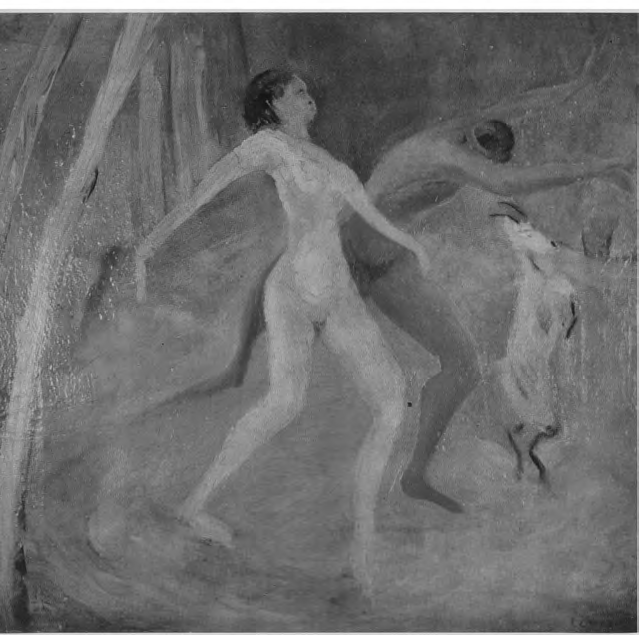
Although biographer David Ellis does not connect the painting to either the novella or to Lawrence’s developing notion of fourth-dimensional prose, he wisely notes the relation of time, movement, and stasis to the painting’s distorted figures: “The naked man and woman are deliberately thin and elongated (the man’s left leg tapering into infinity) in order to suggest vivacious movement” (459). I would add several points. The woman’s left leg also disappears into the hazy swirls of time, with the vivacity of movement and its stalled component indicated by the melting liquidity of both legs—an oddity that approximates aspects of Lawrence’s image of the forging flow. The specter of that Pan-goat lurking in the background is perhaps suggestive of the woman’s instinctual thrall; she resembles Cynthia Asquith, and the man reminds us of D.H. Lawrence in body type and facial elements.16 In that formative scene of fortune-telling, Lawrence employs a narrative style that precisely reproduces the fourth-dimensional effect of the Dance Sketch painting. The gipsy’s gaze forges the soul in her body and melts that hardness that shields her virgin state: “Something hard inside her met his stare. But the surface of her body seemed to turn to water” (24). Then begins that hypnotic emphasis on pause and duration that comprises the central principle of choreographic integration in the scene. As she follows the gipsy woman up the steps of the caravan, Yvette remains “naïve” (Lawrence’s pointed term) about a temporal state that is not obedient to conventional clock-time, as she ingenuously predicts to her friends that she won’t “be long” (24). While her fortune is being told, “it was a long time to wait the others felt” (24); her friends interpret the passage of time in consecutive elapsed moments that do not account for the immersive experience of Yvette in the depths of time. As she emerges from her uncanny experience, she is described as having “witch-like slim legs” (25), a verbal snapshot that again recalls the radically tapered leg in the painting. She seems dazed as she addresses the group through a phrasing that by now serves as a choric echo: “Did it seem long?” (25) Such a question signifies her gradual emergence from the dream-trance initiated by the gipsy and then augmented and deepened through her experience in the caravan.
X
This insistent pattern of Yvette’s “soft, vague waywardness” (25) in the scene prepares for the reappearance of similar phrases and metaphors in several meetings with the gipsy. The first occurs when he stops by the Saywell home to peddle his wares. He is described in terms that recall Yvette’s demeanor in the earlier scene, for he appears “as if in a kind of dream, swinging alone. It was like something seen in a sleep” (36). There is no refracted perspective here, no attempt to project Yvette’s perception of his movements or his emotional state. The novella insists that this view of the gipsy encapsulates his characteristic state of being, his “into-oneself ” existential posture. Indeed, he exists perpetually in the confident drowse of instinctual primacy; as more symbol than person, it is not surprising that he lacks a name until the last words of the work. Within the stipulations of Lawrence’s doctrine, he can invoke power over vulnerable but secretly receptive women like Yvette. His effect on her is not a summoning of erotic response but a transformation, as in a fairy tale, in which “her tender face seemed to go into a sleep” (37).
After the gipsy departs, the propensity in Yvette for this dream-sleep is more explicitly connected to her moments of a dementalized state of being; that is, her primary consciousness as a “Lawrencian” woman is not rooted in easy obedience to the socially conditioned and conventional materiality in the world; she emanates, in contrast, a fundamental receptivity to sensate experience that can attain the swoon of transcendence. She is “lost” in the very manner that for Lawrence means finding oneself. Recall again those evocative lines that denote the extent of Yvette’s lack of standard indications of location and feeling: “There was something strange and mazy, like having cobwebs over one’s face, about Yvette’s vague blitheness[ . . . ]It was like walking in one of those autumn mists, when gossamer strands blow over your face. You don’t know where you are” (38). Gradually Yvette begins to comprehend—“in [her] blood and [her] bones” (“Art and Morality” 167)—the special qualities of the gipsy, as well his effect on her. No more a victim of the petty morality of her family, or the politically correct assumptions of her community, but now alert to the penetrating gaze from the gipsy that gives her a “feeling that she had been looked upon, not from the outside, but from her secret female self,” and aware that the gipsy had “seen none of her pretty face and her pretty ways, but just the dark, tremulous, potent secret of her virginity” (39). “Virginity” as “potent” sounds oxymoronic, and such a synthesis of innocence and power will function as a major theme in the work. It also offers further suggestions about Lawrence’s own preoccupation with his impotence and his creative energy.
In their third meeting Yvette goes on her own to the gipsy encampment—a visit she undertakes alone as an aggressive attempt to encounter him again. The most important scene in the novella, it functions as a tour de force of Lawrence’s narrative technique. It carefully establishes the innovative verbal realm of the fourth dimension by manipulating, or bending, the usual parameters of time and space in fiction. Lawrence employs an integrated pattern of repetition and the frictive to-and-fro rhythm he described several years earlier in the Foreword to Women in Love. The break-through here for this writer is to wed the repetition to the theme of time in order to establish the hazy texture of a live dream. The words evocatively blur the distinction between slow-time and defined temporal duration as Lawrence employs dialogue that is staccato and restorative, and within narrative lines that are both metaphorically precise but indefinably abstract:
Yvette went to the fire to warm her hands.[ . . . ] Yvette crouched in silence, warming her hands.[ . . . ] “You said you’d be here on Fridays,” she said, “so I came this way as it was so fine.” “Very fine day!” said the gipsy[ . . . ] “My hands!” she said, clasping them nervously. “You didn’t wear gloves?” “I did, but they weren’t much good.” “Cold comes through,” he said[ . . . ] “You want to come up and wash your hands?” he said[ . . . ] Vaguely, as in a dream, she received from him the cup of coffee[ . . . ]On her face was that tender lack of sleep, which a nodding flower has, when it is full out[ . . . ]the waking sleep of its brief blossoming. The waking sleep of her full-opened virginity . . . “You want to go in my caravan now, and wash your hands?” (44,45,46,47, my ellipses)
The lulling repetition of phrases creates the texture of “the waking sleep” described in the passage. The seductive and reiterative question to Yvette—she senses what “washing hands” really portends—and the image of her flower-like readiness may briefly titillate readers about a forthcoming sexual initiation.17 But Lawrence, in this one novella, is not concerned with the erotic potential of such an encounter. While the gipsy remains aware of Yvette’s sensual appeal, he is no crafty and relentless seducer. Note that relevant touch of humane awareness in him that seeks to protect Yvette from even the appearance of impropriety: as they are about to enter the caravan, he tells her that “you want to put your hat on” (47)—an acknowledgement that he hears a car approaching the encampment. The warning breaks that spell of her live-dream, and she returns home with a hint of the deeper realms of her consciousness. Her brief foray into the realm of the fourth dimension has not been in vain.18 As Yvette becomes more attracted to the superficial charisma of Eastwood and Fawcett, she not surprisingly overrates their apparent freedom and their exuberant energy. Compared to the anger and stringencies she endures at home, this agreeable couple represents to her an unforeseen species of rebellion and romance. The dream-effect of the gipsy soon begins to fade in his absence, a diminishment of his power over her that Lawrence presciently qualifies by asserting that he still lingers in “some hidden part of herself which she denied: that part which mysteriously and unconfessedly responded to him” (54). The essence of Lawrence’s criticism of Fawcett and Eastwood consists of their inability to seriously engage the incarnate spirit of life; that is, they seem unable to believe in any notion of transcendence, for they are blithely involved in the earth-bound dimensions of Eastwood’s love of leisure and Fawcett’s fondness for material objects. They remain so eminently modern and so contentedly disconnected to the usual obligations of family and vocation. Lawrence displays the rare gift in a writer that can make a couple somehow appear charming but also boring and inconsequential. The attractive and intelligent Major can sense the special character of the gipsy but remains ignorant of the stagnant nature of his own existence; he embodies a profoundly un-Lawrencian and mechanical view of life with a too-confident query that directly connects to the theme of time in the novella: “Why shouldn’t my future be continuous days and tomorrows?”19 Thus he lacks the ability to get beyond his coddled ego and his accustomed habits of self-satisfaction. He also carries with him a trendy edge of irritation about the world that camouflages his spiritual emptiness, and Lawrence cannot resist the opportunity for an intrusive putdown within the context of a major metaphor in the novella: “His anger was of the soft snowy sort, which comfortably muffles the soul” (56).
XI
Eastwood’s contentment with the diurnal progress of time contrasts with Yvette’s instinctual insight about the gipsy’s rescue of the Major in the war. Eastwood believes the incident was occasioned “by accident,” and Yvette disagrees, remarking that “it might be destiny” (58). In her affirmation of the provenance of a fated future—in Lawrencian terms, her belief in fourth-dimensional time and in Mailer’s terms the faith in the “connection of new circuits” (375)—she has allied herself with the writer’s emphatic vision that extolls the renewing power of temporal states to interrupt and defy normative chronology. Lawrence insists that it is unfortunately integral to modern life that time speeds forward through its repetitive patterns of events and experience. He conveys his indictment in The Virgin and the Gipsy in a manner that is integrated within the plot, metaphors, and doctrine of the work. When Yvette returns to her old life and the instinctual flow seems blocked again, she remains cut off from the gipsy except for that carefully worded and brief reminder of him that I quoted earlier. In the context of Lawrence’s influence on Mailer, it is worth quoting once more, for it embodies the central concept of this work: “She did not forget the gipsy entirely. But she had no time for him.[ . . . ]Time being only the current of the soul in its flow” (64). Thus, time here is configured as a “heated” and instinctual awareness perceived in and represented by the soul. When the soul remains isolate, hard, or cold (i.e., not inflow, not “melting”), it is measured by the mechanical passage of hours that preclude the transcendent connection that Lawrence extolls.
Yvette sees him briefly from the window when he comes again to the house “with things to sell” (64). Although they do not meet during this visit, their intense connection still exists, for “he knew she saw him” (64). She begins to ponder his appeal in more probing terms, and she realizes that “she liked that mysterious endurance in him, which endures in opposition, without any idea of victory” (64). His is the stance of a silent and inner confidence, of reliable intuition—an “opposition” that contrasts dramatically with the moral hypocrisy of her family and the self-congratulatory life of Eastwood and Fawcett. She also ponders the immature and capitulative view of marriage articulated by Lucille, as her sister argues that she is “not sure one shouldn’t have one’s fling till one is twenty-six, and then give in, and marry” (65). Yvette feels that in her life, “the fling meant at the moment, the gipsy” (65). On this possibility she cannot take the initiative, and he remains cautious about her vulnerable emotions and community standing. He will not seek her out.
The next time they meet is by accident (or destiny!) as she rides her bicycle and not-so-randomly encounters him with his cart. This brief encounter begins with some of the most quietly sensual lines Lawrence ever writes. Her observation is framed in slow-time to capture the details she enumerates:
As she saw him, she loved him with curious tenderness the slim lines of his body, in the green jersey, the turn of his silent face. She felt she knew him better than she knew anybody on earth, even Lucille, and she belonged to him, in some way, for ever. (65)
In two years, it could be Lady Chatterley watching Mellors—except Connie is no virgin and well knows the sexual capacities of men. But in this livid moment of Yvette’s instinctual “knowing,” the erotic elements are implied but still unknown to the inexperienced woman. Even for the gipsy, “the desire was still there, still curious and naked, in his eyes. But it was more remote, the boldness was diminished” (65). So the novella again takes us to the proximity of sexual consummation, but it will always back off. As a form of fairy-tale, explicitness is not part of the genre. It waits for destiny to bring them together again.
The gipsy explains the woman’s dream to Yvette, with its advice for her to trust the impulses of her heart and body, and to listen for “the voice of water” (66). As they part and he asks her if she will be “coming up to the Head” any more, her wistful and reiterated answer links directly to the time-bending element inherent in fortune-telling and to the realm of the fourth dimension in the novella: “‘Perhaps I will,’ she said, ‘some time. Some time’” (66). The “time” is as appropriately unspecified as the lack of precise context for the gipsy woman’s prediction about water. The image of Yvette just before the flood places her partly in the world of instinct and dream time, and partly in league with the world of the quasi-glamourous couple. The dichotomy functions as persuasive psychological realism that prepares for the more definitive and earth-shaking event to come: “She stayed in the garden by the river, half dreamy, expecting something.[ . . . ]Her soul had the half painful, half easing knack of leaving her[ . . . ]Some days she was all the time in spirit with the Eastwoods” (67, 68 my emphasis).
It will take a natural calamity to let the flow run freely, and Lawrence organizes the conclusion of this work so that the “unleashing” of her soul will correspond with the breaking of the dam. It is important that in the moment before the flood, her soul has resolved the divided soul as it more distinctly flows toward the gipsy: “For this afternoon, she felt intensely that that was home for her; the gipsy camp, the fire, the stool, the man with the hammer, the old crone” (68). Recall the disparate lists of objects and people subsumed within the stipulated parameters of Lawrence’s description of the fourth dimension. Yvette is now primed for immersion into that dimension beyond conventional time; her instincts have already created a design that works for her, one that reveals “a recognition of the relation between various things, various elements in the creative flux” (“Art and Morality” 167). Yvette’s awareness of the interrelationship now comes naturally to her—neither rehearsed nor over-calculated. Lawrence’s coordination of Yvette’s insight, relevant doctrine, and plot development is impressive: “You can’t invent a design. You recognize it, in the fourth dimension. That is, with your blood and your bones” (“Art and Morality” 167). She has established a species of renewal for herself, even before the climactic meeting with the gipsy, and within the context of the Lawrencian ideology that organizes the novella. As the gipsy drags her to escape the tidal flow of water, the irony is that Yvette’s soul now moves in synchrony with the flood: she “was barely conscious: as if the flood was in her soul” (69). Her desperate struggles up and down in the water recall “The Horse Dealer’s Daughter,” but in this novella, the emphasis is less on Yvette’s transformation than on a condition beyond the delineation of time: “With a ghastly sickness, like a dream, she struggled [. . .] Blind, unconscious of everything [. . .] in a state of unconsciousness [. . .] in blind unconscious frenzy” (71–72). Lawrence remains admirably consistent in his texturing of The Virgin and the Gipsy when he draws that diplomatic curtain between their attic nakedness and the voyeuristic urge to examine their intimate hours together. But there is no sex between them—it would be neither appropriate to their mood nor desired by them within the exigencies of warmth, rest, and survival. The fourth-dimensional sleep that they enter, as the flux of life literally swirls between them, is sufficient testament to the unity of Lawrence’s vision and to the legitimacy of their nuanced attachment to each other.
XII
Lawrence also wisely does not offer much “visualized” time about the hours in the attic, or any precise sense of the duration of the scene. Those elapsed and undefined hours of refuge have less to do with the clock-world of ego than with inchoate experience of infinite time and space described by Ouspensky. The discussion by Lawrence in “Morality and the Novel” of his attempt to capture personal vision in a painting is useful for understanding the lack of comment about the lovers’ grateful sleep: “The vision on canvas exists only in the much-debated fourth dimension. In dimensional space it has no existence” (171). The restrained and cadenced description of their passage into the uncharted arena of the fourth dimension further makes sense in Ouspensky’s view that the dimension involves “a new concept of time[ . . . ]Flashes of cosmic consciousness. The idea and sometimes the sensation of a living universe. A striving for the wondrous sensation of infinity” (Ouspensky 192, 198, quoted in Young 35). Such a sensation, Lawrence knows, requires a special kind of prose to reproduce its properties. Here the endless coiling of clauses in a single remarkable sentence finally slows the frantic rhythm of their escape with intertwining metaphors leading to a shorter sentence and producing a total calm, ushering them into the timeless state that is the aesthetic heart and soul of the novella:
And although his body, wrapped around her strange and lithe and powerful, like tentacles, rippled with shuddering as an electric current, still the rigid tension of the muscles that held her clenched steadied them both, and gradually the sickening violence of the shuddering caused by shock, abated in his body first, then in hers, and the warmth revived between them. And as it roused, their tortured, semi-conscious minds become unconscious, they passed away into sleep. (74)
Until the last line of the novella the gipsy is properly nameless, less of a developed character than an emblematic force, an inscrutable violator of Yvette’s routinized life and untouched soul. Whatever personalized element exists in The Virgin and the Gipsy is primarily restricted to those eccentric family members at the Saywell residence. As a strong but anonymous provider of the flame that forges a new consciousness in her, the gipsy’s symbolic function is anticipated in Lawrence’s essay, “The Novel”:
These wearisome sickening little personal novels. After all, they aren’t novels at all. In every great novel who is the hero all the time? Not any of the characters, but some unnamed flame between them all. [. . .] In the great novel, the felt but unknown flame stands behind all the characters, and in their word and gestures there is a flicker of the presence. If you are too personal, too human, the flicker fades out, leaving you with something awfully lifelike, and as lifeless as most people are. (182)
Lawrence’s most graphically detailed character in the work lacks even a flicker of flame—the Mater. The grotesque image of the drowned woman, “bob[bing] up, like a strange float, her face purple, her blind blue eyes bolting, spume hissing from her mouth” (71), first appears, in more generic form, also in “The Novel.” With karmic precision that essay prepares for the lyrical arrangement in the novella of moving stream, bloated morbidity, and living connection. Perhaps Lawrence writes the fiction to dramatize the essential components of the doctrine—the resemblance is that close: “For the relatedness and interrelatedness of all things flows and changes and trembles like a stream, and like a fish in the stream the characters in the novel swim and drift and float and turn belly-up when they’re dead” (185). Granny dies, in effect, inflated by ego, bluster, and water; she is “related” to no thing or person except through the beastly grasp of her petty power: “one old purple hand cleaved at a bannister rail” (71). Now the raging stream carries her away—a woman inert, discolored, and self-contained as a balloon.
A final word on the novella, on the contemporaneous essays, and their relevance to Lawrence’s life. What of that presumed lack of sex between the willing virgin and the experienced gipsy in that private attic haven? Even accepting the imperative for survival that prevails over the temptation of eros, and even granting the elemental symbolic function of the gipsy’s persona, it is difficult to be convinced about the self-discipline of their chaste interlude between deluge and daylight. Such intimate proximity, such confirmed desire, such passionate potential! Might Lawrence, in the interest of his readers’ need for verisimilitude and amorous conclusion, offer them a more torrid performance? For the impotent writer in 1926, a man returning to the craft of fiction but unready to write his magnum-phallic-opus, Lady Chatterley’s Lover, a man past the cul de sac of The Plumed Serpent but not yet convinced of a new visionary direction—for this recuperating and committed man, compromised lover, and embattled artist, is it not understandable for him to insist that a sensual and intimate closeness can rival the penetrating heat of lust?
Sex is flame, too, the novel announces. Flame burning against every absolute, even against the phallic. For sex is so much more than phallic and so much deeper than functional desire. The flame of sex singes your absolute and cruelly scorches your ego. (“The Novel” 181)
In “The Novel and the Feelings” Lawrence urges a yielding to the innermost “honorable beasts that call in the dark paths of the veins of our body” (205). Joe Boswell and his creator are mature enough to understand that sex is so much more than phallic. In letting Yvette sleep they may have set her free to grow. The beast here is truly honorable, and she has been scorched.20
Cushman’s essay remains the most comprehensive discussion of the continuities and contrasts between the two works. But as my comments below (see note 11) indicate, his demeaning dismissal of key aspects of Lawrence’s technique and vision in the novella does not do justice to Lawrence’s significant achievement. While Leavis, Moynahan, Humma, Siegel, and Turner all state relevant issues of comparison as Lawrence moves from The Virgin and the Gipsy to Lady Chatterley’s Lover, these critics also establish a distinct appreciation for the excellence of this novella, and thus they avoid the reductive nature of Cushman’s evaluation.↩︎
In his incisive remarks (147) about the “spurious hygiene of life” at the rectory, and the pervasive antinomy of cleanliness and dirt, Turner describes a compelling pattern of counterpoint in the novella that anticipates aspects of Humma’s focus on dichotomies in the text. Siegel also writes intelligently about the essential contrast between “openness and enclosure” that Lawrence uses to structure the work (177).↩︎
I must acknowledge here my indebtedness for the relevant dates to the meticulous chronological account provided by Bruce Steele in Study of Thomas Hardy and Other Essays.↩︎
In this provocative context of the intersection of art and biography, Turner quotes an alleged remark from Lawrence to Jessie Chambers about George Borrow, in which Lawrence approvingly describes him as a writer who “so skillfully blended autobiography and fiction that no one could tell where one left off and the other began” (Turner 142, from Moore 81). It is not surprising that such a comment intrigues me. Much of my recent book, D.H.Lawrence and The Marriage Matrix, is invested in illuminating within Lawrence’s works the revealing strands of psychobiography that he candidly extolls as intrinsic and effective in Borrow’s writing. Indeed, the echoes of such a bio-literary form of synergy exist for Lawrence in many forms—some of them speculative and haunting. For instance, in terms of Frieda’s lamentation (already quoted) about the dire prognosis offered by Dr. Uhlfelder, the sad tone of her concern sounds eerily similar to the urgent and maternal emotions Gertrude expresses in Sons and Lovers when Paul falls deathly ill with pneumonia—which, of course must resemble the words of Lydia Lawrence about her son’s actual illness, which further suggests the elements of control and command so central in Lydia’s own personality that are also prominent in Lawrence’s wife. This notorious and interweaving triad of maternal-oedipal-and-marital becomes endless in its speculative possibilities in the work of many writers, but the open book of Lawrence’s life and artistic obsessions inevitably invites considerable attention.↩︎
See Ellis 164, 294, and Chapter Five in The Marriage Matrix for more on issues of Lawrence’s sexual capacity. For a skeptical response to allegations of his impotence during this period, see Worthen 338, 482.↩︎
The subject of Lawrence’s possible impotence in the mid-1920s has a long history of commentary by biographers and critics even before the appearance of the Cambridge biographies. Among the friends and colleagues of Harry T. Moore in the 1940s and 1950s is E.W. Tedlock, the Lawrence scholar who establishes a close personal relationship with Frieda Lawrence Ravagli, who generously assists Tedlock in the preparation in 1948 of one of the earliest annotated bibliographies of Lawrence manuscripts. I cite these connections to introduce some additional support for Spilka’s confidence in Moore’s story about Lawrence’s alleged impotence. Here is the relevant—and perhaps coded passage—by the notoriously discrete Tedlock; his comments concern Lawrence’s stay in Italy just after he wrote The Virgin and the Gipsy. Tedlock’s metaphors of season and weather perhaps offer a diplomatic and indirect way for this critic to share intimate information—no doubt received through his lengthy and scrupulously private association with Frieda—about the frustrations of her sex life with Lawrence: Ironically, in the Italy of his sun-symbol of vital renewal, the season was often rainy. Once, out of its denial of his need, he dreamed of a flood back in New Mexico in which his horse was drowned and he was able to find only a “bunch of rather weird, rather horrible pintos.” He had never known a spring so impotent as that of 1926, when after five days of sun, the weather reverted to gray and wet. February was the bad month for him to get through to the resurrection of spring. For a man who had lived intimately with his disintegration and death from childhood, and had felt at times a desire to lapse into them, what was now going on was a newly crucial contest for life. (Tedlock 95, my emphasis).↩︎
I elaborate in considerably more detail on the significance of this forging metaphor and its variant representations in Lawrence’s work, in Chapters One, Two, and Five in The Phallic Imagination.↩︎
Even more than sixty years after its publication, Spilka’s discussion in The Love Ethic of D.H. Lawrence of the techniques and doctrinal centrality of “communion” scenes in Lawrence’s work remains unparalleled in its clarity and uncommon understanding of the writer’s vision (8–31). See also aspects of Spilka’s notion of a “fourth dimension” in The Rainbow that can apply to my own reading of The Virgin and the Gipsy: “he is dealing with a vague and nourishing force or flow which occurs in time” (18, Spilka’s emphasis).↩︎
For more on the relevant chronology and context of the start of Frieda’s affair with Ravagli, see Ellis 290–296, and Squiers and Talbot 312–314, 329, 339, 347–348.↩︎
Ellis’s title for the third volume of the Cambridge biography is derived from resonant phrasing used by Lawrence in a letter to Gertie Cooper on January 23, 1927 (Letters V 632).↩︎
Cushman maintains that “the portrayal of the spell the gipsy casts over Yvette is highly unconvincing, not to say laughable,” and he reduces the characterization of the gipsy merely to the status of “an unadulterated embodiment of machismo” (165, 164). But such “machismo” is certainly “adulterated” by evidence of the gipsy’s caution, sensitivity, insight, and troubled past. Cushman’s harsh assertion is only justified if the relationship between Yvette and the gipsy is subject to the conventional strictures of a narrative realism that the critic otherwise suggests in his essay is not the essential tenor or intent of the work. Cushman also correctly notes that “when Yvette sees him, she melts” (164), but he does nothing with that wording’s seminal relation to the “forging” trope and the fourth-dimensional theme so crucial to the novella’s narrative technique. Carol Siegel, however, wisely does not find the attraction between them as unconvincing even in the real world of flirtation and desire. She stresses an important intuitive kinship—in my mind a species of “secret sharer”—that infuses the relationship: Yvette “sees in his defiant, outcast posturing, and even in the free sway of his hips, her own kind of strength and understanding” (178). Such an observation provides a persuasive link to the mutuality of an attraction between them grounded in an intuitional alertness that even feels persuasive in the realm of psychological realism.↩︎
See especially Chapter Five in The Phallic Imagination for more on the many aspects of such influence.↩︎
Mailer writes a letter to me on Aug. 3, 1994, concerning my discussion of Lawrence’s novella in a considerably shorter version of this essay first delivered as a presentation at an International D.H. Lawrence Conference in Ottawa, Canada, and then published in a journal. In the letter, Mailer writes candidly about Lawrence’s pervasive influence on his own work and developing doctrines; more precisely, he considers my perception of the issue of time in The Virgin and the Gipsy. Note Mailer’s concluding remarks about the precocious sense of Lawrence’s eclectic awareness, as well as Mailer’s own intriguing prediction about the scientific basis of Lawrence’s visionary insight: I have to tell you that egocentrically, as I was reading [your essay] and came across Lawrence’s remark, “Time being, after all, only the current of the soul in its flow,” I was struck with how close that was to the end of The Deer Park and the remark, “Rather think of sex as time[…]” Now, mind you, Peter, I had never read The Virgin and the Gipsy. In college I was prodigiously influenced by Lady Chatterley, which I read in the Treasure Room at Widener—the only way to read it back in the early 40s!—and Sons and Lovers and The Rainbow. But that was all of Lawrence I read in college and never his short stories till years later and never The Virgin and the Gipsy at all. So when a paragraph or two later you chose the same quote from The Deer Park, I was truly struck with that, how much the spirit of Lawrence influenced me. Indeed, if I had more of a lyrical gift, I could have written that line: “. . . the current of the soul in its flow.” You know I suspect he’s scientifically correct and a hundred years from now [. . .] scientists will even begin to think that way; there are so many signs of it already.↩︎
While Cushman understands that the natural environment in the novella is far from pastoral, he fails to connect that insight to the entrenched sense of industrial blight that pervades the car-trip scene. Turner’s essay, however, illuminates the major critique of “industrial civilization” (141) that resonates throughout the work, and he effectively relates that important theme to relevant metaphors of cleanliness, disease, and dirt described above (see Note 2). Ruderman also is excellent on how Lawrence expresses his anger at the ravages of modern industry primarily through the proud independence and fearless otherness presented in the character of the gipsy, who is presented as a “possible source of personal and societal renewal” (125). The real value of Ruderman’s eclectic and comprehensive book resides in the penetrating way she interweaves culture, history, and metaphor throughout Lawrence’s art; her remarks on The Virgin and the Gipsy are especially notable in her understanding of the racial and social stereotypes that Lawrence both affirms and revises in his layered presentations of Mrs. Fawcett, Major Eastwood, and the gipsy.↩︎
The Explanatory Notes section of the Cambridge edition of the novella relevantly adds that Lawrence’s use of the “forelock” phrasing builds on its proverbial association to mean “bringing literal time as an excuse to frustrate an initiative” (262). Such an interpretation might also add, “to frustrate the instinctual primacy embedded in Lawrence’s concept of the fourth dimension.” The image additionally suggests the idea of tugging one’s forelock as a gesture of subservience: tugging time by the forelock shows it who’s boss!↩︎
In the interest of full disclosure, I used Dance Sketch as the cover illustration of The Phallic Imagination, but this essay provides an opportunity to discuss elements of its relevance to Lawrence’s visionary and aesthetic imagination.↩︎
The 1970 film version of The Virgin and the Gipsy, directed by Christopher Miles, grasps the significance of Lawrence’s fourth-dimensional treatment of time and instinct in this caravan scene. Miles portrays the couple in a necessarily hazy and fragmented scene of reiteration and recall; the interrupted present-time and repetitive dialogue work together to appropriately stop and deepen temporal sequences to establish the delicate mixture of caution and desire that informs their attraction to each other. The scene wisely blurs the line between dream and reality in focusing on the simmering emotions of Yvette. Miles’s understanding of the integrated elements of passion, fear, and opportunity in the scene suggests an appreciation of the visionary and artistic subtleties in the novella. Similarly, Turner’s essay intelligently documents aspects of Lawrence’s departure in the novella from nineteenth century and Victorian notions of narrative realism. But he never quite connects Lawrence’s technique and assumptions to his radical redefinition of fictional time in the construction and thematics of the work. Turner, for instance, asks rhetorically—in reference to the various “enclosures” that entrap the Saywell sisters—“What are the thresholds to be crossed” (150)? While Turner incisively discusses how they “feel themselves locked up in their lives” (150), the larger issue, encompassed but not addressed by his question, must engage how Lawrence defiantly “crosses” the customary “threshold” of three dimensions to provide a salutary direction for Yvette’s existential awakening and, ultimately, her escape.↩︎
The illustrious critic, the late M.H. Abrams, in a superb recent book about the significance and definition of “the fourth dimension” for a poem, describes that dimension as an awareness of “the physical aspect of language” (2). In that scene of the gipsy and Yvette exchanging dialogue before they almost enter the caravan—with all the stops, reiterations, pauses, and ellipses in the prose—Lawrence, in effect, is implementing Abrams’s view of the fourth dimension as “enunciating the great variety of speech sounds” (2) that are intrinsic to the work in question. Abrams’s emphasis is on how the fourth dimension both reflects and affects the sounds of reading aloud a poem; but the applicability of his insight to Lawrence’s narrative prose is evident when Abrams adds that fiction, like “all art forms, has a physical medium, a material body, which convey nonmaterial meanings” (2). Thus as a reader silently reads the respective scene in The Virgin and the Gipsy, the repetitive and fragmented sounds of the conversation echo in the mind to create the dream-ambience of the material scene that is crucial to the transformational significance of this auspicious meeting between the two characters.↩︎
In this regard, Turner has the Major just right: “He cannot turn his anger to creative account” (164). Ruderman is equally incisive on Mrs. Fawcett, seeing her as “a woman whose positive flouting of convention is countervailed by her cosmopolitanism and materialism” (60–61).↩︎
Critics are all over the place on the question of the success and significance of the final scene. Widmer oddly asserts that the novella “got surprisingly vague with the tabooed bedding-down scene” (197)—but any explicit passion would have been the real surprise given the development of the work. Siegel argues that we are left with Yvette as a woman who “cannot survive without her admirer” (11), as the critic insufficiently recognizes the strength and independence Yvette has achieved. Turner is excellent in his recognition that “the great climax to The Virgin and the Gipsy is not the physical but the spiritual embrace of that which had been taboo” (156). Ruderman hedges her bets: “Whether the rescue by the Gypsy marks a permanent change in Yvette’s life is an open question” (132), and Cushman dismisses its credibility entirely, calling it “a fairy-tale ending” (167). WORKS CITED Abrams, M.H. The Fourth Dimension of a Poem. New York: Norton, 2012. Balbert, Peter. D.H.Lawrence and The Marriage Matrix: Intertextual Adventures in Conflict, Renewal, and Transcendence. Newcastle upon Tyne: Cambridge Scholars, 2016. _____. D.H. Lawrence and the Phallic Imagination: Essays on Sexual Identity and Feminist Misreading. New York: St. Martin’s, 1989. Cushman, Keith. “The Virgin and the Gipsy and the Lady and the Game Keeper,” in D.H. Lawrence’s “Lady”: A New Look at Lady Chatterley’s Lover. Ed. Michael Squires and Dennis Jackson. Athens: U of Georgia P, 1985. 154–69. Daleski, H.M. The Forked Flame: A Study of D.H. Lawrence. Madison: U of Wisconsin P, rev. ed. 1987. Ellis, David. D.H. Lawrence: Dying Game, 1922–1930. Cambridge: Cambridge UP, 1988. Freud, Sigmund. “On Narcissism: An Introduction.” The Freud Reader. Ed. Peter Gay. New York: Norton, 1989, 545–562. _____. “On the Universal Tendency to Debasement in the Sphere of Love.” The Freud Reader. 394–400. Hough, Graham. The Dark Sun: A Study of D.H. Lawrence. New York: Capricorn, 1956. Humma, John. Metaphor and Meaning in D.H. Lawrence’s Later Novels. Columbia: U of Missouri P, 1990. Lawrence, D.H. “Art and Morality.” Study of Thomas Hardy and the Other Essays. Ed. Bruce Steele. Cambridge: Cambridge UP, 1985, 163–168. _____. “Blessed are the Powerful.” Reflections on the Death of a Porcupine and Other Essays. Ed. Michael Herbert. Cambridge: Cambridge UP, 319–328. _____. “The Crown.” Reflections on the Death of a Porcupine and Other Essays. 251–306. _____. The Letters of D.H. Lawrence, Volume V, March 1924–March 1927. Ed. James T. Boulton and Andrew Robertson. Cambridge Cambridge UP, 1989. _____. “Morality and the Novel.” Study of Thomas Hardy, 169–176. _____. “The Novel.” Study of Thomas Hardy, 177–190. _____. “The Novel and the Feelings.” Study of Thomas Hardy, 199–205. _____. The Virgin and the Gipsy and other Stories. Ed. Michael Herbert, Bethan Jones and Lindeth Vasey. Cambridge: Cambridge UP, 2005. _____. “Why the Novel Matters.” Study of Thomas Hardy, 191–198. Lawrence, Frieda. Not I, But the Wind. New York: Viking P, 1934. Leavis, F.R. D.H. Lawrence: Novelist. New York: Knopf, 1955. Mailer, Norman. The Deer Park. New York: Putnam, 1955. Meyers, Jeffrey, Ed. The Legacy of D.H. Lawrence. London: Macmillan, 1987. Moore, Harry T. The Priest of Love: A Life of D.H. Lawrence. New York: Farrar, rev. Ed. 1974. Moynahan, Julian. The Deed of Life: The Novels and Tales of D.H. Lawrence. Princeton: Princeton UP, 1963. Ouspensky, Peter A. Tertium Organum: A Key to the Enigmas of the Universe. 1911. Trans. Nicholas Bessaradoff and Claude Bragdon. New York: Random House, 1970. Ruderman, Judith. Race and Identity in D.H. Lawrence: Indians, Gypsies, and Jews. New York: Palgrave Macmillan, 2014. Siegel, Carol. Lawrence Among the Women: Wavering Boundaries in Women’s Literary traditions. Charlottesville: UP of Virginia, 1991. Spilka, Mark. The Love Ethic of D.H. Lawrence. Bloomington: Indiana UP, 1955. Squires, Michael and Talbot, Lynn K. Living at the Edge: A Biography of D.H. Lawrence and Frieda von Richthofen. Madison: U of Wisconsin P, 2002. Tedlock, E.W. D.H. Lawrence: Artist and Rebel. Albuquerque: U of New Mexico P, 1963. Turner, John. “Purity and Danger in D.H. Lawrence’s The Virgin and the Gipsy.” D.H. Lawrence’s Centenary Essays. Ed. Mara Kalnins. Bristol: Bristol Classical, 1986, 211–228. Widmer, Kingsley. The Art of Perversity: D. H. Lawrence’s Shorter Fictions. Seattle: U of Washington P, 1962. Young, Richard O. “Where Even the Trees Come and Go: D.H. Lawrence and the Fourth Dimension.” D.H. Lawrence Review 13 (1980), 30–44. Worthen, John. D.H. Lawrence: The Life of an Outsider. New York: Counterpoint, 2005.↩︎