The modern artist must live by craft and violence. His gods are violent gods.
—Ezra Pound
In 1971, Norman Mailer wrote about the state of current commercial and underground cinema and pointedly refers to the mainstream cinema’s glaring weakness: its template superficiality, studied realism, and lack of aesthetic experimentation when it comes to representing, to documenting, the intricate and lurid reality of social experience: “The contemporary film does not do enough, it does not give enough of a mirror to the complexity of our century. The production of the high-budget film is too massive to be sensitive” (460). For Mailer, the problem was selectively focused: “how to get a little of the real life—always complex—of a good actor into a film. That still remains the accident rather than the rule” (460). Among other criticisms, Mailer concludes that the current state of mainstream and even some experimental cinema was lacking in nuanced performance and was frequently an exercise in calculated realism propagated by economic concerns and the actor’s assumed emotions, presumptive posing, which vitiates the sense of existent social and political conditions. Mailer was not alone in this critical stance toward the ossified traditions of Old Hollywood.
In 1971, Peter Gidal cites experimental filmmaker Andy Warhol’s view of cinematic and performance aesthetics, a position that invokes Mailer’s tone: “I [Warhol] leave the camera running until it runs out of film because that way I can catch people being themselves. It’s better to act naturally than to set up and act like someone else,” to which Gidal adds, “although judging from Warhol’s films, acting is part of being oneself ” (101, author’s emphasis). To be oneself is to perform oneself, like Warhol’s “stars” Brigid Berin and Gerald Malanga in Chelsea Girls (1966), and these actors do not emote in an essence driven, psychologically motivated, classic Actors Studio sense. Performers mindfully play at but do not become the part. Actors reveal themselves as characters—however directionless, absurd, even boring the unfolding plot-scenario, technically obtuse or visually weird the production—to the discerning audience. Norman Mailer, writer, director, and actor, also experimented with the space and time of the cinematic real in a manner similar to Andy Warhol’s films produced in the 1960s-1970s, and, according to Gary Rhodes, “Rather than the medium being the message, Mailer’s message was to disrupt the medium, to disrupt the complacency of the film audience with what it sees and hears . . . [It was a] Leviathan thesis” (574). It is a thesis with several compelling chapters.
Perhaps the single most remarkable quality of Norman Mailer’s experiment in promiscuous auteurship, Wild 90 (1967), his initial foray into filmmaking, is its improvisational tone infused with a generic hybridity, in which an essentially untraditional gangster narrative alienates while it fascinates the audience. We are not exactly sure what it is we are seeing, or hearing, or even thinking, but Wild 90 achieves a classificatory status, fifty years after its debut, which I will argue places it alongside both mainstream gangster films as well as the experimental narratives of the American cinema of its era, especially Andy Warhol’s Vinyl (1965) and D.A. Pennebacker’s Don’t Look Back (1967).
Wild 90 is not a gangster film full of reliable generic tropes; it is a playful reassertion of gangsterism, a dress-up decoy, full of fragmented thoughts and sentences, acts of drunken declamation, and general states of decline, as revealed in violent men’s eyes. Perhaps it is difficult to literally hear and follow what characters say to each other and the audience in Wild 90 because of technical, production limitations, but it does not matter what the actors are specifically communicating. The unscripted dialogue possesses a measured yet directionless presence, like the characters themselves. According to film editor, Jan Welt, “the sound was our Achilles’ heel . . . [when the sound was mixed down to an optical track] it left us with an inaudible mess” (Chaiken 510). However muffled, in Wild 90, the dialogue reveals the actor-character’s “take” on the gangster in the moment. These factors contribute to the film’s sense of interpretive realism as a playful reassertion of generic-based identity.
Shot by famed documentarian D.A. Pennabacker, Wild 90, Mailer’s improvisational fiction in documentary form, belies cataloguing along familiar generic lines:
We shot four or five hours every night for four nights, never doing retakes, never doing retakes—for that would have gummed the experience on which we were building. . . . obscenity pops from every pore of Wild 90. It evolved from the foulest-mouthed movie ever made, and is thus vastly contemporary and profoundly underground. (Mailer 468)
One must note the dynamic contribution made by the cinematographer D.A. Pennebacker to Mailer’s films.1 Wild 90 is a creative collaboration that recalls the experimental narratives of Andy Warhol and director-cinematographer Paul Morrissey produced in the 1960s through the 1970s.2 Wild 90 should be read alongside other 1960s underground films as part of the independent production tradition of the experimental American cinema. Specifically, in Wild 90 (and occasionally, in Pennebacker’s documentary about folksinger Bob Dylan’s tour, Don’t Look Back), there is a preponderance of extreme, tightly composed close up shots; shooting in real time, vérité style dictates the order of events; the pan and zoom motion of the hand-held camera is extensively deployed; the neo-realistic long takes extend over real space and time; and the editing is artfully unpredictable. In Wild 90, likely due to economic-production limitations, the lighting is frequently overly lit or too dark and the live sound recording, despite its mixing, strains credibility for some.
Despite these cited production strengths and weaknesses, Wild 90 is seductively unsettling while engaging, and these same distancing effects are regularly cited as aesthetic highpoints in Warhol films of that era. Peter Gidal notes that “Warhol’s early film work can be defined as boring or exciting, depending on one’s attitude, and then, in turn, the ‘boredom’ can be defined as positive or negative” (86). Gidal adds this overview of Warhol’s cinema, which is applicable to Mailer’s experimental technique: “the early films integrate the subjective and the clinical . . . Gestural super-reality converges with overtones of dada-absurdity . . . One’s concentration is forced into a different focus” (92–102). One reads and then rereads the contemplative narrative.
In Stephen Koch’s comprehensive study of Warhol’s cinema, Stargazer, Koch examines Warhol’s Vinyl, the adaptation of the Anthony Burgess novel A Clockwork Orange; the parallels between Warhol and Mailer’s experimental cinema, especially Wild 90, are neither facile nor overlooked: “Warhol was impressed by A Clockwork Orange . . . The book is filled with the sexuality of violence . . . Throughout his late [film] work, Warhol is fascinated by the tough male illiterate” (Koch 69). Mailer’s film, like Warhol’s experimental adaptation, reeks with explosive male posturing and symbolic phallic preening. Later describing the atmosphere in Warhol’s Factory surrounding the production of Vinyl, Koch writes: “The sense that making a film was work—was utterly banished” (70), and although the film was scripted by Warhol collaborator Ronald Tavel, who wanted the material fully rehearsed before shooting, Warhol had other ideas about the extemporaneity of performance and tone:
Warhol did not want the script to be rehearsed . . . he insisted upon interrupting and disrupting rehearsals . . . There is no way that Warhol would allow his deep fascination with these subjects [male violence] to turn into something unequivocally felt and real on the screen. For all its fistfights, arm-twisting, groveling, whining, sneering, for all its he-men pilloried and tortured, Vinyl is silly with the look of farcical cornball amateurism . . . The film is laughingly self-indulgent with its subject . . . And yet, there is something deadly serious about it all . . . The struggle of Vinyl’s static pictorialism with movement is ideally viewed through a distracted awareness. One does not directly watch the film, but rather, one looks at it and then looks away again. (70–74)
Both Vinyl and Wild 90 conspicuously adhere to this paradoxical overview; each film is an experiment in the spontaneity of production and performance, an aesthetic contemplation of processed male violence, full of humorous posing.
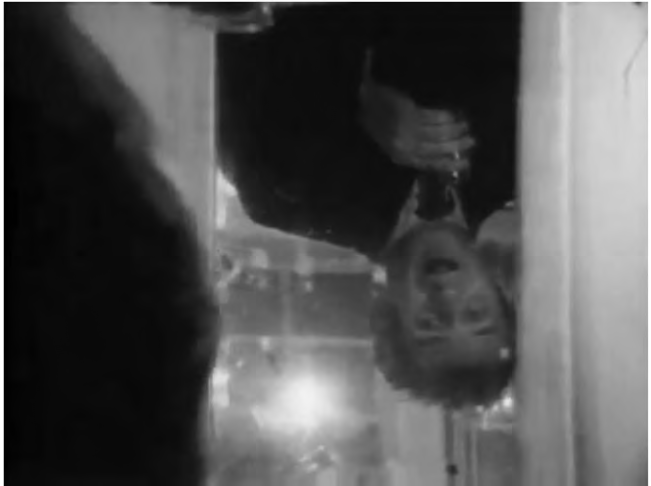
Wild 90, fueled by an alcohol-driven urgency, is shot in real time and fundamentally plot-less, an improvisational struggle to cohere as it is infused with gangster clichés, serious comedy, and especially, distancing precepts, which collectively defamiliarize the standards of the real, the space and time of the commercial film gangster. Instead, Wild 90 suggests meaningful interpretation. The three principle actors, with ridiculous sounding street-names, pretend to be gangsters, with playful props like pistols and machine guns, but they do not become film gangsters. In Wild 90, the audience follows the men and plot in places, always looking for a way inside the narrative, which is Mailer’s ideal as director/actor/author:
The underground movie tends . . . to become an inside joke, and looks for playful situations or nightmares which members of the club can appreciate out of the focus of their own games. But the average underground film is not rushing to be a mirror of the time, just an amusement-park mirror. (Mailer 461)
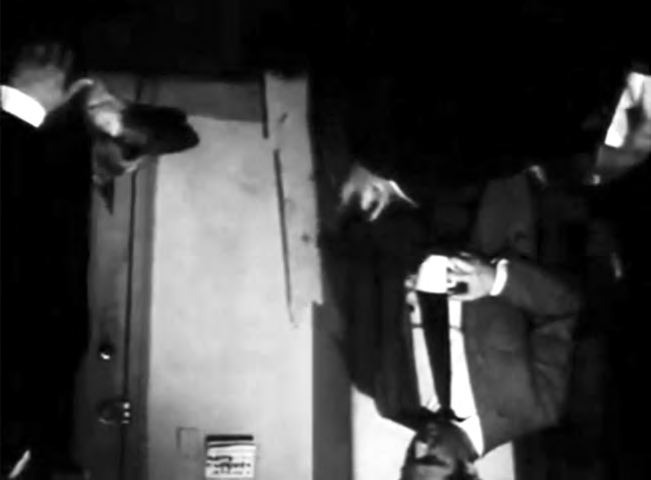
Wild 90 may be read as a slightly cracked reflecting mirror on the droll normalcy of a deglamorized gangster culture, like a “comedy of adopted manners” (Mailer 447). These three Brooklyn gangsters inhabit a secluded loft-like, pre-gentrified space through several nights, drinking and arguing about robbing a grocery store. Discussions of women and related topics of besotted concerns lapse into paroxysmal bouts of violence, while women, associates, police, and a barking dog visit the men. As noted by Nigel Leigh, “there is no script, the performances are impromptu and the plot is nothing more than a long obscene conversation between men. . . . In the most noteworthy section of Wild 90 . . . Mailer has a barking contest with his dog” (400).3 The dog genuinely merits a credit listing. This shot sequence, between Mailer-as-gangster and an enraged German shepherd is a dramatic highpoint, a moment of absurdly inflected realism. I think of old men in public parks who yell at pigeons and crying infants.
Basically, with the exception of visits from women, local friends, and officials, little happens to advance the narrative beyond this canine highpoint; we are still waiting for Godot’s universe to reveal a plan. In Wild 90, Mailer’s unscripted musings credibly serve as a prefatory notice to Tarantino’s engaging yet scripted male repartee in his gangster narratives, especially Reservoir Dogs (1992) and Pulp Fiction (1994). Wild 90 is a study in the insipidity of violence and its anti-heroic males, abusive, humorous, parodies of character: “Undoubtedly Mailer is trying for a new kind of realism, something more truthful than the mainstream cinema . . . his films become entangled in their own poetic conceptions” (Leigh 401). Mailer’s innovative praxis involves a comical clash of personalities that mandates the audience question the space and time of the real. Like Pinter’s witless gangsters in his play, The Dumb Waiter (1957), Mailer’s gangsters seem to exist elsewhere, in a comically obscene universe, and Mailer’s own assessment of Wild 90 insightfully incorporates both film and social history: “there are times when Wild 90 seems close to nothing so much as the Marx Brothers doing improvisations on Little Caesar with the addition of a free run of obscenity equal to Naked Lunch or Why Are We in Vietnam?” (447).
In The Fascination of Film Violence, Henry Bacon states, “the beginning of ultra violence in Hollywood cinema is quite clearly marked” (97), asserting that this representational shift occurred during the 1960s.4 Consider that in 1967, a unique year for American violence both nationally and internationally (the Detroit race riots, the Vietnam War), two commercially released gangster films, Bonnie and Clyde (dir. Arthur Penn) and The St. Valentine’s Day Massacre (dir. Roger Corman) are both historical revisions of similar generic configurations located in Wild 90: the heist/criminal plan, the interpersonal, power-driven dynamics, the compulsion-expression of fierce outbursts, and especially, the sense of the playful, contemporary performance.
According to Brian Faucette, “what was often lacking in the classical Hollywood period [the 1930s–1940s] was a realistic portrayal of the sexual tension and violence which men may be capable of enacting upon society, especially women”(75). Arguably, the revisionist phase of the gangster genre production should be enlarged to include experimental narratives such as Wild 90. When Faucette asserts that 1960s mainstream productions, such as The Rise and Fall of Legs Diamond (dir. Budd Boetticher 1960), Bonnie and Clyde, and The St. Valentine’s Day Massacre collectively suggest that “the gangster figure has never disappeared from the American consciousness” (76), then it is reasonable to classify Mailer’s experimental narrative as another generic permutation, however disruptively playful. According to Henry Bacon, there are technically innovative parallels between these mainstream gangster narratives:
The final scene of Bonnie and Clyde, in which the main couple are [sic] killed under machine gun fire, was a turning point. Multiple camera shooting, slow motion at different speeds, and effective editing created a tension . . . the result was horrifying but in some strange way . . . beautiful. The film did suit the counter culture of the 1960s. They [Bonnie and Clyde] were played by the gorgeous Faye Dunaway and Warren Beatty, and they were presented as charming, beautiful, and stylish . . . Doors had been opened to radically more explicit film violence. (98)
In the 1960s, commercial Hollywood cinema redeployed familiar generic formulae, with actors like Warren Beatty, Faye Dunaway, George Segal, and Jack Nicholson, who would dress, speak, and overall work at being 1920s-1930s gangsters, but the audience never lost sight of the performance aspect of their characterizations. If the aforementioned films revise notions of performance and visual propriety because of unsettling displays of violence, Mailer’s experimental production extends the parameters of realism further. Wild 90 assaults the audience with disruptive, fierce artfulness.
In Wild 90, Mailer and the Maf Boys (Mailer 451, emphasis added),5 improvise their way around the premise of gangster identity based on historical, local legends involving the Gallo Brothers-Mafia war in Red Hook, Brooklyn in the early 1960s, which led to the Gallo gang’s protracted hideaway.6 Mailer referred to the presence of thug folklore as an informing agency for his film: “We would rather take off from a contemporary piece of local history in Brooklyn . . . we would be our own three characters holed up in a loft . . . that would give us the situation on which we could improvise” (452–453).
In Wild 90, there is a palpable feeling of the performers’ self-awareness, and what the audience perceives involves, according to Mailer, “our idea of the Mob . . . it is a kind of psychological reality” (462–463). Mailer goes on to state that “in Wild 90 . . . we had no script to reduce us—we were able to play through a situation with our own wit rather than with somebody else’s” (467). Unlike the scripted improvisations of director John Cassavetes’ productions in the 1970s, such as his gangster film, The Killing of a Chinese
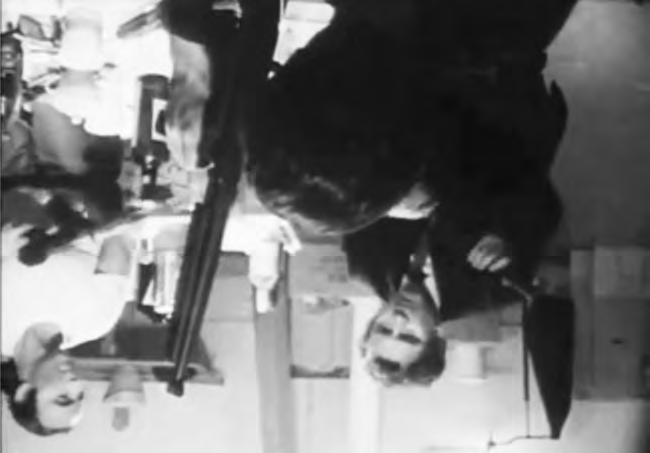
Bookie (1976), in which actors followed pre-set cues and scripted plot points, Mailer’s unscripted flow of charged, inebriated rhetoric is flamboyantly absurd, but not without a measure of preconceived context. Even when Mailer fractures the fourth wall at the end of the film and names the CIA as he addresses the camera, there is a playful dispensation afforded this rupture with tradition. This is Mailer being Mailer as he performs Mailer, and the meta-textual referencing persists. For the audience, Mailer was already a “star,” a social commodity:
One of the major functions of star performance is to make a particular kind of narrative economy possible . . . [an] extratextual signification he or she brings to it. . . . . The intertextuality of star performance is often directly acknowledged within texts. . . . Such meanings are found, not in the performance, but in the intertext—the collusion of performance, subsidiary texts, and audience knowledge. (Drake 88)
In Wild 90, one does not locate the classic gangster portrayal of tragic dispositions from the American cinema of the 1930s, or noirish sensibilities elicited from the 1940s-1950s cinema. Wild 90 features Mailer’s persona, his familiar and constructed “idiolect” (Drake 88), in performance. Wild 90 exhibits a generic hybridity, in its direct linkage with the experimental films produced in the 1960s and with commercial gangster film narratives. As Brian Faucette concludes his analysis of the revisionist, commercial gangster films produced in the 1960s, he states that they: “indicate how questions of masculinity and its importance on the fabric of American society were being interrogated by filmmakers as well as by the culture at large” (84–85). Mailer’s Wild 90, a largely unacknowledged experimental film, portrays the banter of the unfocused, violent male and belongs to—not apart from—the underground American film culture of the 1960s. Wild 90 should be read alongside the absurdly playful tone of Andy Warhol’s cinema, especially Vinyl, as well as D.A. Pennbacker’s technically arresting visual pyrotechnics in Don’t Look Back, but with Wild 90, one cannot mistake the machine guns, alcohol, and macho attitude: it is Norman Mailer, larger than screen life.
When folksinger Bob Dylan performs (not in the musical sense) as the “legend” of Bob Dylan, playing-acting as the slighted, difficult poet, as he argues with an annoying reporter in Pennebacker’s Don’t Look Back (1967), Dylan invokes the idea of Dylan, the “meta Dylan,” and all it signifies, which involves the performative nature of acting in the documentary film genre.↩︎
Pennebacker, a fine director in his own right, worked with Mailer once again as his collaborator-cinematographer in Beyond the Law (1968) and Maidstone (1970).↩︎
On page 300, Leigh cites Warhol’s film Kitchen (1963) as a particular inspiration to Mailer, especially in its use of slow-paced time.↩︎
Bacon refers to two other important films, which signify this cultural shift: Robert Aldrich’s WW2 epic, The Dirty Dozen (1967) and Sam Peckinpah’s revisionary Western, The Wild Bunch (1969).↩︎
It is interesting to note that in this article, Mailer refers to the Maf Boys as his response to Warhol’s film Chelsea Girls.↩︎
This era of Brooklyn folklore is dramatically represented in Crazy Joe (Lizzani 1974), a gangster biopic that merits rediscovery. Ironically, Joey Gallo himself was rumored to be performing Tommy Udo, the insane, vicious killer in Kiss of Death (Hathaway 1947) as a familiar means to intimidate people.↩︎
Works Cited
Bacon, Henry. The Fascination of Film Violence, New York: Palgrave Macmillan, 2015. Print.
Bonnie and Clyde. Directed by Arthur Penn. Warner Home Video, 2010.
Chaiken, Michael. “Editing Mailer: A Conversation With Jan Welt and Lana Jokel.” The Mailer Review, vol. 3, no. 1, Fall 2009, pp. 506–528. Print.
Don’t Look Back. Directed by D.A. Pennebacker. Docurama, 2000.
Drake, Phillip. “Reconceptualizing Screen Performance.” Journal of Film and Video, vol. 58, nos. 1–2, 2006, pp. 84–94. Print.
Faucette, Brian. “Interrogations of Masculinity: Violence and the Retro-Gangster Cycle of the 60s,” Atenea, vol. 28, no. 1, June 2008, pp. 75–86. Print.
Gidal, Peter. Andy Warhol: Films and Paintings. NY: E.P. Dutton and Co., 1971. Print.
The Killing of a Chinese Bookie. Directed by John Cassavetes. Sony Pictures Home Entertainment, 2010.
Koch, Stephen. Stargazer: The Life, World & Films of Andy Warhol. NY: Marion Boyars (revised edition), 1991. Print.
Leigh, Nigel. “Getting it Wrong: The Cinema of Norman Mailer.” Journal of American Studies, vol. 24, no. 3, 1990, pp. 399–402. Print.
Mailer, Norman. “Some Dirt in the Talk.” The Mailer Review, vol. 3, no. 1, Fall 2009, pp. 446–471. Print.
Rhodes, Gary D. “Commando Raids on the Nature of Reality.” The Mailer Review, vol. 3, no. 1, Fall 2009, pp. 570–581. Print.
The St. Valentine’s Day Massacre. Directed by Roger Corman. Twentieth Century Fox, 2006.
Vinyl. Directed by Andy Warhol. Rarovideo, 2013.
Wild 90. Directed by Norman Mailer. Cinemalta, 2007.