Since I began attending The Norman Mailer Society conference in 2006, I have been interested in two seemingly separate areas of teaching and scholarship. “Mailer Studies” in a traditional academic sense, and digital culture’s influence on the Humanities have been my primary research interests. While I have addressed both in conference presentations, journal articles, and course offerings, Phillip Sipiora’s 2012 paper on the “legacy power” of Norman Mailer inspired me to combine my two interests.
“Project Mailer” (PM), a Digital Humanities (DH) project that I outlined at the 2014 conference of the Norman Mailer Society, has begun modestly. This year has seen the start of The Mailer Review’s online presence; two informal sister publications: “Norman Mailer” and “Teaching Norman Mailer”; the NMS Podcast; a renewed emphasis on the Society’s social media presence; and (hopefully by the time you read this) the digital publication of the “Works” section of Norman Mailer: Works and Days. In addition, the Project Mailer web site has been designed to act as a hub to support new projects undertaken by the Mailer community. Two strategies provide the foundation for the design of PM: the project should be as future-proof as possible, that is employ the most current strategies for coding, digitization of artifacts, archiving, and accessing content, but it should also be simple and elegant, providing easy and unrestricted access to those who most need it. Therefore, it seemed the best way to approach the project was to employ a distributed DH model one that chooses the best platform for the content and makes that content the most accessible for the Society members.
Distributed DH: Theory and Praxis
“The street finds its own uses for things.”
—William Gibson, “Burning Chrome”
Michel de Certeau notes in The Practice of Everyday Life that inherent in the design of urban spaces is an imposed method of action structures that attempt to control behaviors. Sidewalks provide sanctioned places for walking, benches for sitting, offices for working, houses for living. Yet, everyday life often ignores the sidewalks and wears a dirt path through the grass symbolizing a tactical rebellion by citizens. When given sanctioned ways of behaving, people often rebel by creating their own paths to walk regardless of the original intent.
In the digital world, designers and systems architects often give us gadgets and platforms that attempt to direct how we work and play. Yet, unlike the concrete and glass of the urban landscape, the digital is much more malleable to the desires of users. The digital often provides a faster and more direct mode of feedback. Platform designers and their users have immediate means for feedback, response, and revision. There might even be a correlation between the success of a platform and how developers respond to user needs. In my experience, newer platforms are very interested in what users have to say, and they often show alacrity in implementing these suggestions. Users, therefore, have a say in how they want to work influencing platform development. However, once a platform reaches the stage of metonym, it changes the users, rather than users changing it. Think Google, Apple, Facebook with Instagram and Twitter on the rise. Even when Facebook makes an improvement to its platform, many users resist because they had gotten used to the older functionality.
This idea has made me rethink my approach to building DH projects. Why build from the ground up when pre-made platforms will likely do the work we need?
In a 2008 study that evaluates several DH projects, Claire Warwick, et al., note that users are influenced by “switching costs” and will resist learning a new interface even if it’s an improvement (389). They observe that the most well used DH projects are also the most long lived. There might be several reasons for this, but it may also have to do with platform programming users: since little option was available at the time, users learned an unfamiliar interface so they could access the information within. This way of working, while difficult at first, becomes comfortable to the users, so even when something better comes along, the costs of switching to the new way of working are perceived as too high. In other words: users will stick with systems they are used to even when an improvement is offered. For new projects, Warwick recommends a “simple, uncomplicated interface [over] resources that required significant effort to learn how to use” (390).
Or, perhaps, we should just use the platforms that we are already familiar with to avoid needless switching costs. What could be more simple than interfaces that are already part of our everyday lives, or those that take uncomplicated and elegant approaches in usability? What could be more simple than web-based apps and social media?
Distributing the load over ready-made platforms seems the best approach for Project Mailer to promote ease-of-use and accessibility. This approach leaves platform design to the professionals and allows us to choose the media that best suit our needs for shaping content.
A Medium for the Review—mailerreview.org
In my estimation, one of the most important elements of Project Mailer is digitizing The Mailer Review in a form that’s accessible, readable, open, and natively digital. The platform I chose for this is Medium. Medium is blogging all grown up, providing professional publication tools for communities of writers.
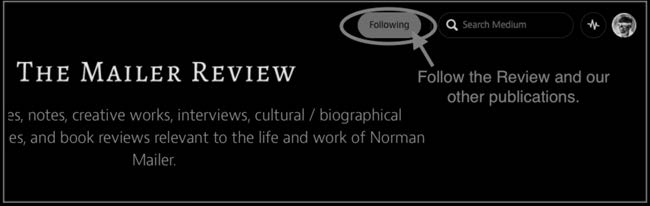
Currently, Medium is the one of the best reading and writing platforms on the web. It is accessible, employing a simple web-based interface that uses large, readable fonts and easy controls that do not appear until needed. It provides users elegant ways to publish, comment, and reply. Medium allows users to make “publications” that support multiple writers and editors. Soon, it should allow publications to use their own domain names. Medium offers powerful publishing tools for both professionals and amateurs, emphasizing community and participation. Users may also embed multimodal content with ease, and Medium’s style sheet displays this content in an aesthetically pleasing manner. With Medium’s Terms of Service, owners retain control and ownership of their content, and they give an easy way to backup and delete posts and accounts, if users so desire.
When I say that Medium is “open,” I do not necessarily mean free or nonproprietary. I mean accessible, in the way that social media is accessible: open to all and convenient for everyday use. Medium is open in the sense that anyone can make an account, publish, and participate easily and through a variety of devices. Currently, there is no cost to using the platform, even for professional organizations like The Norman Mailer Society. However, since it only launched in August 2012, it will likely need to earn revenue from its users, so it could begin charging for its services in the future. Still, I would suggest that these costs would be modest, especially when compared to print.
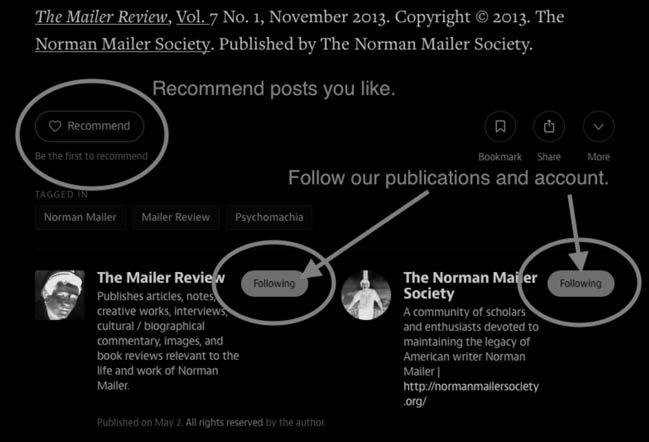
Another aspect of Medium that falls under “open” would be its emphasis on participation. Whereas print publications are static and flow from the top down, digital platforms offer users the opportunity to respond within the platform. Here, Medium excels by giving users the ability to comment, annotate, highlight, tweet, and recommend posts, subscribe to publications, write for publications, and respond to posts. These responses, then, become their own posts. The multiple venues for participation with content makes Medium an effective digital platform.
While the content of The Mailer Review is distributed electronically through EBSCO and therefore lives in a complicated database hierarchy behind discouraging paywalls, Medium allows us—the Mailer community—greater flexibility to publish and control our own content, giving access to everyone who so desires. Since Medium is currently free, we need not worry about revenues. That said, we could monetize links to Mailer’s books through Amazon, if we needed to. However, my first priority is not financial remuneration, but promoting Mailer’s legacy.
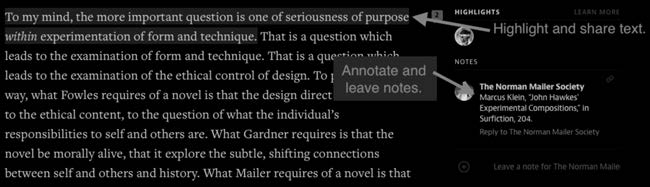
Another benefit of Medium allows us to publish the electronic version of the Review in a native digital format. This approach allows us to take advantage of the platform’s features and develop new approaches to endnotes, citations, and layout. Digital publications can link directly to works cited, embed video clips and images, annotate and highlight primary texts, and give both authors and publishers greater flexibility than paper. In other words: I see the digital Review eschewing those conventions of publishing on paper that no longer make sense and embracing new creative ways of publishing content that no other academic journals have yet done. What better way to celebrate the legacy of our namesake?
As of this writing, we have (re)published a couple dozen articles from the Review into digital form. Comments and participation are appreciated.
Participate on Medium
As it exists now, The Mailer Review should still be the Society’s primary publication in print. Let me strongly emphasize my continued support for the print journal. We live in a transitional time, and we must continue to publish quality content on both paper and bits. I hope, too, that many of you will contribute to our digital endeavors. Here’s how you can help on Medium.
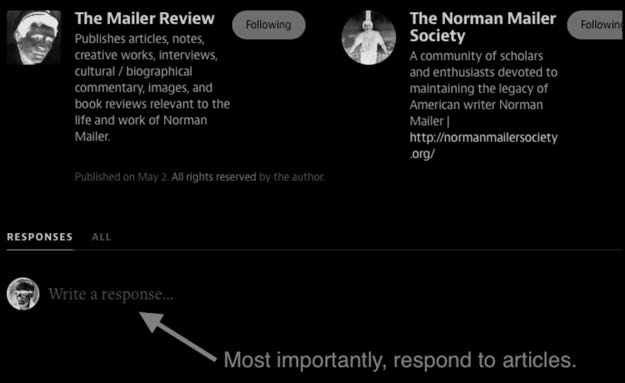
In addition to the Review, I’m also using Medium to host two other web-only publications: “Norman Mailer” <normanmailer.us> and “Teaching Norman Mailer” http://j.mp/teaching-mailer. Many of you have already contributed and I hope that others will be interested in doing so as we continue to use Medium. The former has published interviews with John Buffalo Mailer and Tom Hayes, several tributes to Barry Leeds, and numerous other miscellaneous pieces, including Mike Lennon’s “Norman Mailer’s Provincetown.” To contribute your own work, use your Facebook or Twitter account to create an account on Medium. You can then subscribe to our various publications, “recommend” articles you like, add notes and comments to posts, and respond to others’ posts from the Review with your own. Most importantly, with an account you can write your own posts to share in one of our publications. We publish anything having to do with Norman Mailer: notes, essays, personal remembrances, and multimodal pieces that include images, video, and audio. Our submission guidelines give more information.
When you make an account, you might mention in your bio that you are a member of The Norman Mailer Society, so others can find you and follow your account. Be sure to post a photo. Follow the Society’s account and the accounts of others in the Society:
- Norman Mailer Society—https://medium.com/@normanmailersoc
- The Mailer Review—http://mailerreview.org/
- “Norman Mailer” Publication—http://normanmailer.us/
- “Teaching Norman Mailer” Publication—http://j.mp/teaching-mailer/
What if you do not want to establish an account but would still like to contribute? That’s fine, too. Just get in touch with me, and we’ll make it happen.
The NMS Podcast—projectmailer.net/podcast
The Norman Mailer Society Podcast (also on iTunes) is a twice-monthly audio show created and hosted by Society member Justin Bozung. Justin has already produced a dozen excellent episodes and has several more planned for well into 2016. Episodes are most often interviews with members of the Society, those interested in and influenced by Mailer’s work, and those who knew Mailer personally. Justin has also uncovered rare audio with Mailer that he cycles into episodes.
In addition, Justin plans a series of roundtable discussions on various topics centered around Mailer and his work. While episodes of the podcast are planned though the rest of 2015, Justin encourages anyone interested in contributing to the podcast or participating in the roundtables get in touch with him via Facebook or Twitter (@mondofilm).
Works
By the time you read this, the first digital installment of Mike and Donna Lennon’s Norman Mailer: Works and Days should be published and available to Mailer researchers. “Works” is an updated bibliography of major texts by and about Norman Mailer that utilized the Lennons’ original Norman Mailer: Works and Days. This updated and digital version uses Wordpress to drive the database, links entries with cross-references, uses Livefyre for annotations, encourages sharing with social media buttons, and employs a wordcloud that organizes entries by year and type. Some entries even have high-quality images from the publications. Here’s an example, entry 80.23:
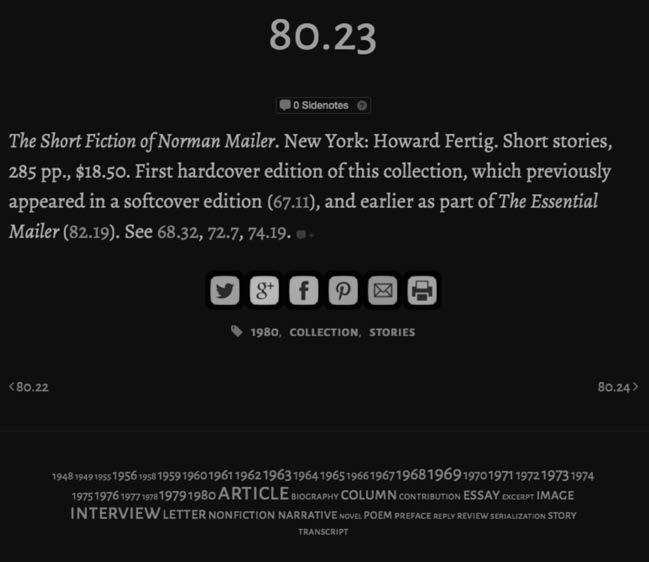
By the time “Works” version 1.0 is available, we hope to have some full-text entries, some facsimiles of original manuscripts, and other ways to initiate, save, and manipulate searches.
As of this writing, we have published 737 entries from 1948 through 1980. That leaves about three active decades left to encode before version 1.0 of “Works” is ready. In mid-July, we opened up “Works” as a beta and invited comments from members of the Mailer community. Therefore, some changes may have already happened and new features might have been implemented. After the publication of “Works 1.0,” we will begin the second part of the project: the “Days” posts. “Days 1.0” should be ready by #Mailer-Conf16 and incorporate nicely into the “Works” framework.
Thanks and a Look Forward
I would like to offer my sincere thanks to Mike Lennon and Phil Sipiora for supporting these endeavors. Without their support and enthusiasm, none of this would have been possible. Thanks to Justin Bozung for all of his hard work and the creation of 2015’s best new Podcast. Also, thanks to other Society members for offering and delivering materials. Thanks, too, to the remarkable kindness and generosity of the whole Mailer community; you all really are the best. It’s ultimately because of you that this work continues.
One of the chief characteristics of digital projects is that they are malleable: that is, relatively easy and quick to revise and reshape to meet new needs. The Digital Humanities aim to maintain the rigors of traditional textual analysis by bringing artifacts into digital environments, thus creating something new, participatory, and multimodal. With Project Mailer, Norman Mailer could be one of the first 20th-century literary figures to have such a presence in digital form. This should keep Mailer and his work relevant as more of us define our lives by digital pursuits.
I have always seen Norman Mailer as a hacker at heart. A hacker is someone who enjoys a playful cleverness and modifies systems to make them usable in ways not originally intended. Hackers are creative, unconventional, and occasionally disruptive. They are unafraid to push boundaries and take risks, even if sometimes their approaches fail. They strive to make life better by hacking the systems that organize and structure their reality. While Mailer’s distrust of technology is well known, he embodied the spirit of the hacker in most of his work. He pushed the boundaries of genre, borrowing from others, poking holes in the novel to let journalism and history flow in, letting the literary influence public discourse and political contests. He was not afraid to hack a genre to make it what he needed—not what was expected or what was conventional. Mailer occasionally failed with his hacks, but his hacks have become essential to his artistic identity and to our understanding of him and his work.
Project Mailer asks us to get in touch with the hacker inside us all. Mailer famously distrusted the technologies of the information age, and he was correct to do so. Not because they were evil, but like any technologies they have a way of enslaving the unwary. It is not social media and smartphones that make us zombies, but our uncritical use of them. It is our responsibility to shape the media that shapes us. Mailer knew this, and though critical of television, he used it to his advantage. We, too, must do the same of the digital word to keep our community and the legacy of Norman Mailer alive and healthy as we look to the future.
Works Cited
Certeau, Michel de. The Practice of Everyday Life. Trans. Steven Randall. Berkley: U of California P, 1984. Print.
Lennon, Mike and Donna. Norman Mailer: Works and Days. Shavertown, PA: Sligo Press, 2000. Print.
Warwick, Claire, et al. “The Master Builders: LAIRAH Research on Good Practice in the Construction of Digital Humanities Projects.” Literary and Linguistic Computing 23.3: (2008): 383–396. Print.
Social Media
With the launch of Project Mailer, we have made a concerted attempt to have more of a presence on social media, particularly Facebook http://bit.ly/fb-mailer, Twitter http://twitter.com/normanmailersoc, and Google+ http://bit.ly/plus-mailer. The former is probably the most active, with new members joining everyday. Social media works in conjunction with our main web sites—The Norman Mailer Society and Project Mailer—in posting updates, announcements, news, and other multimedia members send to me. We have even had some spirited debates on Facebook. If you have been reluctant to join Facebook, getting involved with the discussion on the Society’s group page might be just the motivation you’ve been looking for. Also, a Facebook account lets you easily make a Medium account, too.
While the Society maintains a social media presence on multiple sites, I try to cross-post all information, so there is no need to join or follow us on all sites. However, the more participation we have across all of our social media, the more visible and relevant the Society appears. For example, I used the hashtag #MailerConf14 for last year’s Society Conference, and many participants began tweeting updates, photos, and other reactions about the conference. I plan to use #MailerConf15 for this year’s conference in Provincetown. Hopefully, we will have participants’ Twitter handles published on the program so we can tweet to each other throughout the event.
I encourage everyone to become involved with us on social media. It promotes the Society, our work, and the legacy of Norman Mailer.