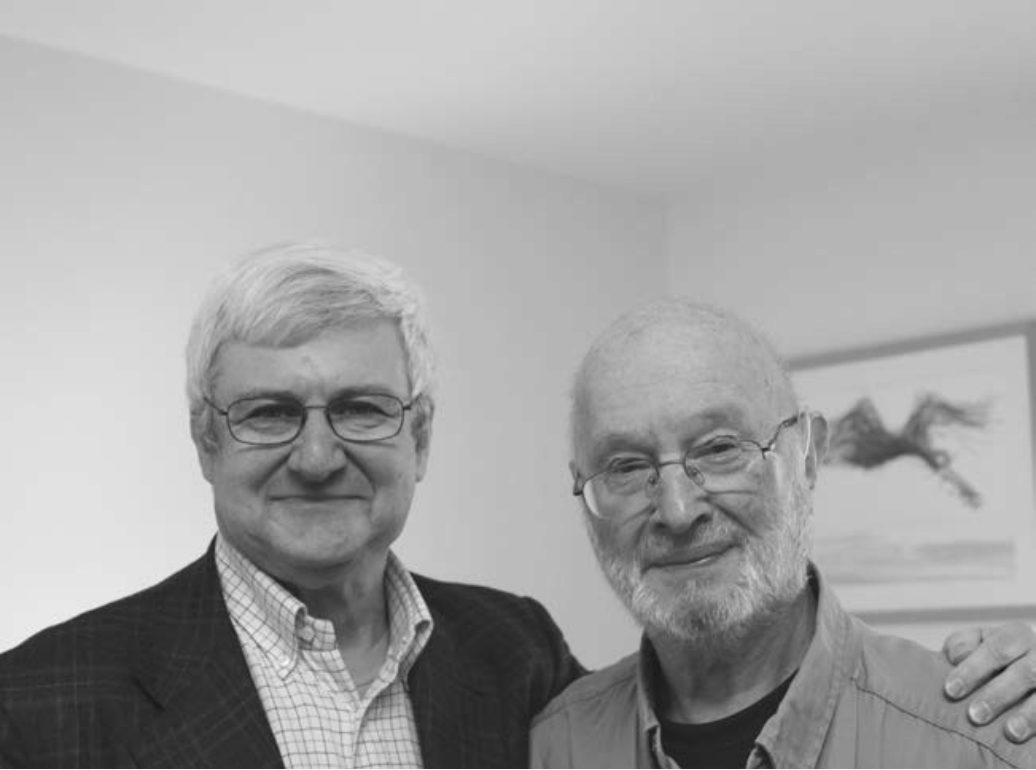
Of the artists and writers who most effectively captured, characterized and commented on the evolving American scene from World War II to the twenty-first century, Norman Mailer and Jules Feiffer would have to be near the top of any list. In the following interview with Mark Olshaker, the noted cartoonist-illustrator-author-playwright-screenwriter-teacher reflects on his and Mailer’s times, their legacies, how the Village Voice made his career, and what it means to be a “permanently enraged Jewish cartoonist.” The conversation took place on December 7, 2013 at the dining table of Feiffer’s home in East Hampton, New York. Mark’s wife Carolyn was also present and added to the frequent laughter.

Mark Olshaker: Norman always said that as much as he liked Brooklyn Heights, he never got any work done there because he couldn’t resist the urge to socialize all the time. He said he had to go to Provincetown to work.
Jules Feiffer: Yeah, here it’s great working. We have a few friends that we see and it’s terrific and the living is much easier. If I were younger, I’d be living in New York City, but I can’t walk the way I used to; I can’t hear a goddam thing. And all the attractions of the city don’t make any sense to me. I’m an adolescent living in an old man’s body. It’s much easier here because I’ve got a car, and I used to walk miles a day but I can’t do that anymore. It’s just too frustrating now in the city; it’s not pleasant. I mean I have no nostalgia for it. I love it out here. I was in a small house in South Hampton which my daughter, who was living in Pennsylvania, decided to move into. So she’s here. It’s nice.
Olshaker: Jules, how did you get started as a cartoonist and an illustrator?
Feiffer: Well I got started when I was five years old, when my mother gave me a pencil. Or maybe I was three years old, I don’t know, but I’ve been drawing all my life. I love comic strips, which were some things to love in the 1920s and early ’30s. I was born in ’29, so I became aware of this stuff when I was 22 or 23, and the Sunday supplements were huge. We think of technology as making things better but the fact is that these forms got worse and worse as the years went on. Back in the ’20s and ’30s, the comic strips were in their glory forms; they were the universe we wanted to sink into. There were colorful Sunday supplements before movies had color, or any real color. And there weren’t many competing forms of entertainment. So that and radio were the universes that the people who wanted entertainment treasured—and black and white movies that you went to once a week. These were the forms that got us through the Depression. And much more cheerfully than any form of entertainment that has got us through the recent recession.
Olshaker: In your autobiography you talk about how you marveled at the story that could be told in eight panels on Sunday.
Feiffer: Yes, eight or twelve panels, and the level of the work, the quality of the work. I have a considerable library of these strips that I loved as a kid, and not only do they hold up, some are better than I thought they were.
Olshaker: And you’re still doing it. So you’re eighty-three years old and you’re still a kid?
Feiffer: Like a lot of writers and artists, the difference between us and the real world is that we still are in touch with our feelings and our thoughts and what we were like as children. When what the adult world basically demands to let you into it, is that you get amnesia about all that; that to make it in the world, you’ve got to stop thinking the way you did because that’s like a kid, because you’re going to make a fool of yourself. All of that you’re supposed to give up, so outside of the excesses you get when you drink too much or over-drug, which gets you back in touch with that person, and there are both highly irresponsible and sometimes dangerous ways, you tend to forget it because when parents talking to children don’t know what they’re talking about because they were never those kids. Whatever they were at that time they’ve blanked, they’ve shut down.
Olshaker: Do you attribute your success in children’s books to that sensibility?
Feiffer: I think the people who write for children, by and large, never stopped being in contact with themselves as children.
Olshaker: I remember your book Some Things are Scary and with the exception of a few other children’s books writers like Maurice Sendak I can’t think of many writers for children who were willing to acknowledge that sort of thing.
Feiffer: That wasn’t my book. It was written by a woman named Florence Parry Heide. It had already been published, illustrated by a man named Robert Osborn, who was one of my great influences as a cartoonist and a friend of mine. A brilliant man, but a lousy kids’ book illustrator and he didn’t get the book at all, and didn’t do a good job. And they wanted to reissue it some fifteen-twenty years later and they sent me the manuscript. I thought, I could have written this. This is wonderful! I had never heard of Florence Heide. She was then in her late seventies, early eighties or something like that, and we didn’t meet until after I did the book. She knew what it was like to be a kid, she was a wonderful woman and we fell in love with each other immediately as they say. We were life-long friends until she died.
Olshaker: Who were your creative influences? I know of Will Eisner, for example.
Feiffer: Well, when I did this graphic novel, Kill My Mother, I was going back to the forms I loved as a kid, which I found as a young man I couldn’t replicate. I just didn’t know how to draw in that style, and somehow in my eighties I managed to learn. In any case, the prime influence was a man named Milton Caniff who is now, many generations later, largely ignored or forgotten, but at the time he was the biggest and the best of the cartoonists. He took the form of the adventure strip—which had been introduced by a man named Roy Crane, who did Wash Tubbs and Captain Easy, some years earlier—and took it to whole new dimensions and a new kind of reality. He was bitten by the movies, and started doing basically what would look today like storyboards on paper, and he had a gift for storytelling, a gift for dialog, and for putting them all together. He was using the form at its most perfect and most sophisticated. The comics are words and pictures, and when you do it right, it’s harder to tell when one begins and the other ends and I was aware of that by the time I was six or seven.
So he was an influence, and Will Eisner was, but also the funny guys like EC Segar who created Popeye, and Frank King who did Gasoline Alley, and Chester Gould who did Dick Tracy. There were some great, great things going on.
Olshaker: Getting a little ahead of myself here, but was it ironic and/or fulfilling that you were a Popeye fan as a kid and then ended up writing the screenplay for the film?
Feiffer: This is a form of irony, sweet contemplative irony, that has besieged me my entire career—being a fan of Will Eisner’s and then ending up his assistant and writing these stories that I adored. That was my first form of semi-professional writing. And over and over again. Loving Popeye and then getting a call from Robert Evans asking me to do the screenplay. And I said, “Depends on what you’re talking about. If you want to do the next Max Fleischer Popeye cartoon as a live action film, I’m not interested. If you want to do Segar’s comic strip, yes, I would love to.” And he said, “I want to do whatever Popeye you want to do.” And over and over again I found that. When I started illustrating children’s books, after years of doing the Feiffer strip in the Village Voice, I found that the illustrating of kids’ books was taking me back to the comics and the form and the use of design and the use of color and, for that matter, pictorial style, that I loved as a kid. And for reference work I would go to the library and look up newspaper strips from the thirties and that’s where I would be inspired to illustrate one book after another. And this still goes on.
Olshaker: Could you tell us how you got the job with Will Eisner to begin with? And could you tell the audience Will Eisner’s significance in those days?
Feiffer: Well, actually, his significance in those days was generally unrecognized except for the cognoscenti—I mean, comic book fans, people in the business. He wasn’t that broadly known. It’s interesting today where Eisner’s name is much better known in the general public than Caniff ’s because Caniff [Terry and the Pirates, Steve Canyon] and Al Capp [L’il Abner] were the be-all and end-all of the form. Eisner was for the cultured and the cognoscenti. But Eisner was the single most innovative artist in comic books. I mean, there were many more famous than he was. Eisner never had the fame of Bob Kane who could barely draw, who did Batman—Batman was a big, big, big deal—but Eisner was a better illustrator than Joe Shuster, whose work I admired, who created Superman. But Shuster, who I liked, was a primitive, and Will—who came from the Bronx, from a Depression family (very close to my own, also from the Bronx eight to ten years later)—brought his own passion for stage design, for movies, and for literature and put them all together in increasingly sophisticated forms. He had produced all sorts of comic books, presided over companies that turned out features, and he drew his own, he hired people to do others, he wrote; I mean, it was a factory. He would start doing one thing and move to something else and then something else, working very fast and very efficiently. He also understood technology, which has always been antagonistic to me. I didn’t understand any forms of technology then, and now we’re in a digital age I’m buffaloed by it, and thank God I’ve got people to do things for me because if they had to depend on me nothing would ever get done.
But Eisner was a man of many gifts. He always wanted something in the newspaper, and he did this more sophisticated character called The Spirit, who was a crime fighter. Basically he was used to provide a lead character who would officiate over the short stories that Eisner would write once a week that ran in the beginning eight pages and then later on seven pages. It was the stuff of pictorial grandeur and detail, showing rundown neighborhoods, and rain, and violence. When one Eisner character punched another Eisner character the reader felt it in a way that nobody else drawing this could make you feel it. He put you into the scene, in a way. He loved the city, he loved the urban squalor. He came out of the age of trolley cars, and when he drew a trolley car in a rain-swept street, you were in it. You felt as if you were in that moving trolley car. His atmospherics were extraordinary. When it came time for me to do my graphic novel, I tried to graft to that book what I loved from him and what I learned from him into my own presentation of the work.
Olshaker: You mentioned Superman and you mentioned Eisner and his background in the Bronx like yours. Now I know Superman’s creators were from Cleveland, but being a commentator on comic history you also wrote that yes, Superman did come from another planet, and that planet was Minsk. What did you mean by that?
Feiffer: I was the first to suggest that Superman’s secret identity was not that he came from Krypton but that he came from Poland or that he came from Minsk or that the Jewishness of both writer Jerry Siegel and artist Joe Shuster and their own autobiographies irresistibly—when it came time for me to think about this and write about this—brought up Clark Kent, and these are two nerdy Jewish boys, wearing glasses, unattractive to the gorgeous Lois Lanes in high school, fantasizing to themselves, “If they only knew what I was really like.” All of us as teenagers, if we’re not jocks and we see the guys who are with these beautiful girls who we lust after, if we know what to do with lust, we see the kind of men they want, or boys they want, who were the lunkheads who never read a book but who look great, and who can play ball, and who are rowdy, and who can push girls around. If you try to push a girl around she’ll smack you in the face. But these other guys get away with everything and the nerds who wore glasses and had bad complexions and didn’t know how to talk to girls got nowhere. So what better fantasy is there than to say, “If she only knew my real identity! If I take off these glasses, if take off this dopey suit—because I don’t know anything about clothes either—if I show her this costume I’m wearing underneath, I will be irresistible!” And I suspect that had a lot to do with the original creation of Superman. One of the reasons it really caught fire was because there were so many readers out there who felt not like the jocks who got away with it all, but like the nerds who got away with nothing. Because when you were Superman you got away with it all. You could identify with him, you could sink yourself into that.
Olshaker: Was this also about the immigrants, the assimilationists, and acceptance in American society?
Feiffer: The difference in those times, dating back to the early twentieth century and certainly for the Eastern European Jews and Italians, was that their children, as opposed to today, were eager, as quickly as possible, to drop the ethnic identity they came from. This was particularly true when movies came along, and sound came in during the thirties and forties, so you could hear how people were “supposed” to talk. These movies were largely produced by Jews, and written and directed by Jews and Roman Catholics and first generation and second generation Irish, but everybody off the boat idealized a WASP America that they invented from the pulp literature of the time and the Saturday Evening Post and Andy Hardy’s world—the world populated by Judy Garland in Meet Me in St. Louis. Look at Meet Me in St. Louis: It was Irish Catholic Judy Garland, in a move produced by Louis Mayer, a Jew, and directed by Vincent Minnelli, an Italian. It was about this idealized WASP world that we knew best because it was given to us by the outsiders who were anthologizing it.
Olshaker: I thought it was very interesting that Louis B. Mayer, who was from Russia originally, a junk dealer who opened up a theater and moved from Massachusetts to Hollywood, who becomes a big mogul, takes up polo immediately, and at the same time, though, insists that the MGM commissary always serve his mother’s recipe for matzo ball soup.
Feiffer: Is that right? And the Jews in Hollywood did as much as they could to keep the Germans happy in the early days before World War II, because much more important than their own people was the marketplace.
Olshaker: Speaking of World War II, it seems that your time in the army had a major influence on your psyche, and your work. Did Munro come out of that?
Feiffer: Munro came out of the fact that I was drafted and it was a mistake to draft me because I was me! How dare they!
Olshaker: Did you see yourself as a six-year-old?
Feiffer: Jesus Christ, that was a little old for me.
The line was “They only made a man out me.” It certainly didn’t, but it made a satirist out of me. It gave me—it unleashed the anger that I could never admit to as a nice Jewish boy, thoroughly repressed by my nice parents who meant the best for me. So whatever awful things they made me do because I was too scared to defy them, I would forgive them everything because my mother got us through the Depression. I owed them too much, and if I ever forgot it she would remind me, so that the rage was concealed by the sense of obligation and guilt. But I felt no sense of obligation to the United States Army and, God knows, no guilt. So the army in its oppressiveness, in its treating me like an ant, like somebody who didn’t deserve to be walking on this earth, gave me the license to open the door on all of this rage that had been sitting there, forced into the closet by mother, who would have been shocked and horrified. I couldn’t do that to my mother but I could do it to the army. And so it all came out and thank god for the army. Thank God for those two years of oppression.
Olshaker: Do you think you had the same attitude as someone like Joseph Heller who accepts the fact that the army is defeating Hitler, but look at what it’s doing to us?
Feiffer: Yeah, I think there was a general feeling, but it didn’t make Joe political the way it made me. Joe was a sardonic and an extraordinary, brilliant social critic. I was never the fan of Catch 22 that other people were, but I think Something Happened is one of the great American novels, unknown and underappreciated, and a gorgeous piece of writing. But he, too, was a product of the time. You can’t imagine Heller twenty years earlier—you know, one of the things I do say about my career to people, in terms of my importance one way or the other, is that whatever it is that I did or continue to do, if I had started doing it a year earlier or a year later, it might not have gotten me the attention it did. The chapter I call in my book about my career, I call “Walking into the Zeitgeist.” That I happened to stumble into the right time to be doing the sort of work I was doing and for that kind of reception, that’s just pure luck, pure accident. What’s not an accident is recognizing it’s happening and taking advantage of it.
Olshaker: When and where did you first meet Norman Mailer?
Feiffer: I started at the Village Voice in October ’56, and Norman, of course, was one of the original founders of the paper, although he wasn’t around much. But I did see him at the office and he was doing an occasional column, which became Advertisements for Myself in book form later on. The column was called “The Hip and the Square” as I recall. And it was a long column—you didn’t stop Norman from talking when he wanted to. Like Advertisements for Myself, it was full of absolutely brilliant stuff and garbage, side by side. Stuff that would stop you and you would go, “My God, how did he come up with that! That’s amazing,” and then beat the hell out of it. It ran not that long a time but made a hell of an impression on me. We got to know each other casually during that time, and then ’59 or so when I met, and fell for, and started living with Judy Sheftel. She was a literary chick and she hung around with writers.
Olshaker: Now, Judy also took the famous photograph of Norman in the admiral’s cap that appears on the cover of Advertisements for Myself.
Feiffer: Judy and Norman were friends. She took a number of pictures of him, she took pictures of Alberto Moravia and other writers. She could have had a very successful career as a portrait photographer of literary people. She loved them, but she never took it very seriously, never knew anything about the camera. She told me Norman bought her a movie camera and got her to take pictures of him while he was fucking different woman. One episode, because Judy was about as hip about technology as I was, the camera got stuck and stopped shooting, and Norman had to leap out of bed mid-fuck and fix the camera and show her what to do with it. Then he leaped back into bed and continued shooting his pornography.
Olshaker: So what you’re saying is that Norman was a director even back then?
Feiffer: Well, Norman was a control freak as you well know and had to run everything. That basically outlined—aside from admiration for his writing—my difficulties with him as a presence, because I often felt unless I was drinking enough to get over it, an unease in his presence, because he liked to run the show. He liked to direct the show. It wasn’t my show; it was his show. You were in the Norman Mailer show.
Olshaker: Were you around when Judy took that photograph of him?
Feiffer: I don’t think so. I don’t think so. I think that was before my time.
Olshaker: Because it certainly has all of the essence of Norman about it.
Feiffer: She was a wonderful photographer. She loved writers. And that admiration and because she was literary—she loved to read—that came out in the pictures.
Olshaker: Is that how she fell for you? Because you were literary?
Feiffer: We were . . . Mike Nichols and Elaine May, before they became that well known, did a Town Hall show of their work before they did it on Broadway. They were friends of mine. I was a kind of a follower of them because we identified with each other’s work. They loved my cartoons; it seemed to be the kind of stuff they were doing on the stage, and I loved what they were doing. I was in line to pick up my tickets to go to their show, which was at Town Hall, and found myself standing behind Kenneth Simon who had just come over from The Observer in London to be the critic for The New Yorker for theater, and I recognized him because I had seen him on TV a couple of times. And he had written the introduction to the English edition of my first collection of cartoons Sick, Sick, Sick, which was then appearing every week in The Observer in London, and now the book was coming. So recognizing him from his voice and visually, I introduced myself. He was delighted to meet me and asked me to join some friends of his after the show. Those friends turned out to be George Plimpton and company, you know the old Plimpton crew, which included Peter Matthiessen, Donald Ogden Stewart, Jr., and a bunch of other people including Judy Sheftel. What happened that night is that suddenly I found myself involved with the literary New York, and brought into their company and met Judy at the same time and we began dating.
Olshaker: How did you come to the Village Voice?
Feiffer: Out of desperation and failure. I had gotten out the army in ’53. I had already written several drafts of Munro, the story of a four-year-old kid who had gotten drafted into the army by mistake, and could find no one to publish it because of the things it had to say in the time that I was trying to get it said, which was during McCarthyism and Post-McCarthyism. And also in a form that nobody understood. What I got from editors, from publisher to publisher who I took it to, all of them loved the work—or said they did—but said they wouldn’t know how to market it because I wasn’t famous. What I heard myself being told was what a shame I wasn’t James Thurber or Saul Steinberg or William Steig, because if they did this work it would be published in a minute. So I understood that I had to get famous in order to get published. And on all of these editors’ desks there were copies of this new newspaper that wasn’t even a year old at the time, the Village Voice, and all of them were reading it. I really hadn’t looked at it seriously, but I began to think that if I were in that paper they would begin to think I was famous because that’s what they read. So I’ll go down to that paper and see if I can get myself in it. And I did. I just walked in. At that time I had nothing to lose because I had basically four years of total failure in doing the work that I considered to be my life’s work.
Olshaker: How were supporting yourself during that time?
Feiffer: Just doing dopey art studio jobs. With some very nice people and some very nice bosses but the work was stupid. So I would keep the job for six months and then get myself fired, which would put me in line for unemployment insurance, and then I’d have six months off to do my own work. And I did that for several years. Six months on, six months off. This was my way of getting a Guggenheim or a Ford Grant. All of them turned me down, but unemployment didn’t turn me down.
So I showed my work to Dan Wolf, who was editor and Ed Fancher, the publisher, and Jerry Tallmer, who was basically the editorial brains of the paper and the theater critic, and theater maven. Jerry was the unacknowledged founder of much of modern theater criticism as we find it today.
Olshaker: Wasn’t Ed involved with Adele Morales who become Norman’s second wife?
Feiffer: I didn’t know that.
All of them responded to me as positively as I’d ever seen anybody respond to my work in those years. I was stunned and I was so beaten up and paranoid by then about reception to my work that I was willing to do anything they wanted to and all I was told was to do anything I goddamn pleased. They kept saying that and I didn’t understand what they were saying because no one had ever told me this. So I began doing the strip in the Voice and exactly what I hoped would happen, happened. It made me famous and got me in charge of getting my work out there. Suddenly the work that nobody had wanted now everybody wanted, and I was on my way. But without the Voice I don’t think I would have ever had a career.
Olshaker: Now you originally called your work Sick, Sick, Sick. Was this a commentary on what was then referred to as the age of anxiety? Because when I look at your first several strips they do seem to all be about anxiety.
Feiffer: Yes, and I was too, but on a personal level. The word angst was very much in the air in those years. It was also the age when Freud was making his breakthrough into popular culture. Even if you weren’t seeing a shrink, people talked in that language. A very popular writer at the time was Erich Fromm, now generally forgotten. But I remember reading his books one after another, and The Sane Society was one. Then there was David Riesman, who wrote The Lonely Crowd. Anyhow, this was a long time ago.
Olshaker: And Norman was very friendly with Robert Lindner who wrote Rebel Without a Cause and The Fifty-Minute Hour.
Feiffer: Yes, and Norman had his own orgone box and was a devotee of Wilhelm Reich. All of that stuff was very much in the air. If we weren’t seeing shrinks we read stuff and talked the talk, usually with a drink in our hand. And we used psychology to get laid. You tried to find the weak spot in a woman that would get her to take you to bed. I mean, because what other reason would she? This was all in the air at the time, so my distinctiveness was simply to do a cartoon each week that represented the world of the readers to the reader. No one else was doing that. The prevailing humor outside of Mike and Elaine at the night club, which only a few people saw; the prevailing humor was basically still the humor of the 1940s and ’50s, drawn from old time radio which was then transferred into television. Ozzie and Harriet was a radio show that became TV; Burns and Allen was a radio show that was transferred to TV; Jack Benny was great, also a radio show.
But you had a whole younger generation, post-Korean war, urban educated, who aside from the Sid Caesar Show didn’t see any humor or anything that related to them directly. And even Sid Caesar was an older generation, but his genius made up for that. All I was doing was writing about people my age and putting them on the six panels. I didn’t deliberately set out to do that; I was just doing what I knew. It caught on right away, much faster than I ever anticipated, and God knows I was not going to complain about that.
Olshaker: One of the things that I find interesting is that so many of your early strips, the characters are pathologically introspective and Norman was pathologically introspective but wanted to tell everyone about it. Was that sort of the norm of the New York intelligentsia, the literary establishment of the time?
Feiffer: Norman may have been introspective, but he was never one of my characters because Norman’s persona . . . Norman buried, as much as he could, the nice Jewish boy inside of him, which might have been one of my characters, and became macho. More like Huey, one of my other characters. But until I came to Huey many years later, I wasn’t interested in the macho characters. I was interested in the guys who couldn’t get laid, because I happened to be one of them. I was interested in the people who just didn’t fit in—both male and female—and felt ill at ease with the life they were living and the surroundings they were living in. This happened to be a lot of people at a time when the culture was changing. All through the ‘40s, the war years and the early post-war years, there was a finite quality to the culture. Everything seemed to be settled in place. The first time we became aware of some sort of level of dissatisfaction or disturbance was in the early noir films, where suddenly, we’re out of World War II and we won, we were less touched in terms of losing our men and woman than any other country, and didn’t have to fight on our own soil, were not bombed. And yet the movies that started coming out were of darkness and dissatisfaction and betrayal, and coming home and discovering that people that you thought you knew weren’t those people, and the science fiction films saying the same thing. And the Cold War, transferring Russians into Martians and beings from other planets, and everyone is out to get you. So here we were, the victors, and suddenly we were prosperous when all through the preceding years, we had been poor and fighting the Depression. And all of that good news turned out to scare the shit out of us apparently and alienate us. Because if you look at the Depression-era musicals, they were worried about money but they’re happy and full of energy and laughing and singing. And women worked and women were strong. They weren’t just vapid housewives as they were in the fifties. There was Rosalind Russell and Myrna Loy. They were tough and they demanded their rights. This was all through the ’30s. Then the world became a different place and everything was stifled in the late 40s and early ’50s. And it was out of that stifling—which was partly political because of McCarthy and culturally stifling with all of those changes that nobody wanted because they seemed to overthrow the old institutions—so without anything officially repressive, they were being sat on, and there came a generation that was resisting them in its own way. Some of this resistance was conscious on my part. A lot of it was political because I also was quite aware of what politics you were allowed to have in the newspaper and on television and on radio. And it wasn’t mine, because much like Norman I was much further left than one was allowed to be in public discourse at that time. It’s hard to imagine when today every point of view gets on TV and when you have something like MSNBC, which basically represents a lot of my views. But those views were never expressed on radio or TV back in the ‘40s or ‘50s, so that somebody considered a liberal in the eyes of those of us who would listen to these guys, wasn’t liberal at all. The real lefties like I.F. Stone and Murray Kempton never got on the air. And they were attacked. For the New York Times to say something nice about I.F. Stone, he had to die. Only in his obituary.
Olshaker: He had to create his own paper.
Feiffer: That’s right. But these were my heroes.
Olshaker: This brings up an interesting point because Norman several times said that he didn’t think the Voice was radical enough in the 1950s.
Feiffer: Well, what I love about the Voice . . . what Norman wanted out of the Voice and what I wanted were two very different things. In its heyday the Voice was giving me exactly what I wanted. It was “the voice.” It literally was the voice of a variegated, disparate young generation with lots of views about different things, who agreed and disagreed on all sorts of things, who wasn’t necessarily politically left but who was culturally out there. It was page after page after page, whoever was writing, representing a generation who simply wasn’t represented. That’s why it was getting attention. You know, what’s interesting is that when Jim Bellows took over the Herald Tribune some years later, it took on the identity of the early Village Voice in many aspects. The dirty little secret of the New York Times today is that it’s got a lot of old Voice writers on it and it, too, incorporated into its Times identity a lot of the sensibility of the early Village Voice. So the Voice, simply because it was about stuff happening that nobody was commenting on became the unofficial and unacknowledged spokesperson for all of this stuff going on at a particular time. None of it deliberate; it was just in the air. But the officials who controlled the air, including The New Yorker magazine weren’t acknowledging it, because they had their own institutional impulses, which they chose to follow. And theirs were better than yours, so they were going to follow them and to hell with you.
Olshaker: Do you think the Voice was the pioneer for the Berkeley Barb, The Boston Phoenix, The East Village Other . . . ?
Feiffer: I think that’s understood. the Voice was the inspiration. I mean, these papers all have very different identities and they weren’t little Village Voices. They became whatever they wanted. At a point I really liked The East Village Other a lot better than I liked the Voice because it was much more audacious than the Voice. The interesting thing about the Voice in many ways was that Dan Wolf, its founding editor, was in many ways quite a conservative and often disagreed with the contributors. But the whole point of the Voice was that the writers were not edited, they could say any damn thing they pleased, so it attracted a lot of first rate talent who were being published elsewhere for pay, but that elsewhere never allowed them to be themselves. They had to be what Esquire wanted; they had to be whatever the magazine or newspaper they wrote for wanted. But for Nat Hentoff to write about what he wanted to write about outside of jazz, he had to go to the Voice because nobody would let him talk politics or culture. So it was with just about everybody else. You had an endless number of well-known names beginning to write for the Voice because they could be themselves. Everybody was faking themselves in print in those days. I remember—I loved this—reading a front page Times review of Herman Wouk’s Marjorie Morningstar by another critic at the time (I don’t remember his name), which was a rave and then picking up The Nation and seeing the same critic panned the book.
Olshaker: Was the Village the sort of crucible and hotbed of progressive thought and the arts and graphic arts that we have come to assume it was during that period?
Feiffer: I never thought of the Village as being a hotbed of progressive thought. I didn’t get my politics from anybody in the Village or anything in the Village. As I saw it there was no politics to get to at the time; there was no left anymore. The left had been thoroughly destroyed in the McCarthy and post-McCarthy days. It wasn’t about the politics; it was about the resistance to the generally oppressive nature of the society out there at every level, whether political or not. The forms of disguise we use to present ourselves, and socialization was a form of repression. And everybody was repressed. Years later I was invited to a party at Charlayne Hunter-Gault’s house, when she was still living in the States. She lived in a townhouse in the west seventies, not far from me on the Upper West Side. And it was full of famous black reporters, television reporters, all of whom spoke in English the way everybody else did. And I walked in and they were all speaking black, including Charlayne. And I realized, Oh my God, it’s like assimilation. They know that language they have to speak in order to be accepted and they also know the language they have to speak in order to be with their own people. They just easily go back and forth between the two languages—essentially both English but they’re different languages. They were leading perfectly acceptable lives in complete disguise. And everybody was. So one of the things I took up in my work, in all my writing, was how were living these encoded existences. What I chose to do in my work was try to reveal what the code was, to break down the code for the reader. If you did that in real life, with your family, on the job, it would be very upsetting to people. Because while everybody spoke in code, and everybody operated by the code, and everybody understood what the code was, if you acknowledged that there was a code they’d be horrified.
Olshaker: This is very interesting because this is at the same time Norman is writing “The White Negro” and talking about how the hipster takes his lead from the black man who has to disguise himself in society and lives a very existential life.
Feiffer: It was two parts. Much of it came from jazz musicians, and I don’t think Norman was that much into jazz. It was white jazz artists. And much closer in understanding how all of this worked was Lenny Bruce, who was a kind of Jewish, hipster, jazz, black man who spoke the language and walked the style and talked in those cadences and improvised in the way a musician might. So if you saw him working on an act on a nightclub floor before he got it all together and turned it into a bit, the way he used language, the way he improvised—I mean you never knew that this wasn’t from written material. He would riff on an idea, particularly if he was pissed off about something. I saw him at his first show at The Blue Angel, which was a rather fancy uptown place for him, and he left the audience completely cold and he wasn’t that good in the first show. And I went backstage with him and he was really burning; he was pissed; he was mortified. And he said, “Stick around for the second show.” I did, and he just took off. He threw away all the material he had and just started improvising and it was breathtaking, it was absolutely breathtaking because it was out of anger, it was out of his wounded pride, and it was stunning stuff.
Olshaker: Norman also said that you epitomized the Village Voice in the early years and you had the single greatest effect on its success. Now if I can ask you to put modesty aside, how do you react to that?
Feiffer: Well, I never knew that. You know, Louis Menand from The New Yorker, someone I admire a lot, who wrote about me and Norman at the Voice, but I thought he built me up to make a whipping boy out of Norman, and thereby misunderstood both of us. He misunderstood what made me work, at least in my eyes, and he gravely misunderstood and underappreciated Norman, which he made up for in the last piece he wrote, which I thought was quite a good piece. And it’s been talked about since. You kind of had to be there to understand above and beyond the novels, the social force and insights that Norman brought to the conversation that nobody else brought. Whether it was in the Voice or on occasional op-ed piece he would write in the Times, he would start writing about an issue I thought I knew everything about and “What new could he possibly tell me?” and by the middle of the column my breathe would be taken away because Jesus Christ, suddenly he had touched a nerve. And I can’t give you instances; I don’t remember any. But he would pick up something, say something, which would suddenly throw a whole new perspective and like the truth always once you knew it, you didn’t have to question, could this be right? You knew automatically it was right, just the way Jimmy Baldwin and his early writing on race would make you marvel at the insight. The insight, once you read it, was something that on some level you always knew was true but you just didn’t know acknowledge it or didn’t know how to verbalize it or didn’t think about. These truths become apparent not as a revelation of something that’s in outer space, it’s a revelation of something you always understood and never quite got your head around. Norman did this over and over and over again, more than anyone else. None of the notable writers of that time, as good as they were—Styron and company, Bellow—were able to bring, at least to those times, that particular kind of insight.
Olshaker: You and Norman both in your own ways characterized the 1950s. You also characterized the 1960s. So, how were the ’60s different?
Feiffer: The ‘60s were in reaction to the ’50s. The ’60s was when we started to deal forcefully and chaotically because we were all without official power. With all the issues that had been festering from the ’50s and ’40s, and in particular the big things in the ’50s that launched everything else were the sit-ins and the Civil Rights revolution. That started everything, and without that it’s hard to imagine the Vietnam protests going on as they did in the anti-war movement. The first actions were these kids at lunch counters and then demonstrations and then integrating schools and in particular the works of people who—I mean I was thrilled that just a few months ago that the Presidential Medal of Honor was given to Bayard Rustin who was the unacknowledged mastermind of so much that went on in those years and who changed my life completely. Shortly after the army, I was running around looking for places always to meet girls, and I went to a Fellowship of Reconciliation meeting to hear this man who I had never heard of speak about civil rights which I knew all about because I read progressive papers, and he started talking about it in ways that I’d never heard anybody talk about it before. He talked about the civil war still going and things now familiar to everybody because he and Baldwin and a few others were the ones writing about them and talking about them. But this was all news to me. And as I said about truth, as soon as he said it, I didn’t think I have to think about this, and Could he possibly have a point? It was like a lightning bolt.
Olshaker: And yet Bayard Rustin couldn’t get to the top of the movement because he was gay.
Feiffer: He was gay but not just that. He wasn’t interested in being the star of anything. He was an organizer, and a mover and a shaker. But he was a big part of it. He was rejected by a lot of Martin Luther King’s group including King himself for a while.
Olshaker: You and Norman were both known for provoking audiences as well as for criticizing your own political fellow travelers. We talked about how Norman did it in his column.
Feiffer: But Norman liked to do it publicly.
Olshaker: Yes, and in fact, Norman described himself as a “left conservative.” Is it more fulfilling and satisfying to criticize your readers than to praise them?
Feiffer: For me if was never about that. With Norman, Norman took particular pleasure—Izzy Stone was another one—in being honored by a group he would then start insulting or, you know, start throwing words like “cunt” around. Bob Dylan did the same thing. It’s as if he was saying, “If you think you can get away with saying something nice about me, you’re wrong because I’m not the person you think I am.” Norman, when he was accepted on some level couldn’t tolerate it and had to show that it was a case of mistaken identity. And it may have given him some pleasure to empty a room because he emptied a lot of them, including having me walk out on him.
Olshaker: Tell me about that.
Feiffer: Well, I went to some birthday party of his—where the hell was it? The Four Seasons or something. Everybody you wanted to meet was there, and it was a huge thing. It was a love feast and booze was everywhere and everyone was having a ball. And Norman gets up and turns the whole thing into a disaster in about a minute and a half.
Olshaker: Speaking of that, the Jewish Daily Forward described you as “permanently enraged Jewish cartoonist.” Do you think that’s an apt description?
Feiffer: Well, I think at a certain time it was and I’ve spoken about rage. Back in the late ’50s through the early ’60s, I talked about and wrote about in a book on Lyndon Johnson—the importance of range in a political cartoonist and without rage, you’re not doing your job. Comparing the mainstream cartoonists of the time—with the exceptions of Herblock and Paul Conrad and maybe one or two others—as not living up to the standards of those who are considered the most important of our political cartoonists who went back to the early days of The Masses. And Robert Minor and Art Young and John Sloan, just extraordinary painters and graphic artists and cartoonists who were socialists and tough as nails and it was that anger, that rage at the inequality of the system that got them going. So when I first became equated with their stuff I realized what we were missing in our time. It was that kind of anger that I wanted to put in my work but I wanted to do it also with wit and make it entertaining.
Olshaker: Your anger, your wit, the way you entertain—somehow you always manage to capture that zeitgeist you mentioned earlier, the tenor of the times.
Feiffer: In the mid-’60s, post-Kennedy assassination, I felt that I had lost my teeth, that I was still doing tough stuff in the Voice and elsewhere, and it was too widely admired. I thought that somehow or other I wasn’t making my point. And that was one of the reasons I wanted to write on Little Murders, because I felt I was being misunderstood. I wanted to spread out to a longer form.
Olshaker: Was that hard? I mean you essentially suddenly became a playwright.
Feiffer: Well, yes, I became a playwright in post-assassination America. I saw all sorts of things happening. Everybody talks about it now, how it changed everything, but people were not talking about it then. If you go back and look at the newspapers and look at articles a week after, the month after, the year after, that’s not what was being talked about. But it was what I knew had happened, and I was waiting to read about it in the New York Review of Books, in the Village Voice, but nobody was writing about it—and certainly not in The New Yorker. So I thought I had to. It wasn’t the material, because it was too complicated, to put into a six-panel comic strip, or even a longer form. So I started working on it as a novel and tried to novelize in characters. And so the characters that later became the characters in Little Murders, like Alfred and Patsy and their families, they’re in the novel. But I got bogged down in trying to write a “novel” novel and in being a real writer and write descriptions of things. It just got to be an awful mess. And I spent two years or so trying to put together this awful mess and it wasn’t going anywhere which is when I went to Yaddo, which I was afraid to go to, but Alfred Kazin who was a friend of mine and Phillip Roth who is a friend of mine both raved about the place and recommended it to me and me to it. I went and in three weeks I had a first draft of the play. I took all the stuff from the novel that wasn’t working, I took all the good stuff, and suddenly overnight, on my first or second day there, I discovered I was a playwright, something I didn’t know.
Olshaker: Now what’s fascinating is that to me Little Murders is one of the great cultural touchstones of the 1960s. It was first a play, and what was interesting is that when it was staged on Broadway in, I think, 1967, it was a spectacular flop.
Feiffer: Yes. It ran five days.
Olshaker: Then it became a hit only when the Royal Shakespeare Company staged it in London. And then there was an off-Broadway production staged by Circle in the Square for which you won an Obie and then the ground-breaking movie in 1971.
Feiffer: Well, Alan Arkin directed the off-Broadway production and much of the cast was lamentable with the exception of Linda Lavin who plays the lead and who was extraordinary. And I was somewhat disappointed in who he picked to play in the movie. I wanted Jane Fonda who would have been marvelous, but I think Alan was afraid of her, that she would be too powerful. But Elliott [Gould] came from the Broadway flop and he came on to produce the movie. He didn’t insist on playing the lead and I insisted he be in the lead and I think Alan did too.
Olshaker: What’s your reaction to the fact that this quintessential American 1960s play got its real life over in Europe?
Feiffer: Oh, it didn’t surprise me. The RSC had already picked the play before we opened it in New York and I was thrilled. It was the first American play that they were going to do. I knew nothing about the director who was a BBC television director of quality dramas there, but it was the RSC and it was Peter Hall. I assumed they knew what they were doing and the Broadway production was such a botch. . . .
Olshaker: You felt so at the time?
Feiffer: Oh, I felt so from virtually the beginning. The producer was a thug, the director who I picked, who I chose was . . . I had asked Mike Nichols to do it and he didn’t get the play, so we couldn’t have Mike. I was looking around for someone else and I offered it to several people I admired and they all turned it down. I offered the lead to Walter Matthau and he didn’t get the play at all. People didn’t understand the play. Mike didn’t understand the play.
Olshaker: Do you think it was that people weren’t ready for this sense of anger and fear?
Feiffer: I never talked to anybody about it; I just took it for granted that people weren’t—some of that, a lot of that had to do with the quality of the original production. The director who I admired intellectually—I mean he could describe the play; he understood everything about the play and he was wonderfully articulate—just couldn’t direct anything. And so the casting was bad and then some of my own work in order to fix it and in order to shape it to the actors and their limitations started to hurt it. But it was my first play and I didn’t know enough to say, “Fuck it! They have to do it the right way and I’m not going to rewrite it to make it work for them.” But you know I was desperate to be a good worker in the theater and part of the collaborative process and I thought I was doing good stuff. I thought I was doing what had to be done. Then when I went to London having made all these changes, all of which weakened the play—although I wouldn’t have said so at the time—and met the director Christopher Morahan. I said to him, “Here’s the new script because the other stuff doesn’t work,” and he liked it and he twinkled and he said, “Why don’t we do it as it is and we’ll put in these changes as they’re needed?” And of course he put none of them in because they weren’t needed. He did the real play.
Olshaker: That reminds me of the line (I’m misquoting it) where the preacher says “You’re father is going to give me $50 not to mention the deity,” and Alfred says, “What are you going to do?” And he replies, “I’m going to take the $50 and not mention the deity.”
Feiffer: Yes, because betrayal, too, is one of the things that has to be acceptable. But one of the reasons it was a hit in London, of course, was because of the innate anti-Americanism. I understood that at the time, but also Christopher did a lovely job of getting the balance of the rage, the anger, and the social commentary into the play, which only haltingly made an entrance into the Boston and New York productions. I knew once we were on the way to the opening and the director had been fired and John Dexter, the English director, had been brought in, mainly as a traffic cop because we were such a shamble that he couldn’t really get at the play. He was just giving entrances and exits so he understood what people were doing, and it was clear that the play was going nowhere and I had come to terms with that—this was still when the critics were coming to opening night—and the last preview had a lot of theater people in it. And suddenly the play took off. And suddenly I watched it and it was the play I thought I wrote that I hadn’t seen. This was it! That audience, who I would have wanted to see my play, saw my play and they went crazy over it. People came out of the theater just very, very excited. I remember a young actor named John Voight, a good looking guy, came and hugged me and told me how great it was. And John Lahr, who was then writing for a paper called Manhattan East, wrote this lengthy review of it, which was the only review that understood what the play was about.
Olshaker: The play, at least to me, really evokes a near total breakdown in society, in morals, in safety, in the ability of the government to function, in religion. . . .
Feiffer: That’s what the play was supposed to be.
Olshaker: Did that reflect your views at the time?
Feiffer: Yeah, you know what I saw happening: Oswald shoots Kennedy and then Ruby shoots Oswald and I understood immediately that this country is insane. That we are in the midst of, or on the verge of a national nervous breakdown and everything is coming unglued, and this is the most blatant surface manifestation of it. But also there was the Texas tower shooting. There were all these acts of rage and random violence, some of which happened when I was writing the play. I had a kid write me—and I write about this in the memoir—Richard Wishnetsky from Detroit, who had been on the left and then found the left full of hypocrisy and bullshit, and the only two people he respected were Hannah Arendt and me who he lumped together. And I thought that was both hilarious and insane. And he kept writing—
Olshaker: You never had an affair with Martin Heidegger, did you? [Laughter] I didn’t think so.
Feiffer: After I resisted for a long time, he came to see me. I thought because I was one of the people he most deified that he’d want to hear me say something, but he never shut up, telling me what he thought. So I had these cartoon thought balloons in my head, saying “How the fuck do I get rid of this guy?”
[Laughter]
And I said “Well, I gotta go now” but my friend Don Talbott from the New Yorker Theater around the corner from where I then lived at 89th and Riverside, was having a Bogart festival. Dan was the first one to give currency to American films being art, so I asked Wishnetsky if he’s ever seen Bogart. He’d never seen Bogart. So I took him to the theater, bought him a ticket and got him into The Big Sleep and The Maltese Falcon. He came out and he called me up to thank me and tell me how much he enjoyed the films. I thought, Thank God I’m rid of him. And then I went to Yaddo a few months later, the following February, to write Little Murders. And on the way back to the city for a long weekend visit with one of the other New Yorkers who was a writer, named Nina Schneider, she was driving, and we hear on the radio about how this young man Richard Wishnetsky who, at a bar mitzvah in which his sister was participating in the service, shot the rabbi and killed himself, calling everybody liars and phonies. And that was my plight.
Olshaker: You started out intending for Little Murders to be a play and then it became a film. What was the evolution for you from playwriting to script writing? Was it natural or not?
Feiffer: I found, as I continue to find, that it was a form that seduced me when I was a little boy or pre-adolescent, that I know how to work in it, that I know how to write it.
Olshaker: I understand that Carnal Knowledge also started out as a play, but was never produced.
Feiffer: It was finally produced after the movie came out. I wrote it as a play to begin with. I sent it to Mike and this time he responded very, very quickly. He said, “I love it, but I think it’s a movie, not a play.” Movies didn’t use that kind of language at the time; it was before the movies opened up. I said, “Can we get away with the language?” And he said, “We can do anything we want.” This was after Mike had made it with The Graduate and was the hottest movie director in Hollywood at the time. So I said give me thirty seconds to think about it and I said yes. And I realized that if he had done it as a play it would have been killed, that there wasn’t a single theater critic I could think of who wouldn’t have murdered it and it never would have been heard of to this day.
Olshaker: What were you going for in the play and in the film?
Feiffer: Having done Little Murders, I thought the next thing I want to do is talk about how we lie to ourselves about sex. In particular coming through—and I was a contributor to Playboy and spent a lot of time at the mansion, but I also hung out with a lot of guys in New York. And one of the things that I understood as a given that nobody talked about was that heterosexual men didn’t like women. Now this is all pre-feminism; there was no women’s movement at the time. A lot of this stuff we’re now familiar but this was basically uncharted territory. So I wanted to do a story showing two boy-men in their post-high school, early college days, talking about chicks, talking about bitches, talking about cunts and they’re young, and their free-spirited, and it’s amusing. It’s the way kids talked. And then I wanted to show them ten, fifteen years later and they’re still talking that way. And then twenty years later and nothing’s changed and it ain’t funny anymore. It’s kind of horrifying, it’s scary. What scares them most are women, because women they—there’s a speech in the play and Mike cut it out because he said it’s already there, we already understand it and if we have to tell them, it’s too much. But it’s in the play, we use it in the play. It goes, the Johnson character, who is played by Jack Nicholson says to the Sandy character played by Art Garfunkel in the movie, “We all know boys don’t like girls when they’re little and they think they grow out of it. But they never grow out of it. They just grow into liking pussy. And pussy is connected to girls and to get pussy you need a girl. But then she wants to have a commitment, she wants to get married.” And it goes on and on it that mode. But it charts what I saw over and over again, which is very much in that movie. When Ann-Margret suggests that they start living together after they’re been having an affair for some time, he is wildly uncomfortable and trying to squirm his way out of it. And when they finally do get together he has this explosive fit at her and screaming and yelling. It’s all because he’s tied down when he doesn’t want to be, and still very attracted to her and still can’t do without her. And she has control and power over him because of his sexuality and he can’t stand it but he also can’t resist it. And that awful scene between Ann-Margret and Nicholson in which he screams and abuses her and yells at her, it was reported to me over and over again in some theaters that the guys, at the end of it, when he has his finale tirade, applauded: “Finally somebody’s saying it the way it should be.”
Olshaker: With that film you joined the hallowed ranks of D.H. Lawrence and James Joyce in having your work declared obscene. The Georgia Supreme court upheld it and it took the U.S. Supreme Court to overturn and essentially declare that you were not a smut peddler. How do you feel about that?
Feiffer: There’s a quote I think in the New York Times, they asked me about that. I said just it shows that if you have a movie studio spend a couple of million dollars on your amendment rights, you’ll still have them.
[Laughter]
Olshaker: I found a quote where you say, “The more I write plays, the more important cartoons become.” What does that mean?
Feiffer: I wrote about this in the book, too. When I got accepted into the “quality lit” world, and I would go to Plimpton’s and people would start talking to me and tell me how much they admired my column, I would say, “You mean my comic strip?” and they would say, “It’s not a comic strip, it’s an essay.” It was anything but a cartoon to them because I was saying things that meant something to them. So I began to get puzzled by everybody who was my fan, that they loved my work but they refused to give it the name it had. Because I knew I was a cartoonist, and I knew that was a comic strip and I didn’t feel ashamed that I was a cartoonist or that it was a comic strip. But they did. So they had to social work it into a loftier thing; they would say, “No you’re a writer, you’re a playwright, this is a play. That’s what you’re doing.” So it’s really a joke because it’s not the way it happened, but I thought, “Okay, I’ll write a play.” And this did happen, I wrote Little Murders and some of the critics reviewed it and said, “This isn’t a play, it’s a Feiffer cartoon.”
[Laughter] So that’s how I validated myself as a cartoonist. Another thing about the shame of being a cartoonist, that I was asked one time to chair a panel at the New York Ethical Culture Society with cartoonists. So I got David Levine and Ed Sorel, and I think Roz Chast, and some of the best of the best people in the business to show their work, and George Booth, and talk about their work and it was a wonderful evening. And the audience, all fans of course—who else would show up?—a woman gets up during the Q&A and said, “You’re all so marvelous, you do such wonderful work. Have any of you ever thought about doing something more profound like directing film?” And I just burst out laughing. I said this is the perfect example of the cartoonist’s curse: even your fans condescend to you.
Olshaker: Where do you see the future of satire and social commentary that you’ve practiced long on?
Feiffer: I think the form is at its most advanced now. What you see on Colbert and The Daily Show, it doesn’t get much better than that. Not only is their stuff strong and as pointed as, God knows, anything I’ve ever done, it’s widely circulated, it’s widely popular. It’s what one could have hoped for a hundred years ago. I mean, I understood that if I was tough and demanding and said things nobody else was saying, there would be a small audience and I hoped I’d get away with it. But now, it’s millions of people and then on the Internet, of course—all these forms that I’m too old for and don’t understand and have very little curiosity about, like YouTube and all that. I mean I don’t know how to access Facebook; I can’t do any of that shit. I’m working on a script with an assistant who is typing for me and she’s not around and I have to go through the script, I’m hopeless trying to put changes in. These are forms I don’t get and never will get, so I can’t really know, that my nineteen-year-old is adept at. They know stuff I could never get near. It’s another world.
Olshaker: But having said that, Jules, we seem to be living through a renaissance of illustrated storytelling, included comics and graphic novels. So what do you make of that?
Feiffer: For that matter I think what one is seeing now with alternative comics—graphic novels and other forms, artists like Chris Ware and others, Art Spiegelman. You are seeing some extraordinary work done that is better than anything that was ever done in the alleged Golden Age. Chris Ware is a genius; Art’s a genius.
Olshaker: Are we finally accepting this as a legitimate form: words and pictures together?
Feiffer: There are people who still don’t accept it as a legitimate form but I’ve spoken to literary people. Just a year or two ago I was talking about graphics to a literary woman who was an editor and she’d never read Maus. And she was never going to, because even getting a Pulitzer Prize and all the attention it got, it still was not legitimate. So you just give up on that.
Olshaker: In the 1980s when [Olshaker’s wife, who was present at the interview] Carolyn was going to law school I went with her one day and I heard Abby Hoffman describe the campus where he was speaking as a “hotbed of student rest.” Where did that revolutionary spirit go and do you still see remnants of the 1960s social conscience, or not?
Feiffer: Well, I think you saw it in the generation that came to attention when Obama first ran for the presidency and, for that matter, the second time around. I mean, however he let people down, let me down, it inspired a whole new generation of social thought, social activity. You see a lot of it on weekend mornings on MSNBC, the commentaries they have and the people they get on. That kind of talk would never have been allowed on television twenty-five years ago.
Olshaker: I’m going to wrap up quickly, but do you see future generations embracing you and Norman Mailer and the people who sort of informed my consciousness in the ’50s and ’60s and ’70s? Where do you see your future, and Norman’s?
Feiffer: Well, first of all I’m still working and I’m doing stuff that I think is as good as anything I’ve ever done. All of us who do this creative stuff, you want the work to be known and you want it to last, but I also understand it goes in and out of fashion and there are periods of time that nobody read Fitzgerald after his death and now nobody reads Hemingway. Everybody read them at one point. I don’t know how many people read Mailer today or acknowledge Mailer or even know what a Mailer is. And that will go in and out. In terms of my own work, of course I would like it to be around but I’m also realistic about this. There was a great, wonderful cartoonist of comic books, somewhat older than I, his name is Irwin Hasen. He used to draw the Green Lantern and some other stuff, and he liked to drink and I liked to drink and he and I would go to the Café des Artistes and talk and talk and talk and talk about old comics and old cartoonists.
Olshaker: With all the naked women surrounding you and all that?
Feiffer: Yeah. And he would say, “I can’t ever get over it, I can’t believe I got away with it. I can’t believe I got away with it” And I would say, “Irwin, every cartoonist thinks that way. None of us can believe we got away with it.” And that part of it, a huge part of it. There are things that I’ve been able to do, and write my own ticket and do it just the way I wanted to, and managed to get away with it. And it’s astonishing to me. I mean, I was never allowed to make the money that I wanted to, but Jesus Christ, it’s worth the tradeoff.
Olshaker: One formative question here: One way that you and Norman seemed to have differed is in your upbringing, he in Brooklyn and you in the Bronx, by your own descriptions, by stereotypically strong Jewish mothers and kind of weak or passive fathers. Now Norman’s Jewish name was Nachum Melech, meaning Norman the King and his mother seemed to think he could do no wrong when in your memoir you kind of describe your mother as thinking you could do no right.
Feiffer: No, my mother was very proud of me and I was a Jewish prince. And if she didn’t want me to be a cartoonist, I wouldn’t have been. She supported that because she herself was a fashion designer and she respected that. I was a good little boy. I was not a rebel at all when I was a kid.
Olshaker: But your older sister was?
Feiffer: My older sister was a communist, a member of the party and she was a rebel before that, and so my mother prevailed upon me to be the good one, the nice one, and I was. It wasn’t until after I got out of the army that I basically entered my adolescence. I mean, I was not an adolescent until I was twenty-one, twenty-two when I started exploding in all directions and became a dangerous character. But before that, I was simply afraid my shadow.
Olshaker: What about the fact that your mother gave away your dog?
Feiffer: I still don’t forgive her for that.
[Laughter]
Olshaker: Now you’re working on a graphic novel titled—
Feiffer: No, I’m all done with it now. It’s gone to the publisher. I’m just cleaning it up.
Olshaker: It’s called Kill My Mother.
Feiffer: Yeah, but it has nothing to do . . . there’s nothing autobiographical about it; it’s total noir. It’s autobiography is in terms of the entertainment I loved as a kid. It’s based on the style of the old comics, but more importantly on my love for Raymond Chandler, Dashiell Hammett, and other writers of the form and the movies of Billy Wilder, Double Indemnity, which I only saw fifteen times, and these forms. So it’s basically two families, mostly women. I mean it’s a noir novel that centers mostly on female characters, which is just the way it’s happened to work. It starts in 1933 with Ginger Rogers singing “We’re in the Money” from Golddiggers of 1933, and then in Part Two is Hooray for Hollywood in 1943, with these people who are now in the movie business and then they go to the South Pacific, where a lot of the action happens. And one of them literally does kill their mother and then the other invents a fake mother who she does things to. But it’s all noir, it has nothing to do with anything except my love for the material back then and it was an enormous amount of fun to work on.
Olshaker: Now, we can follow up with other questions on the phone. But is there anything I haven’t asked you about?
Feiffer: I can’t imagine.
[Laughter]