[The] warrior, presumptive general, ex-political candidate, embattled aging enfant terrible of the literary world, wise father of six children, radical intellectual, existential philosopher, hard-working author, champion of obscenity, husband of four battling sweet wives [ultimately he married six times and had eight children], amiable bar drinker, and much exaggerated street fighter, party giver, hostess insulter . . . had . . . a fatal taint, a last remaining speck of the one personality he found absolutely insupportable—the nice Jewish boy from Brooklyn. Norman Mailer, The Armies of the Night (153)
In this excerpt from The Armies of the Night, Mailer’s 1968 novel, the author indicates the significance of his Brooklyn background, as well as its seeming dead weight. To residents and writers, the borough has long been an evocative setting both in a real and fictional sense. It is a place of beauty with a majestic view from the Heights of nearby Manhattan Island. It is America’s first suburb—a place to live, build a family, and participate in a meaningful community. Up until the 1950s, it was a place to find solid middle-class work in a factory, a department store, at the wheel of a trolley car, or along Brooklyn’s extensive waterfront on the docks or in industrial warehouses. In a symbolic sense, it is a place of both dreams and nightmares. It is the safe harbor described in Henry Ward Beecher’s sermons that comforted flocks of pilgrims each Sunday at the end of the nineteenth century. It represents the ground that nourished the ailanthus tree feeding Francie Nolan’s aspirations of middle-class respectability in A Tree Grows in Brooklyn, as well as the Williamsburg of Henry Miller’s boyhood, described as “the only tooth left in a rotten jaw” (25). At the same time, the borough has also constituted the dark harbor of Hubert Selby’s Last Exit to Brooklyn, Jonathan Lethem’s Motherless Brooklyn, and Jennifer Egan’s Welcome to the Goon Squad. As is evident from these and other texts, some authors have celebrated the borough, while others have repudiated it.
The tension between these two perspectives manifests itself particularly vividly, as this essay will attempt to show, in the repression and return of Brooklyn accents in the lives and early work of Arthur Miller and Norman Mailer. In Miami and the Siege of Chicago, Mailer, looking back on his Brooklyn origins, writes how he “was sentimental about the town.” In Chicago to report on the 1968 Democratic National Convention for Harper’s Magazine, he writes how
the urbanites here were like the good people of Brooklyn—they were simple, strong, warm-spirited, sly, rough, compassionate, jostling, tricky and extraordinarily good-natured because they had sex in their pockets, muscles on their back, hot eats around the corner, neighborhoods which dripped with the sauce of local legend, and real city architecture, brownstones with different windows on every floor, vistas for miles of red-brick and two-family wood frame houses with balconies and porches, runty stunted trees rich as farmland in their promise of tenderness the first city evenings of spring, streets where kids played stick-ball and roller-hockey, lots of nineteenth century, the very hope of greed, was in these streets. (72–73)
He then finishes this wistful homage with a revealing claim: “Brooklyn, however, beautiful Brooklyn, grew beneath the skyscrapers of Manhattan, so it never became a great city, merely an asphalt herbarium for talent destined to cross the river” (72–73). According to Mailer, greatness may be honed in Brooklyn, but to achieve one’s true potential, one must leave the borough behind. Both Mailer and Miller seemed to share this view and, in their quest for fame, consciously fought to shake off their origins. In the end, however, Brooklyn always remained central to their work and senses of themselves as well as the place from which they wrote many of their finest plays and novels.
This story begins perhaps when the two authors converged at a crucial point in their lives at 102 Pierrepont Street in Brooklyn Heights in 1946 [Fig. 1]. In that year, Mailer, 23, had just returned from service in World War II and was living with his parents at this address until the summer, when he would rent a cottage in Provincetown and begin his now-famous war novel, The Naked and the Dead. From 1944–1947, just below the Mailer family, Miller lived in “dark, wood-paneled” rooms of what had once been a “very elaborate home” with his wife Mary Grace Slattery. As Mailer writes in his biography of Marilyn Monroe, the two writers would meet occasionally by their mailboxes, “each certainly convinced on parting that the other’s modest personality would never amount to much” (19). The truth, of course, was that both authors were about to be catapulted to fame, with texts, Mailer’s The Naked and the Dead and Miller’s Death of a Salesman, that many still consider to be their masterpieces.
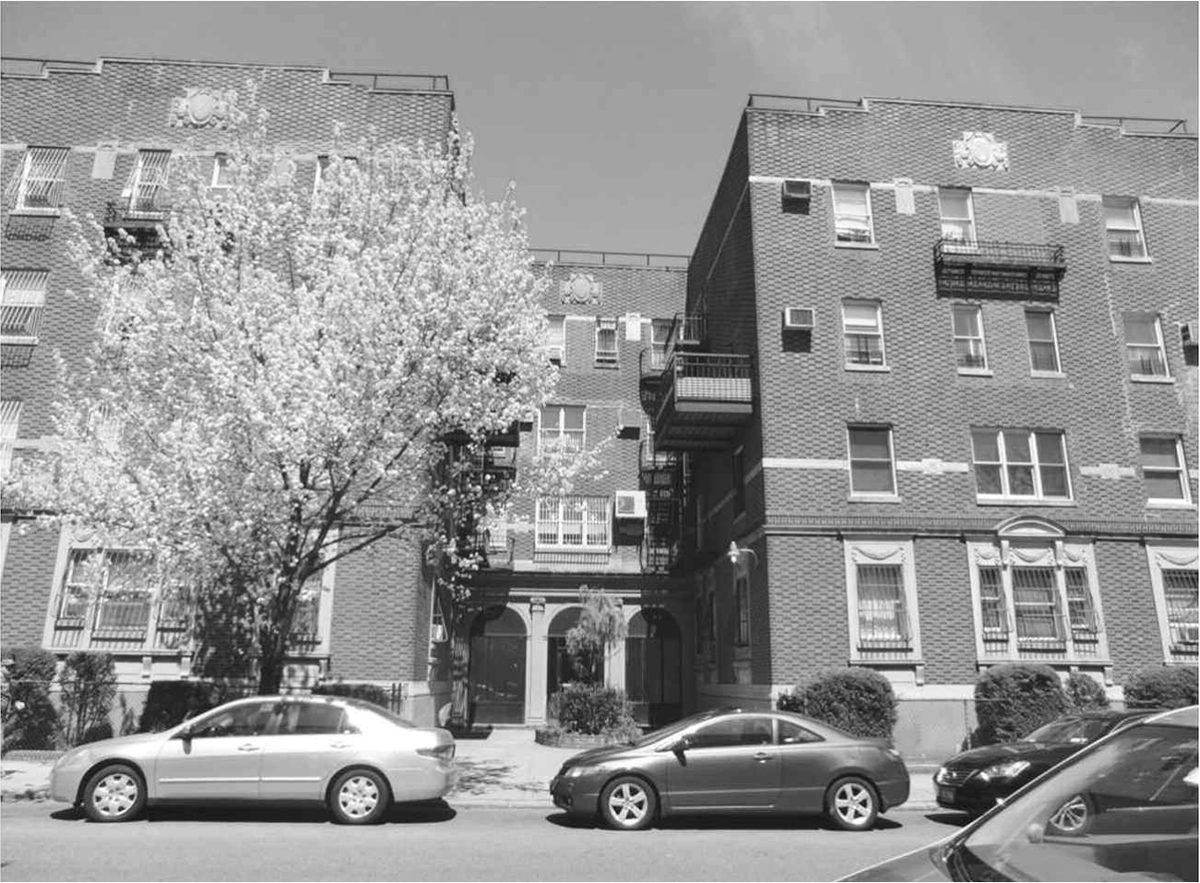
Let us for a moment imagine entering the apartments of Miller and Mailer at 102 Pierrepont just after the war. We would find two artists with surprisingly similar personal traits and aesthetic aims that stem in no small part from their deep Brooklyn roots. First and foremost, we could not help but detect in both a burning ambition to undergo what Norman Podheretz calls “the longest journey in the world, the journey from Brooklyn to Manhattan” (3). Second, we would find two artists sharing a blue collar pride in craftsmanship and respect for physical labor. A consequence of this is that both later exhibited the guilt and shame associated with simply being an artist once their fiction began to appear. In their texts, we also find surprisingly similar themes, including the failure of human agency against larger, unknowable forces and the destructive pursuit of elusive aims. Most significantly, Mailer and Miller share in their work and in their biographies awareness of the paradox that artistic success ultimately demanded a rejection of their Brooklyn origins—which once served as the springboard for their success.
In his autobiographical essay, “A Boy Grew in Brooklyn,” we learn of 1350 East 3rd Street in the Midwood section of Brooklyn that Arthur Miller’s once-prosperous family moved to in 1929, following the Crash. Rather than being devastated from the decline, Miller waxes nostalgically of a neighborhood that had “no distinguishing marks” other than “a flat forest of great elms through which ran the elevated Culver Line to Coney Island” (1). It was a village filled with “characters and practical jokers” who looked after each other and knew each other well. It was also a place of work and elbow room until the squeeze of the Depression brought both anxiety and newcomers to his family’s door. As Miller writes, “an invisible vise seemed to be forever closing tighter and tighter. . . . The woods were gone now and there were houses everywhere . . . . The star football player became a shipping clerk, and was glad to have the job; I, who had planned to go to Cornell, . . . waited around until the fall term began, and seeing that nobody in the house was in possession of the fare, I went to the employment offices for a couple of months and ended up in a warehouse” (9). Miller also notes how his fellow Brooklynites lacked resources of another kind, for “none of us [were] encumbered by anything resembling a thought”—the Depression ensured that there would continue to be no “intellectuals among us” (7).
From this milieu of alienation brought about by an abrupt loss of meaningful employment and human connection, Miller’s early work emerges. In The Man Who Had All the Luck (1944) the setting is an Auto Repair shop, and the main character, David Beeves, wonders if he is “more than just a jellyfish” buffeted about by the tides; that is, whether his success as a repairman and in life is due merely to luck or to human agency. In All My Sons (1947), Miller draws from his experience working in the Brooklyn Navy Yard during the war to build ships for those who will fight to keep the world safe for Democracy. Accordingly, this play deals with the manufacture of engine parts for WWII aircraft and the responsibility those who produce and distribute these parts have for the larger community. In Death of a Salesman (1949), we learn of a misfit named Willy Loman whose work no longer has social meaning, whose sons also look for access to the American Dream but cannot seem to find it in the occupations available to them.
The companion plays, A View from the Bridge and A Memory of Two Mondays (1955), also concern themselves largely with work, as well as the conflicts between different classes and ethnicities. In A View we find that Rodolpho and his brother have come from Italy to Red Hook for the one thing America provides that his homeland cannot. As he says, “Only work we don’t have. I want to be an American so I can work, that is the only wonder here—work” (615). Unfortunately, his American Dream is shattered by Eddie Carbone, who, enraged over losing his niece to an illegal dockworker, reports him to the authorities. In Miller’s favorite play A Memory of Two Mondays, which he called “an elegy for his own years in an auto parts warehouse,” Bert, a sophisticated college student and stand-in for Miller himself, takes a summer job in a warehouse. While in part an homage to working-class culture, the play also points to the limits of this world, captured in one worker’s lament recalling “a terrible lot of Monday mornings in sixteen years. And no philosophical ideas at all, y’know, to pass the time” (475).
Each of these works can be examined to show the influence Brooklyn’s working-class milieu had on Miller. However, it is Death of a Salesman in which we see how Brooklyn accents—both literally and figuratively—not only give the work its resonance but also connect it to Mailer’s early work in interesting ways. Most conspicuous are the very real Brooklyn elements in the play. It is set in the very house Miller lived in, albeit not during the Depression but amid the postwar housing boom, when neighborhoods such as his were in transition. In an early scene, for example, we overhear a conversation between Willy and his wife, Linda:
WILLY: The street is lined with cars. There’s not a breath of fresh air in the neighborhood. The grass don’t grow any more, you can’t raise a carrot in the back yard. They should’ve had a law against apartment houses. Remember those two beautiful elm trees out there? When I and Biff hung the swing between them?
LINDA: Yeah, like being a million miles from the city.
WILLY: They should’ve arrested the builder for cutting those down. They massacred the neighborhood. (165)
In this house and neighborhood, we are introduced to an aspiring middle-class family that, on one hand, laments the passing of community and pastoral values, yet, at the same time, seeks to eagerly embrace the new capitalist order of ownership and upward mobility. Their home, for example, is filled with new products such as a washing machine and a vacuum cleaner, paid for in installments, in the same manner they pay for their Studebaker, dental work, and the house itself. Connected to this desire for outward social status is their elevated diction. Although at times sliding into Brooklynese (all those “gee whiz’s” and “goddamns”), the entire family has an impressive lexicon that some critics claim to be out of character but in fact reflects a conscious desire to camouflage their Brooklyn origins. Willy, for example, congratulates his son for polishing his car, exclaiming “What a simonizing job” (175). Biff queries Happy: “Are you content, Hap? You’re a success, aren’t you? Are you content?” (Instead of “ain’t you”?) (170). Linda, in turn, mixes upper and lower-class lingo, when, late in the play she calls Biff “a philandering bum” (196). Linda’s phrase suggests the two sides of Brooklyn that mark both Mailer and Miller as well: “bum” is the slang of the streets, whereas the adjective “philandering” is the language of the gentry. Miller underscores this uneasy division in the militant language that breaks out throughout the play such as when Willy tells his sons “that when you hit, hit low, and hit hard” (135) and when Biff brags of his poor treatment at work as a manager when “he can out box, out lift, and out run anybody in that store” (170).
In many ways, Miller wants us to sympathize with Willy who has lost his way in a world of new values. Willy is a man only trying to pay his bills, house his family, and take care of his wife and children. Yet his job as a salesman is one that Miller also ultimately questions as insufficiently masculine. Miller thus depicts Willy as one who fails at his occupation but is successful working with his hands. Like Miller himself (who built his own writer’s studio before sitting down to write the play), Loman is an extraordinary carpenter. As Biff recounts at Willy’s funeral, his most memorable days were seeing his father “making the stoop; finishing the cellar; putting on the new porch; when he built the extra bathroom; and put up the garage.” Tellingly, he adds: “there’s more of him in that front stoop than in all the sales he ever made” (255).
Miller’s play was written in a state of anxiety following the success of All My Sons, winner of the 1947 Drama Critics award. Even after the play was a decided triumph, the playwright still applied at the New York State Employment Service to take “any job” that was available and was subsequently sent out to a factory in Long Island City to “stand all day assembling beer box dividers for the minimum wage” (Timebends 138). As Miller himself admitted, he was at the time “suffering the guilt of success, a protective device to conceal one’s happiness at surpassing others, especially those one loved, like a brother, a father or friend.” His more explicit motive, however, was to live “without breaking contact with [the type of members] in the audience who made the paint and filled teeth” (139). It is in this sense that Death of a Salesman—a play about someone trying to make a living in an “inauthentic” manner, who portends to uphold traditional values but in fact is a cheat and charlatan—can be read as an allegory for the tale of the Brooklyn-boy-made-good Miller himself. Like Loman, Miller is a man who grew up under humble origins wishing to live by and promote lower-middle-class values. He chose, however, the occupation of writer/intellectual—a salesman of ideas if you will—that contradicts and even parodies the background from which he emerges.
To elaborate on this point, it is helpful to turn to Mailer’s own initial fictional creations who also attempt to escape their Brooklyn origins. The Naked and the Dead, for example, is often viewed as an anti-war novel that showcases different versions of masculinity. But examined in a biographical context, it can be read as a young man coming to terms with his Brooklyn upbringing. Several characters represent the many sides of Mailer: both those who hold values and goals the author himself seems to aspire towards and those he outright rejects. On one hand, there are the conscripts Goldstein and Roth, who, like Mailer, are Jewish. Private Goldstein is a well-meaning, young family man who regularly reads and writes letters to his wife. As Mailer writes, “after the war he was planning to open a welding shop” and “thought with excitement and joy of . . . becoming an established man in the community” (205). He later tells a fellow recruit that “there’s a suburb I’d like to live in . . . It’s really a fine place, and nice people in it, cultured, refined. I wouldn’t like my son to grow up the way I did” (450). Goldstein hails from the working-class neighborhood of Flatbush (where Mailer’s family lived before moving to Crown Heights). Despite rampant anti-Semitism in the army, he proves his mettle by offering to bring a dying man back to base. Despite sharing similar Brooklyn origins with the author, Goldstein’s commitment to domesticity, his middling ambitions, and his faith—which Mailer treats respectfully—are clearly not to the author’s taste at the time. In a way, the fictional Roth is a bit more like Mailer in that he attended college, sees himself as overly qualified for army duties, and has come to reject his Judaism. But Roth is given to too much self-pitying and caution for the parallel to stick. A dismal soldier, he falls to his death when his legs give out trying to jump over a ravine.
Although often drawing on an outsider Brooklyn stance, Mailer acknowledged how he “left what part of me belonged to Brooklyn and the Jews on the streets of Crown Heights. In college, it came over me like a poor man’s rich fever that I had less connection with the past than anyone I knew” (Dearborn 19). Accordingly, it is in the character of second Lieutenant Robert Hearn that we see Mailer present another side of himself—that part that rejected Brooklyn to reinvent himself. Like Mailer, Hearn attended Harvard, where he read incessantly and established his credentials as a writer publishing work in the Harvard Advocate. Now in the army, Hearn finds his liberal positions challenged by his superior General Cummings who goads him with a reactionary point of view “grounded firmly in men’s actual natures” (321). Preceding the famous crawfish scene, in which the General forces his Lieutenant to pick up a cigarette butt he has tossed at his feet, the General tells his aide: “I’ve been trying to impress you, Robert, that the only morality of the future is a power morality, and man who cannot find his adjustment to it is doomed” (323). When Hearn attempts to retaliate against the General for his humiliation, he—or rather the reader—learns the extent to which Cummings’ views hold merit in the new America. Demoted to running a recon platoon, Hearn meets his death, out-maneuvered by a dark and cunning Sergeant Croft, who is but an extension of Cummings’ will to power.
In Cummings’ meticulous attention to detail and feverish desire to make himself an instrument of his own policy, critics have discerned the writer in Mailer. But it is the writer with distinctly Brooklyn roots that actually emerges in this text and his subsequent novels, Barbary Shore and The Deer Park. Like Miller, Mailer early espoused a working-class aversion to anything smacking of the literary. As he told one interviewer: “I didn’t begin as a literary man; I began as an engineer” (“Art of Fiction” 7). Accordingly, he understood The Naked and the Dead as the “book of a young engineer” and described work on it as “a lot of spot-welding and riveting.” It is in this sense that he most clearly shares an affinity with Goldstein the welder, only on a different scale and in a different form.
Mailer’s interest in engineering emerged while living at 555 Crown Street in the Crown Heights section of Brooklyn during the 1930s [Fig. 2]. In this middle-class neighborhood, he grew up as “the nice Jewish boy from Brooklyn.” According to Mary V. Dearborn, “when he graduated from the eighth grade, the principal said before the assembly, ‘Norman Mailer, IQ of 165, the highest IQ we’ve ever had at P.S. 161.’ The neighborhood boys regarded him as shy, obedient to his mother and somewhat withdrawn. . . . He [also] had taken up building model airplanes, which would be a passionate interest into his adolescence. One was almost four feet long, and every part of it worked” (17). So impressive were these model planes (and his test scores) that the family decision to have Norman attend MIT to study aeronautical engineering seemed preordained.
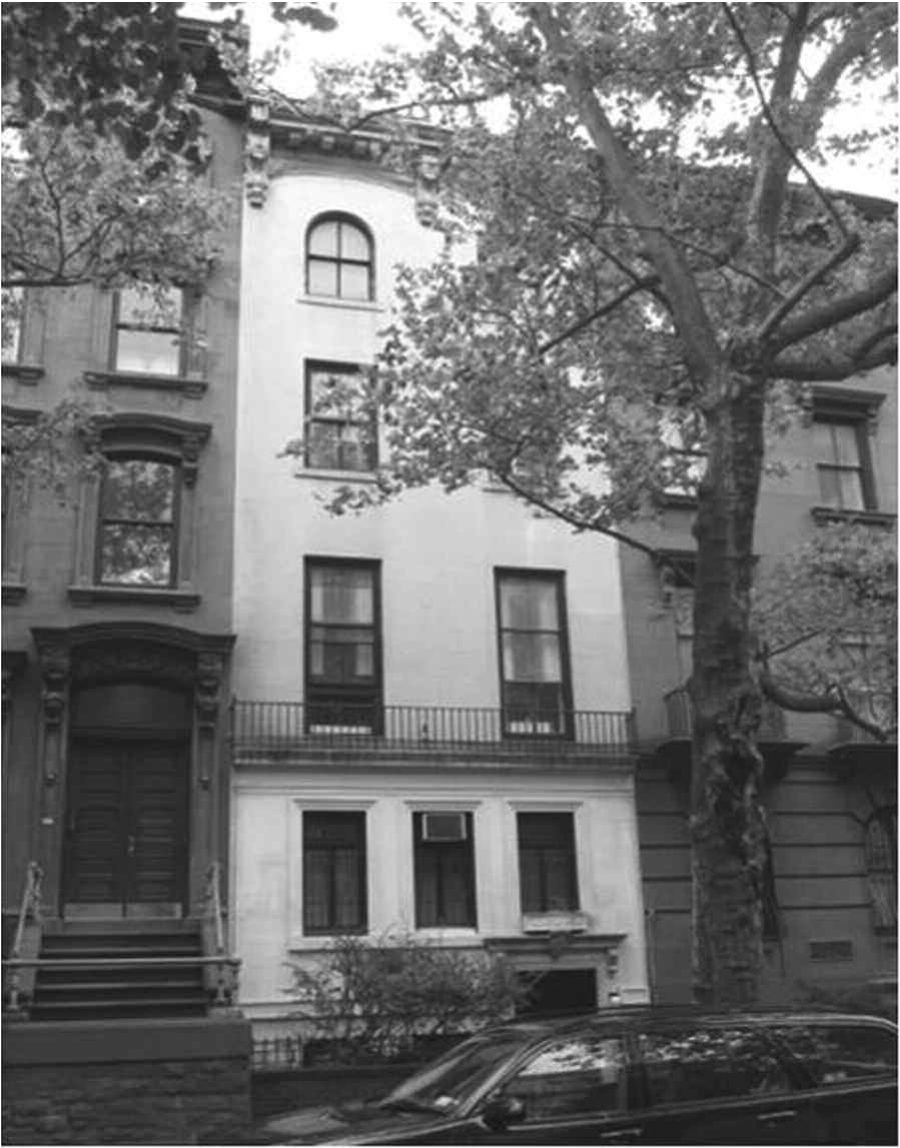
Mailer at MIT is one of those curious “what-ifs” in American history. As Hilary Mills quips, “Had MIT accepted him without reservations, Mailer [might have been] an unknown builder of space vehicles instead of the author of Of a Fire on the Moon” (39). The youthful prodigy, however, balked at the provision that he spend an additional year at secondary school. Instead, he attended Harvard and then enlisted in the army, all the while dropping his engineering plans in favor of becoming a writer. During these years, he would also replace his Brooklyn accent with a Cambridge elocution which he would retain for the rest of his life.
If going to Harvard and then serving in and writing about World War II seems to have taken the Brooklyn out of Mailer, it is telling that in his follow-up novel, he returns to Brooklyn as a setting for Barbary Shore. In fact, he sets the novel in the same rooming house, located at 20 Remsen Street, where he finished editing The Naked and the Dead [Fig. 3]. Apparently, Mailer returned to his roots—imaginatively, at least—to try to handle the sudden wild success of his first novel and his newfound status as a celebrity author at just twenty-five years of age.
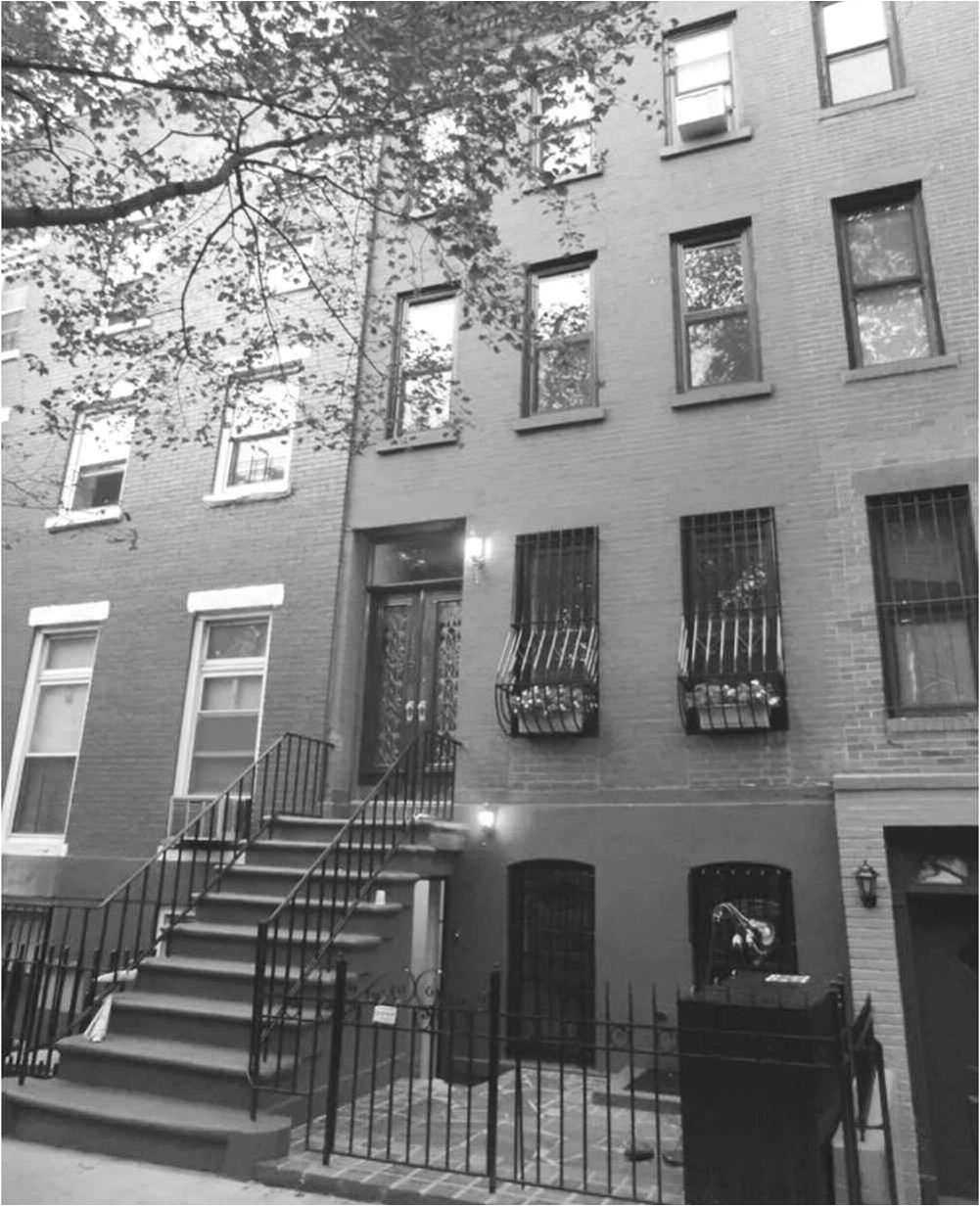
Mailer had originally rented attic space on 20 Remsen Street because the two-room apartment on 49 Remsen Street he was sharing with his first wife Bea Silverman was too small for him to do his work. Bea later explained how “Norman always had this affectation about poverty, even though in those days we couldn’t have afforded much else. But he carried on the affectation even when it was no longer necessary. When he made some money, he still had to have a garret” (qtd. in Mills 87). For Mailer, a work studio in Brooklyn was both a marker of humility and a reminder of where he had come from, even though he did not always want his public to be too aware of this fact.
Recalling Mailer’s recognition of his own erased origins, the narrator of Barbary Shore, Mikey Lovett, is a WWII veteran with absolutely no memory of his past. Lovett begins the novel calling attention to his amnesia and his belief that some unknown trauma is at the source of his condition:
Probably I was in the war. There is the mark of a wound behind my ear, an oblong of unfertile flesh where no hair grows. It is covered over now, and may be disguised by even the clumsiest barber, but no barber can hide the scar on my back. For that a tailor is more in order . . . . I am certain I cannot be less than twenty-five and it is possible I am older . . . . Here and there, memories return. Only it is difficult to trust them. I am positive my parents are dead, that I grew up in an institution for children, and was always poor. Still, there are times when I think I remember my mother, and I have the idea I received an education. (5)
Lovett, America’s first existential hero, finds his mission as a new kind of writer, carrying on a war of subversion against totalitarian, dehumanizing forces also ominous in Miller’s Death of a Salesman. To steady himself, the narrator, like his creator who sought out small, private and enclosed places in which to write, settles in a rooming house in Brooklyn Heights.
Following World War II with millions of GIs returning home, housing in urban centers such as New York was exceptionally tight. In Brooklyn Heights, a high percentage of underutilized and dilapidated Brownstones were cut into one and two-room flats to accommodate the new influx of apartment seekers. Barbary Shore fits into the urban genre known as boarding house literature, a form distinguished by the interplay of unrelated characters who live in close proximity to one another. Mailer’s use of this genre is particularly apt, for the novel is organized by connected scenes in which the narrator must learn to comprehend the impulses of a diverse array of characters in order to best determine his own personal and social aims. On one hand, the landlady Guinevere, a red-headed nymphomaniac, represents the lure of tawdry sex and empty values of middle-class America. There is also Leroy Hollingsworth, the reactionary anti-intellectual, who claims to be a Wall Street clerk but who in fact is a federal informant, reflecting the era of espionage and communist hysteria when the novel was written. Hollingsworth lives in the rooming house in order to spy on an ex-Stalinist named McLeod, who has stolen from the government “a little object” whose true value and purpose are never made clear.
It is in conversations with McLeod that Lovett receives his political education. McLeod is convinced that capitalism and totalitarianism are the dominant forces of the age leading inevitably to “famine and civil war, the deterioration continues until we are faced with mankind in Barbary” (196). His aim is to reverse the process and somehow the removal of “the little object” he now has in his possession will accomplish this. When federal agents finally come for McLeod and kill him, they are too late, for an envelope has already been passed to Lovett, which reads: “To Michael Lovett to whom, at the end of my life and for the first time within it, I find myself capable of the rudiments of selfless friendship, I bequeath in heritage the remnants of my socialist culture” (215). Lovett, in turn, speaks to the reader of his plans and new chosen identity:
So the heritage passed on to me, poor hope, and the little object as well, and I went out into the world. If I fled down the alley which led from that rooming house, it was only to enter another, and then another. I am obliged to live waiting for the signs which tell me I must move on again. Thus, time passes, and I work and I study, and I keep my eye on the door. (215)
Like his narrator, Mailer in this novel seems to have come to a revelation. In the fog of paranoia and suspicion that marked the fifties, the sole path for personal salvation was simply what brought Lovett to Brooklyn in the first place: “to find a corner in which to write a book” (87).
To begin his next novel, the corner Mailer returned to once more was yet another writer’s studio along the Brooklyn waterfront. In the Spring of 1952, he rented space in Ovington Studios, a seven-story building of artist studios, located at 252 Fulton Street. He would utilize this studio until 1962 when the building was torn down, the year he purchased his elegant residence on 142 Columbia Heights overlooking the East River. Built in 1843, the Ovington Building had originally been used by the Ovington Brothers as a department store for their glass and chinaware products. In 1863, it was sold and converted into an Art Colony, which thrived for almost a century. Its old-school charm, high ceilings, and elongated windows with stunning views of the Brooklyn Bridge and the working harbor below made the building a coveted place for painters, sculptors, and writers to work. In the 1950s and 60s, Mailer’s neighbors included the cartoonist Jules Feiffer and caricaturist David Levine. Its most notorious resident, however, was the Soviet spy Rudolph Abel. Living as Emil Goldfus, a retired photofinisher and amateur painter, he was arrested by federal agents in June of 1957. As Nathan Ward writes, his room, at the time, was filled with “his shortwave radio, paint tubes and technical books, along with hollowed-out pencils, tie clips, nails and coins for [concealing] microfilm” (1). It was as if history had been lifted from a chapter out of Barbary Shore. But perhaps a better way of looking at this coincidence is just how prescient Mailer has always been about American political culture even in his most imaginative works.
Like Barbary Shore, The Deer Park too is set amidst the hysteria of the Red Scare, but focused on confronting a new issue for Mailer: failure. Not only had Barbary Shore been savaged by the critics, but the act of writing had become extremely difficult, so much so that the writing of his next work would take three years. The contents of The Deer Park reflect this struggle. Its narrator, a six-foot-tall, blonde ex-Air Force officer named Sergius O’Shaugnessy, has come to Desert D’Or to “begin the apprenticeship of learning to be a writer” as well as to regain his sexual potency (289). Eventually, his virility rebounds as he participates in the sensual decadence of the desert town, based on the real Palm Springs, just outside Hollywood. In this oasis for film stars, directors, their entourages of sycophants and has-beens, Sergius receives some much needed patronage largely owing to a friendship he develops with the well-known director, Charles Eitel. At one point, he is offered $20,000 to sell his own story as an Air Officer and act in the film. Although running low on money, Sergius rejects this offer, realizing he doesn’t want “a slob movie made out of my name” (218). He chooses instead to leave the desert for New York, where he will pursue “the final desire of the artist,” which is to sound “the small trumpet of [his] defiance” (374).
Sergius’s refusal to compromise on artistic integrity is a gloss on Mailer’s own attempt to sell a screenplay version of The Naked and the Dead, but on the condition that he alone would write it—which the major Hollywood studios refused to allow. Mailer also walked away from an original screenplay he had co-written with French intellectual Jean Malaquais, when Samuel Goldwyn, who had contracted for it, insisted his own writers would have final edits to ensure a saleable product for American audiences (Mills 119). This theme of artistic integrity is also reflected in the crucial decision Eitel (a homonym for “I tell”) must make. Like the real-life director Elia Kazan, upon whom he is partially based, Eitel has been asked by the Subversive Committee to testify against Communist Party members with whom he had allegedly associated in the past. Initially, Eitel takes the high ground, but he eventually loses his nerve about being blacklisted. Desperate to regain connection with his audiences and produce a commercial film with a priest for a hero and “an upbeat ending,” he, like Kazan, testifies (180).
In 1954, a film with a priest for a hero and a happy ending did get produced: Kazan’s widely acclaimed On the Waterfront. In a sense, Father Barry’s whistle-blowing on a corrupt union was Kazan’s own defense for testifying before the House of UnAmerican Activities Committee (HUAC). One might go further and argue that the final dramatic scene in which Terry Malloy, played by Marlon Brando, returns to work despite being bruised and battered by union thugs is analogous to Kazan continuing to work as a director despite intense criticism from intellectuals on the Left such as Mailer. But it is Arthur Miller who would go after Kazan even more directly in his work. Like Mailer, he too would engage in what essentially was a Brooklyn street fight to defend his own views on art and politics. For, in the same year that Mailer published The Deer Park, Miller published A View from the Bridge.
Set in Red Hook, where Miller would often walk to and from his Brooklyn Heights home on 155 Willow Street to interview longshoremen, this play adamantly defends loyalty and integrity. The Carbone family harbors two illegal immigrants from Italy, the brothers Rodolpho and Marco, but when Rodolpho falls in love with Eddie Carbone’s niece Catherine, strife tears the family apart. Eddie wants Catherine to leave the harbor in order to secure a good job in the city and marry up. He is first upset that she takes a stenographer job across from the Navy Yard, but what really infuriates him is her interest in Rodolpho. Ultimately, Eddie goes against working-class codes and “rats” on Rodolpho, leading to a fight in which Marcos kills him in retaliation. Just as Willy Loman in Death of a Salesman seeks upward mobility for his sons and expresses his disdain in their failure to do so, Eddie, too, tries to intervene when he sees that Catherine is not taking advantage of her class options. Here again lies the paradox of ambition that both Miller and Mailer themselves would continue to exhibit throughout their careers. Success in the larger world means leaving a smaller world behind, and implies rejection of the latter. Only after the critical failure of Barbary Shore and struggles composing The Deer Park did Mailer finally seem to be able to come to terms with this paradox and see in it a source of power. As he writes of his narrator Sergius, “for the first time I was able to use the first person in a way where I could suggest some of the stubbornness and belligerence I also might have, I was able to color the empty reality of that first person with some real feeling of how I had always felt, which was to be outside, for Brooklyn where I grew up, is not the center of anything” (237). Like Miller, Mailer always strove to be in the center and would eventually find that to get there, he would have to use his Brooklyn origins to full advantage. He would advance this knowledge in a book called Advertisements for Myself, turning to another Brooklyn writer’s tactics to make his own work understood. Borrowing from Walt Whitman’s self-promotion in “Song of Myself,” Mailer ultimately came home to the borough he had fought so hard to leave.
Works Cited
“He Was No Misfit in Brooklyn.” Brooklyn Daily Eagle. 17 Oct. 2011. Web. April 2013.
Bigsby, Christopher. “The Early Plays.” The Cambridge Companion to Arthur Miller. Ed. Christopher Bigsby. Cambridge: Cambridge UP, 1997. Print.
Blumberg, Paul. “Sociology and Social Literature: Work Alienation in the Plays of Arthur Miller. American Quarterly 21.2 (1969), 291–310. Print.
Dearborn, Mary V. Mailer: A Biography. Boston: Houghton Mifflin, 1999. Print.
Mailer, Norman. Advertisements of Myself. New York: G.P. Putnam’s Sons, 1959. Print.
——— . The Armies of the Night. New York: Signet, 1968. Print.
——— . The Deer Park. New York: G.P. Putnam’s Sons, 1955. Print.
——— . Barbary Shore. New York: Rinehart, 1951. Print.
———. Marilyn: A Biography. New York: Alskog, 1973. Print.
——— . The Naked and the Dead. New York: Signet, 1951. Print
———. “Norman Mailer, The Art of Fiction,” Interview by Steven Marcus. Paris Review. Paris Review, Winter/Spring 1964, No. 31. Web. April 2013.
——— . “Miami and Chicago.” Harper’s Magazine 1968: 41–130. Print.
Marino, Stephen A. “It’s All About the Language: Arthur Miller’s Poetic Dialogue.” Critical Insights: Arthur Miller. Ed. Brenda Murphy. Hackensack, NJ: Salem Press, 2010. Web. April 2013.
Miller, Arthur. “A Boy Grew in Brooklyn.” Echoes Down the Corridor: Collected Essays, 1944–2000. New York: Penguin, 2000: 1–13. Print.
——— . All My Sons. Arthur Miller, Collected Plays, 1944–1961. Ed. Tony Kushner. New York: Library of America, 2006: 85–158. Print.
———. Death of a Salesman. Arthur Miller, Collected Plays, 1944–1961. Ed. Tony Kushner. New York: Library of America, 2006: 159–258. Print.
———. The Man Who Had All the Luck. Arthur Miller, Collected Plays, 1944–1961. Ed. Tony Kushner. New York: Library of America, 2006: 1–84. Print.
——— . A Memory of Two Mondays. Arthur Miller, Collected Plays, 1944–1961. Ed. Tony Kushner. New York: Library of America, 2006: 457–506. Print.
———. Timebends: A Life. New York: Grove Press, 1987. Print.
——— . A View from the Bridge. Arthur Miller, Collected Plays, 1944–1961. Ed. Tony Kushner. New York: Library of America, 2006: 569–636. Print..
Miller, Henry. From Your Capricorn Friend. New York: New Directions, 1984. Print.
Mills, Hilary. Mailer: A Biography. New York: Empire Books, 1982. Print.
Podheretz, Norman. Making It. New York: Harper & Row, 1967. Print.
Rollyson, Carl. The Lives of Norman Mailer: A Biography. New York: Paragon House, 1992. Print.
Roudane, Matthew C. “Death of a Salesman and the Poetics of Arthur Miller.” The Cambridge Companion to Arthur Miller. Ed. Christopher Bigsby. Cambridge: Cambridge UP, 1997. Print.
Waldron, Randall H. “The Naked, the Dead, and the Machine: A New Look at Norman Mailer’s First Novel. PMLA 87.2 (1972): 271–277. Print.
Ward, Nathan. “The Spy of Cadman Plaza.” New York Times. 4 Apr. 2009. Web. April 2013.
Wenke, Joseph. Mailer’s America. Hanover: UP of New England. 1987. Print.