This article is based on a series of blog entries1 that discusses the “legacy power” of Norman Mailer, the challenge of carrying this legacy to the college classroom, how I radically changed my pedagogy to teach “Norman Mailer’s ‘America’” to college undergraduates, and what I learned from the experience.
At last year’s conference of the Norman Mailer Society, Phillip Sipiora discussed what he called the “challenge of legacy.” He argued that the work of Norman Mailer, like that of Hemingway and Fitzgerald, has “legacy power”: that is, it deserves to be passed on through the work of academics and enthusiasts, and we literati have a responsibility to maintain that legacy in our various capacities. Norman Mailer’s presence may still be felt in the culture and history of the United States today, even if his work is not literally read. He helped write the culture of the twentieth century and thus influenced the identity of a nation. Mailer’s legacy lives on in the currents of history and culture, and we must endeavor to preserve and perpetuate its flow.
Sipiora’s call to action resonated with another shift gaining momentum in the academy. Like most academic disciplines, the humanities is being influenced by the increasing availability and use of networked digital technologies. This new media landscape not only repositions our relationships with old media forms, but encourages us to think about them in new ways. Nascent disciplines like Digital Humanities consider both the importance of textual preservation and the shifting attitudes and practices in our relationships to these texts. The Digital Humanities borrows from the disciplines of new media and the traditions of the liberal arts to foster communities based on affinity, accessibility, and collaboration.
While the implications for digital media on Mailer studies are many, the academy’s traditional realms of influence—scholarship, teaching, and service—are where I can most see the continuity of Mailer’s legacy. My emphasis here will be on Mailer in the college classroom; specifically, a classroom in the cloud that blends traditional face-to-face with e-learning approaches: exploratory, differentiated learning based on student interests and networked data. In this approach, students use mobile digital devices to communicate, explore, and self-organize their discovery of Mailer.
Obsolete Education
In his TED Talk “Build a School in the Cloud,” Sugata Mitra argues that the educational system invented in the nineteenth century by the Victorians had as a primary goal the maintenance of a global colonial empire. Because instant communication was impossible, education had to produce functionaries who all thought and worked in a similar fashion in order to support the empire. This system needed to sublimate individuality and promote homogeneity in thought and practice to manufacture workers for empire. Even though the empires have fallen, the twentieth-century’s increasingly corporate world found the Victorian system compatible with its goals, so education changed little throughout the last century: factories churning out products, rather than schools educating citizens.
The classroom and its traditional tools are products of this process: grids of desks, podium, chalkboard, books, paper, and pencils. This structure posits the teacher as the authority at the front of the class. Students must remain in their seats and memorize selected materials from their textbooks to restate on exams. This architecture promotes the one-way flow of communication, from the teacher to the students, and the latter are rewarded for their obedience and uniformity, and they are punished for outbursts of individualism or imagination. The classroom and its tools condition students to be students, not educated individuals.
Education has changed little, even today, in spite of the rise of digital technologies and a change in educational approaches. The products of the old approach to education are incompatible with the demands of a postmodern culture that is increasingly decentralized by networked digital technologies. In his book Being Digital, Nicholas Negroponte levels similar criticisms at our educational system. He argues that if a surgeon were taken from 100 years ago and placed in a contemporary operating theater, he would be lost, since science and technology have changed medicine so radically (220). The classroom, however, remains the same today as it did then, so a nineteenth-century teacher would have no trouble teaching in one of our post-2000 classrooms.
Negroponte’s observation suggests another reality: that the jobs education pretends to prepare students for no longer exist. In Tomorrow Now, Bruce Sterling states that because of the twentieth-century’s radical technological transformation, lifetime “stable roles in large paternalistic bureaucracies” are no longer tenable (41). In fact, because of the uncertainty that rapid technological development brings, it is likely we have no idea what kinds of jobs will be available in five years. Perhaps instead of focusing on vocation, education should instead target skills necessary for the digital age, like adaptability, critical thinking, collaboration, communication, and creativity. In his presentation “The Global Achievement Gap,” Tony Wagner suggests that the “Net generation” are accustomed to instant gratification and extending their reach through technology to examine their own social communities and interests in all aspects of their lives except the classroom.
Even as early as 1974, Theodor Nelson questioned the structures of education. Like social indoctrination, the main subject of education is the correct way to learn. Nelson suggests that “schools as we know them appear designed at every level to sabotage the supposed goals of education” based on how information is fed and regurgitated, how students’ own interests and abilities are not considered, and how their responses are carefully monitored and evaluated (308). The products of this system are adults whose “mentality is cauterized, and we call it ‘normal’” (Nelson 308). Our educational system, states Ken Robinson three decades later in a 2006 TED Talk, kills creativity and imagination.
To combat these negative effects of an outdated system, Nelson proposes Project Xanadu, a curated hypertext of human achievement and knowledge. Xanadu was theorized by Nelson to be a system of interconnected and parallel resources that emphasized individual exploration and facilitated unique learning outcomes based on student interests. In this system, the authority did not take center stage, but remained in the background as a facilitator, a gentle guide, or curator. Nelson saw the computer as a key tool for allowing students to relate directly and personally with the subject matter—without interference from the conventional expectations of learning. Education should be “clear, inviting and enjoyable, without booby-traps, humiliations, condescension, or boredom” (Nelson 310).
Nelson’s Xanadu is not the World Wide Web of today. Our hypertext is not really hyper because it can be organized linearly. Nelson seems to desire something less based on the textual objects of the past—something that works symbiotically with the user to create a truly interactive and evolving form: “it has become possible to create a new, readable medium, for education and enjoyment, that will let the reader find his level, suit his taste, and find the parts that take on special meaning for him, as instruction or entertainment” (144). While the World Wide Web is not exactly what Nelson had in mind, it does operate on a similar premise. Among the major problems with the Web are its inconsistencies and the questionable value of much of its information. A web page that was here one day might be gone tomorrow, or moved to a different location. With anyone able to create content, how do we know what content is valuable and which should be discarded?
Add to that what Sterling calls “canon panic”: education aimed at career training and lacking tradition would begin to resemble industry, “clever, fast-moving, but vapidly focused on products and profit” with academics becoming more like business practice (47). If this becomes the case, he argues, scholastic mastery loses its footing. In the digital age, educators must walk the tenuous line between the sheer excitement of networked information and the scholarly tradition of verifiable and organized knowledge. He suggests that educators will increasingly become canon builders, helping students make sense of the expansive knowledge of the digital world that grows every year (Sterling 48). Knowledge of yore depended on the “sacred torch” of weighty tradition, an intellectual canon of cultural classics that the thinkers of the time agreed were important and should be passed on to subsequent generations (Sterling 46). With the encyclopedic and loose nature of the World Wide Web, education needs the guiding presence of the educator, but perhaps in a different capacity in a new age.
The Classroom in the Cloud
Sugata Mitra’s approach to education embraces digital media. In his TED Talk, he discusses the Self Organized Learning Environments (SOLEs). He argues that children who are given access to computers connected to “the cloud”—on-demand data and applications—will educate themselves on how to use them and then put these tools to use to explore their interests further. Beginning with his Hole-in-the-Wall experiment, Mitra has observed that students will teach each other with little need of an instructor’s guidance. Given big questions to explore and the access to technology, students do just that.
Mitra uses the term “cloud” rather than the “Internet” to suggest what I interpret as a curated form of information and services, what the computer industry breaks down into different services based on infrastructure, platform, software, and network. While the implementation of cloud computing services is still nascent and the specifics are more than may be covered here, the important point is that cloud services could contain selected information or organized collections of data provided to students for exploration in controlled ways. Consider the cloud, then, as a digital canon of information collected, organized, and maintained by scholars and humanists, much like an anthology might have been produced in the age of print, but without most of its inherent limitations. Among the advantages to this approach would be the ease of access, the organization of resources, and the breadth of content (Palmer 349). This is the work of the Digital Humanities: pruning the “infinite archive” to an easily accessible collection of data germane to the needs of the scholarly community (Berry 2).
In his TED Talk, Mitra ponders the idea that “knowledge is obsolete.” If the information contained in books to be memorized for tests and daily practice has traditionally been defined as “knowledge,” a moot point perhaps, then in this sense it has been and will continue to be transferred to the cloud—the chief concern of the first-wave of Digital Humanities or humanities computing (Hayles 44). The most convenient way to retrieve information used to be from our gray matter: facts, figures, phone numbers, and whatever else we needed for our everyday lives, private and professional. Still, our brains are like a computer’s random access memory (RAM): the fastest place for immediate recall, but inefficient and impractical for data storage. This would make the cloud like a computer’s hard disk: a place for archive and storage for when we need it. With access to the cloud growing faster and more efficient, much that we stored in our brains can now be transferred to the cloud, freeing up our limited headspace for other tasks. While Marshall McLuhan suggested that when we extend ourselves through our media, a narcosis begins to atrophy the parts of ourselves no longer used, perhaps these parts may now be allocated to different tasks (41). The cloud does not just extend our reach, states Eric Rabkin, it is a technology to transform reality, like the automobile (142).
Integral to a conception of the cloud is participation. If, by definition, networked computers interact, participation is what differentiates human activity. We are not just machines talking to other machines, but human beings with creative potential to collaborate, play, and create our own collective knowledge—to use information in ways that better us and our communities. This is the real sense of Mitra’s innovative approach: it is not just the collecting of information, but the acting upon this information that is important. As recent history has shown us, new media empowers democracy, but without education, revolutions might produce darker outcomes (Lucas 248–49).
When students participate, they take an active role in their education. While traditional models of education teach students to be passive receptors of knowledge, new media encourages them to have a voice. What happens when new media is emphasized in a space that students associate with passivity, conformity, and “student” behaviors? Requiring new media in the classroom is the first step to reconfiguring education for the digital age. Bring education to where the students live rather than changing students to fit “education.”
What does participation involve? It is flipping the classroom in two senses: (1) disseminating materials online that would traditionally delivered in-class, while moving “homework” to the classroom; and (2) eschewing a position of authority to promote collaboration and discovery. With students front-and-center, they may examine the topic from any angles that make sense to them and meaningfully contribute their understanding to the classes’ collective knowledge of the topic.
If McLuhan is correct in his assertion that the medium is the message—that is, a consciously political statement by which he means a “change of scale or pace or pattern that it introduces into human affairs”—then we must consider the message of the classroom medium (McLuhan 8). A literal change of classroom design could also break the message of the “classroom” and allow students to participate more easily; for example, let’s ditch the grid of plastic desks and replace them with cloth chairs and couches; remove the PC workstations in favor of tablets; trade the fluorescent lights and industrial furniture for warmer lamps and group tables. A literal space that is designed for discussion would be a strong step toward breaking the old military-inspired educational paradigm.
Participation also involves collaboration, which in digital humanities is the “rule rather than the exception” (Hayles 51). Encouraging student collaboration allows them to contribute their individual skills to creative, multimodal projects that might be impossible for individual students to accomplish alone. Using social media in the classroom also allows students to communicate with each other beyond the physical classroom and gives them a new dimension to engage the course content. Social media, like Twitter and Google Plus, become the tools of the classroom in the cloud, an informal writing space that gives students permission to explore ideas without the pressures associated with traditional forms of analysis and evaluation, like the essay.
To summarize: the classroom in the cloud emphasizes student collaboration by deemphasizing the message of the traditional classroom. It removes the “sage on the stage” to one of curator or “guide on the side.” It asks big questions that allow room for diversity in response. It makes social media integral to classroom communication, and it encourages collaboration, exploration, and creativity. The classroom in the cloud kicks students to the deep end of the pool, making them reassess education and their relationship to it. By making students responsible for contributing to a collective knowledge of the course materials, it promotes a new commitment and enthusiasm toward the course content.
These ideas provide the foundation of my approach to my spring 2013 HUMN 4482 Studies in Culture course: “Norman Mailer’s ‘America.’”2
#mailerclass
The irony of blending the study of Norman Mailer with the classroom in the cloud is not lost on me. My initial experiences with Mailer and his work included his statements that vilified and condemned computers as “the most advanced, extreme, and brilliant creation of the Devil” (Mailer God 18). As I would learn, this position had been consistent throughout Mailer’s career, yet Mailer was never one to disregard the potential advantages of the Devil. In a 2007 interview in Rolling Stone, Mailer was asked if he ever used a computer, and he responded: “I use it indirectly. My wife uses one, and my assistant, so I get the benefits without having to pay the price” (Binelli 70).
Mailer introduces the PBS documentary “Mailer on Mailer” with a similar statement about television:
I really don’t enjoy the physical concomitance of being on television . . . but I do it because when one wants to reach people . . . [and] if you’re not going to write a book that’s a wonderful book, and you do have a lot of ideas that are piling up in your head, it probably is better to express them on television than to not express them at all.
Like television, Mailer uses the computer when it is to his advantage. However, there is the caveat: Mailer’s use of a technology does not mitigate his critical eye about it. He might use a computer or television—in his eyes both technologies are culturally less profound and important than the book—for his own ends, but he would also let the public know of their potential deleterious effects. In a similar vein, Marshall McLuhan—one of Mailer’s old sparring buddies—warned about the dangers of a transparent technology to “impose its own assumptions on the unwary” (15). In this way, Mailer, McLuhan, and I agree. Teaching with technology allows me to use it for its advantages, critique it, and teach important new literacies.
My approach to Norman Mailer would be through a senior-level course in my college’s catalog called “Studies in Culture”: a humanities course that allows the examination of a selected topic from a historical perspective. A cultural studies course expands the topic’s purview to include texts beyond Mailer’s literary work—like journalism, biography, films—but within a certain time and place. I want to at least touch on Mailer’s entire career, emphasizing Bufithis’ “literary outlaw,” Lennon’s novelist-journalist-historian, and Bloom’s courter of “danger, disaster, and even scandal” (53, 91, 1). The course would consider the cybernetic loop of Norman Mailer writing “America,” while America made its mark on “Norman Mailer.” We would examine representation: the man himself, “Norman Mailer,” in Bloom’s words, the “supreme fiction,” and the many facets of “America” reflected in his work (2). His America was the one after World War II, a nation at war with itself, struggling to write its own identity, the “shits” in one corner, the “white negroes” in the other.
My emphasis would be a view of “America” through the filter of some of Norman Mailer’s work. This approach would allow me to select specific texts, but give the students the latitude to explore whatever issues they found interesting within those texts. I chose texts that I was interested in exploring further, many from Mailer’s earlier career: Advertisements for Myself—including “The White Negro” and “The Time of Her Time”—An American Dream, The Armies of the Night, Maidstone, The Executioner’s Song, On God, and others. I wanted a variety of genres that reflected Mailer’s complicated relationship with his country at particular historical moments.
The class would emphasize intertextuality, participation, and collaboration. This would be our exploration of “Norman Mailer’s ‘America,’” which was also located in a particular place and time. I was excited to answer Sipiora’s call, but I kept wondering how students from a small, liberal arts college in central Georgia at the beginning of 2013 would react to the works of Norman Mailer and an America they never experienced? While planning the course, I talked to several colleagues, most of whom thought my choice to teach Norman Mailer in general and The Executioner’s Song in particular exposed me as a special form of crazy. “Jerry, The Executioner’s Song is over a thousand pages, isn’t it? They won’t read it.” Indeed, with multitasking brains and endless media distractions, teaching this titan of American letters would hold its challenges (Lucas 258). While articles like Matt Richtel’s “Attached to Technology and Paying a Price” suggest that computer technologies may be rewiring our brains, I find arguments like this to be little more than knee-jerk reactions, akin to “texting is ruining the English language” and “violent video games cause violence in real life.” While there might seem to be some logical connections, perhaps it is the way we approach these ideas that’s flawed. Kind of like teaching itself.
Norman Mailer’s “America” would combine some traditional methods with what I think are digitally progressive classroom-in-the-cloud approaches. The course would be held in a traditional face-to-face classroom, meet twice a week, read and analyze texts, discuss aspects of the reading in class, and utilize familiar evaluative measures, like exams and essays. However, to bring the course into the cloud, I decided to call on a technology that seems to be as common today as the car: the smartphone.
Part of the challenge as I saw it was that my students were products of the educational system that Mitra and Nelson critique. How would I get students to reverse their expectations of what a traditional classroom has always been for them: a relatively passive experience where their roles as students were dictated by the very medium of the classroom? In order to break open the walls of the classroom to let in a bit of the sky, I thought the smartphone would do the trick, since most of my students have them anyway—something that I could not count on in the relatively recent past. I wanted each student to have a device (what theorists call “1:1 Technology”) to be responsible for individual work and to participate in online discussions. For those who did not have their own device, the department would supply them with an iPad to use for the semester. Out of twenty students, only one, non-traditional student asked for a departmental device.
The parts of #MailerClass that bring it into the cloud are my devices policy, social media, and classroom approaches that rely on the former two. The next step was to get them to use their devices in class, something that I thought would not be an issue.
Devices and Their Media
I recently attended one of those mind-numbing meetings that all of us academics are summoned to from time to time. In order to mitigate the meeting’s effects, I brought along my iPad, so that I could take notes and respond to my students on Twitter. Before the meeting began, I was tweeting away when a colleague from the IT department sat down in front of me. I looked up and greeted him, and he pointed to my iPad: “Man, if I could just convince my students that those are tools and not toys my life would be a lot easier.” I considered this for a moment and replied: “Can they be both?” Before we could continue our discussion, the meeting began, but I’ve been considering his statement ever since.
If I want to incorporate the use of digital devices in my classroom to encourage students to participate and to explore, the best way to achieve this, it seemed to me, was to encourage them to play with their toys rather than work with their tools. Considering things further, Mitra’s and Nelson’s approaches seem closer to serious play than to mundane work. When education is so serious and adults like Mitra and Nelson argue, then something wonderful is lost in the process. Social media is where students go to play, and I saw no reason to stifle this attitude. Perhaps a bit of guidance would be all I would need to provide in order to make social media an integral part of the classroom in the cloud.
Bring Your Own Device
Upon entering the classroom, most students are familiar with professors telling them: “put away your cell phones.” I, too, was once guilty of this same policy in my classes. While some have suggested that casual use of social media mixed with school work may negatively affect students’ grades (see Stollak, et al.), so might watching TV while working on algebra or studying in McDonald’s. Other studies, as Richtel reports, have shown that computer users have greater neural activity and can often make out greater details than non-users. This greater activity might be channeled to educational tasks. Therefore, instead of struggling against the inevitability of technology in the classroom, I thought that it would actually be better to try to change my pedagogy to incorporate cellphones, or other gadgets, into the curriculum. If students can use their cellphones and social media in critical ways, perhaps it might actually increase their engagement of the materials. Therefore, my BYOD policy was born.
An integral part of #MailerClass would the BYOD policy: “in this class, you must have some sort of networked digital gadget capable of web access with you in class everyday.” Whereas a pen and paper were integral to yesterday’s classroom, the digital device —smartphone, tablet, laptop—would be crucial to the daily operation of the classroom in the cloud.
What makes a requirement like this appropriate today is the ubiquity of devices, especially smartphones. While I would not have expected all students to have a device just a couple of years ago, these days it is pretty much a given for college students to have a cell phone. Indeed, students are more likely to forget their chemistry text or a pen than they are their smartphones. A 2010 study determined that 74% of students have an Internet-connected computer at home, but 93% of them go online (Lenhart, et al. 4). The same report states that those in lower income brackets are more likely to use their phones to go online since access to a computer is likely more limited (Lenhart, et al. 9). According to Joanna Brenner in a recent Pew Research study, 91% of all American adults own a cell phone, and over half of those are smartphones. One in four teens access the Internet mostly through their cellphones (Brenner). And for pure convenience, nothing beats the device that students bring with them in their pockets.
In my experience, most traditional students had some sort of device to bring to class: usually a laptop, smartphone, or tablet. The ones who did not were non-traditional: students coming back to college later in life after raising a family or working in the private sector. As mentioned above, for these students the department had a cache of iPads to draw from, assuring that all students, despite their economic realities, had a device to use for the semester. Additionally, they could use the device for their own applications and other classes, something I encouraged them to do. Even if the students elected to purchase their own device, a $200 Android tablet or Apple iPod Touch is more affordable, portable, and desirable than the least expensive netbook or laptop. In fact, Rik Myslewski of The Register reports that because of the increasing popularity of the tablet, netbooks will become extinct by 2015. Perhaps the laptop will follow soon after.
Cell Phones and Tablets
Students use their phones for a variety of purposes, from communication to game playing, with Facebook dominating the social media pack currently (Sponcil and Gitimu 7). Social media were born out of the Web 2.0 and allows students to stay in touch with and contribute to select communities, some based on personal relationships while others center around amateur and professional interests. As the last two presidential elections have shown, young people are using social media to directly engage with the political process, like starting online political groups, discussing important political issues, or producing a topical YouTube video. As a 2012 University of Chicago study shows, this “political participation” is unique in that it crosses traditional lines of race and ethnicity, is peer-based, and is not affiliated with traditional institutions and centers of authority (Cohen and Kahne vi). Social media have also been credited to the spread and success of the Arab Spring, the challenge to the American copyright system, and on-going civil unrest of the world-wide Occupy Movement (Lucas 248–49).
As any Google search will show, educators are increasingly using social media as classroom supplements. Many use the King of Social Media, but I prefer to leave Facebook purely to the students’ uses. However, I want to harness social media’s accessibility with a critical approach to social media literacy that fosters best practices. Students are already familiar with the mechanism of social media that makes them more accessible, and they have another benefit. They are “lean back” services that deliver content to the user, so they work even better on mobile devices. Unlike a web-based, course management system that students have to visit in their web browsers, content from social media is delivered—or “pushed”—to mobile devices, much like a text message. Notifications prompt a response. If devices condition us to respond to their beeps and pop-ups, why not take advantage of this feature for learning.
Much like the “classroom,” traditional media of evaluation—the essay, research paper, etc— often stifle students rather than excite them. Social media do the opposite. If students would rather tweet than write reader responses, then how might they be motivated to substitute social media for classroom media? While the essay is a traditional literacy of the liberal arts academy, perhaps developing and implementing best practices for social media might also be considered a crucial literacy in the digital age (Greenhow and Gleason 466).
For those who are unfamiliar, Twitter is usually defined as a “microblogging platform”; consider it a hybrid of text messaging and a chat room. Its posts, or “tweets,” are limited to 140 characters, are displayed to a user’s “followers,” and may be read on the web or through any mobile device. Tweets range from reports about a user’s lunch to discussions about quantum physics. Conversations may happen synchronously or asynchronously, and they may be organized under hashtags: any keyword preceded by a hash (#). For example, posts about my Mailer class were labeled with #MailerClass, so they could be found and referenced easily. Each lesson and text had its own hashtag.
The 140-character limit on Twitter requires expressions to be succinct and precise—just the opposite of what academic writing seems to encourage. While Twitter can be criticized for vacuous content, it can also be valuable in getting students to consider rhetoric and composition to form deliberate and exact thoughts. According to Greenhow and Gleason, this encoding and decoding of information represents a new type of literacy: what they call a “Twitteracy” (466). Digital literacies depend on making informed choices about selecting and using digital platforms and applications for the most efficacious communication. Digital literacies are multimodal, dynamic, participatory, forward-looking (Greenhow and Gleason 466-67). The daily use of Twitter to discuss course materials encourages students to engage key points, report their additional research, and learn a crucial literacy for communicating today. However, the use of any digital tool should be appropriate for the application.
The most literate tweets would be the ones that were thickest—an idea I borrowed from David Silver. Thick tweets make the best use of Twitter by encoding as many layers of information in a single tweet as possible. For example, this tweet provides commentary, analysis, and a link to Joan Didion’s review of The Executioner’s Song:
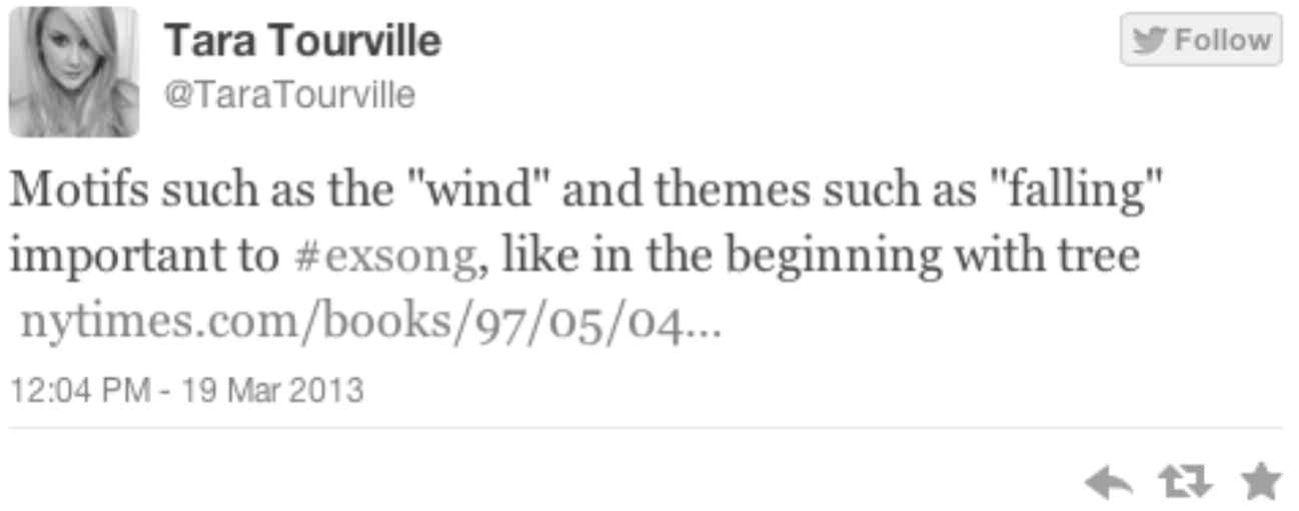
For class, students are encouraged to make their tweets as thick as they can in order to add to the classes’ understanding of the text under discussion. As students began to use Twitter, I often engaged them to make thin tweets thicker by asking questions that encourage further research or provide support for a supposition. As the students became more proficient with Twitter, my interaction was not as important for maintaining their Twitteracy. We could now use the tool for learning.
The course used Twitter in several ways. Each lesson revolved around a specific text or texts, like The Executioner’s Song (#ExSong). I posted questions for consideration at the beginning of the lesson, so students could choose one or two that interested them. Each required knowledge of the primary text and also encouraged students to look for secondary sources for support. In their exploration, they tweet their findings and analyses using the hashtag, so all are collected, easily referenced, and evaluated.
Twitter would often be used in class for asking questions and reporting on group work. For this activity, I would turn on the classroom’s projector, and pull up Tweetchat in a web browser—a service that aggregates tweets based on a single hashtag. As students post their questions and findings, they appear as posted in the Tweetchat window. The class would then come together to discuss some of the points and answer some of the questions, bringing the online discourse into classroom discussions.
Twitter was used in a couple of other ways, especially in the classroom. One use was particularly popular: the lecture liveblog. While I rarely lectured during this semester, when I did, I encouraged the students to capture key ideas in their tweets, usually assigning a hashtag for the day. After class, they could review their tweets and make additional comments. This exercise, too, allowed me to read through their tweets to see exactly what points they found important, ones that I needed to highlight further, and ideas that were misheard or misunderstood. Similarly, I would often ask students to summarize the top points from the day’s lecture or discussion. This use of Twitter also supplied them with additional ideas to discuss and research.
Twitter is also good for preliminary research and exploration into a topic. One approach is to annotate a text while reading. For example, The Armies of the Night is a historically situated work, replete with references to popular or to political culture of the late sixties. Students were asked to Google items that were unfamiliar, tweet a brief explanation, a textual reference, and a link. These annotation tweets were also collected under a specific hashtag, like #MailerArmies.

I have found Twitter to be an excellent email replacement for two reasons: (1) it is much more convenient, especially if your university is using an archaic email system, and (2) it is more immediate. Email seems to encourage more formality than is necessary these days—that message carried over from another print medium: letters. Dispensing with salutations, closings, signatures, spam filters, and all the rest of the email quagmire allows for more efficient communication. Since Twitter is more like text messaging, it allows students to send quick questions. Often a question will be answered even more quickly by another student, relieving me of the task. Since the question posted is public, unless a student sends me a private direct message that they can do for more sensitive questions and concerns, then the whole class sees it and benefits from the answer. This sort of interaction, in my experience, binds the class more closely, so it starts to function as a close-knit unit early in the semester. In fact, most students in the class will follow each other and even begin using Twitter in a social capacity outside of their class work.
Finally, in order for Twitter to function most efficiently, students need to install it as an application on their devices, so notifications can be sent automatically. One of the best features of Twitter is its immediacy: if a student mentions me in a tweet, my phone lets me know immediately, and vice versa. If Twitter is used as an application, expecting students to check their email—or worse the course management system’s messages—is unnecessary. I have found that even the students who only check their email once a week are very quick to respond on Twitter.
Disqus
Disqus began as a commenting system for blogs, but has grown into its own discussion platform. Whereas Twitter is an informal activity—good for in-class communication and discussion, Disqus might be a good substitute for the essay: a more formal environment where students offer new analyses, synthesize critical ideas, and engage in further discussion about the topics. I emphasize Twitter as a place to explore and gather ideas and Disqus as a place to refine those ideas. Disqus is used like an asynchronous forum attached to my course web site. Discussions are organized in threads, and students may respond to a post or vote it up or down. Threads may be organized chronologically or by popularity. Students may post multimedia to accompany their textual responses, but getting them to link to support is the literacy that I emphasize with this tool.
Disqus has the benefit of a very familiar interface: it is essentially a place for comments under a blog entry. I use Disqus on my course web site, Lit-MUSE, as a place for student discussions. It has the advantage of being familiar, so students usually possess the technical literacy for its use when they first encounter it. However, like Twitter, I offer them some best practices. I emphasize that these posts are not essays, but like essays, they must have a central point to make, develop that point clearly and logically, and use primary and secondary sources for support. Links are de rigueur, even though initial posts will have awkward remnants of MLA, like works cited lists stuck on the bottom of a post. I offer a brief lesson on basic HTML (Hypertext Mark-up Language, the underlying code of Web sites) and using links at the beginning of the semester. I stress that MLA Citation Style is necessary for print documents, but cumbersome and awkward for hypertext. While there is still no equivalent for the MLA on the web (a good thing?), I find that students take to linking much quicker than they ever do to MLA.
I begin our study of a text or texts with general questions for students to consider as they read and research. These questions are only meant to give them an idea of what they might pay attention to in their reading or viewing and what they could explore further afterward. However, if students have their own questions or areas of interest, I encourage them to pursue those as well.
With Disqus, I place a heavier emphasis on supplying evidence for assertions. This is not a skill unique to the digital age, but perhaps one that needs to be emphasized. While students could address any aspects of Mailer’s texts they found interesting, their suppositions must be supported with evidence from the primary text or links from secondary sources on the web. I would not discourage students from going to the library for actual print books and periodicals, but I choose not to require these types of sources in the digital classroom. That said, the Internet grows as a scholarly resource daily, and many of the campus library’s holdings are available through Google Books. I know that many may cringe when I say it: but libraries as we have known them are changing because of digital technologies and the behaviors they encourage.
Skype (Facetime)
Perhaps since it seems so novel, yet reminds us of television, Skype seemed to be one of the students’ favorite activities. One student commented: “Skype interviews were probably the coolest thing I have ever done in a college class.” To me, this is an obvious digital resource, but one I’ve never taken advantage of nor is it one that I have ever seen any other educator use.
Every classroom on campus is equipped with an Internet-connected computer, a projector, and some sort of audio. I have used this equipment many times for presentations, but it took a hint from mobile technologies for me to take it the next step: almost all digital devices today have built-in cameras capable of video. Apple touts its FaceTime as a social application for communicating with friends and family, and they equip every device they make with a camera for doing so. If social services like Twitter and Disqus can be used for education, why not services like Skype and FaceTime?
I decided to call on the Mailer community to help me teach my course. I invited Phillip Sipiora to discuss An American Dream, Mike Lennon to provide historical context for The Armies of the Night, and John Buffalo Mailer to talk about The Big Empty and share some stories about his father. Our preparation for these discussions involved reading the primary texts and bringing in questions for the speakers. Both Sipiora and Lennon gave forty-minute presentations after which they took questions. John Buffalo Mailer told some stories and answered questions. Each digital guest spent about an hour with the class, and all precipitated animated classroom and Twitter discussions afterward. One student even took thorough notes of each session and made them available via Google Docs.
On the course exit questionnaire, I asked “what was your favorite activity?” Most students raved about the Skype sessions as a memorable educational experience, for example:
The Skype interviews were my favorite. They showed another viewpoint that expanded the class’s view of who Mailer is. They also lend to class discussion which was essential for this class.
Another states:
My favorite activity was definitely the three times that we had the opportunity to Skype with the Mailer experts: J. Michael Lennon, Phillip Sipiora, and of course, John Buffalo Mailer. Their collective first-hand knowledge of the man and novelist that Norman Mailer was proved to be priceless learning information in the classroom. Not only are opportunities like this seldom in the classroom, but all of the experts were so easy to communicate with and learn from.
And another:
The Skype interviews were outstanding. I could not believe the questions we were able to ask from people who knew Norman Mailer the best. It drew me closer to the artist as a person and helped me appreciate his work on a different level.
Skype proved to be a simple and stimulating activity easily added to the curriculum. All it takes is a community of experts and enthusiasts willing to donate a bit of their time. My class and I both appreciated the efforts of Phillip Sipiora, Mike Lennon, and John Buffalo Mailer for making an already good class even better.
Why Mailer? Some Final Thoughts
Ever since I attended my first conference of the Norman Mailer Society, I was struck by the close-knit community of scholars and enthusiasts that gathered around this American literary giant. I had never before attended a conference that was so intimate and friendly—participants from all walks of life engaged with one another around Mailer’s lifetime of work. And even though my knowledge of Mailer was practically non-existent, the community welcomed me and inspired me to actually look into the man’s legacy that they were all there to celebrate and pass on.
It is because of this community that my #MailerClass was a success. I don’t think I would have had such a good class in any other topic simply because of the support I received from the Mailer community. This class turned out to be one of those special courses—a perfect storm of material, approach, and participants that made for a poignant educational experience for all involved. I think it is worth sharing some student feedback.
Honestly, I was very skeptical at coming into this course (once I realized who Norman Mailer was) because I am a strong believer in God, and I knew that much of the themes dealt with were things I tend to stay away from. I was not excited about having to delve into such dark material. However, I was pleasantly surprised by Dr. Lucas’ ability to teach the texts in an objective and interesting way, and I ended loving the class. In fact, it was one of my favorite classes I have ever taken. I even think that my religious background served me well because it gave me a foundation on which to understand Norman Mailer’s Jewish and, at times, Christian upbringing since so much of that appears in his work.
This course was one of my favorites of all my classes throughout my college career. Yes, it was very challenging and Dr. Lucas expected a lot but it made us work harder and go beyond the surface level of a college class. Whether it was tweeting or in class discussions each helped in my understanding of who Norman Mailer was and his importance as a writer to his generation and future generations.
Best Course Ever! This course taught me more than I can share in this text box. I read novels. The difference being that I actually read for this course. I wanted to read for this course. This course engaged me on a personal level and was exactly what I needed to foster the process of lifelong learning that will be necessary for my career. This course taught me the value of independent thinking and learning. I view art and the artist through a new lens because of this course. I learned personal responsibility in this course, responsibility for my own mind and future. I learned about courage, and what it means to be courageous in the midst of adversity. Continue to offer this course; it has the potential to change the lives of the students that take it. This course is one of those rare ones that teaches the students about life and is applicable to every scenario. The professor who taught the course, Dr. Lucas, is perfect for the job.
During this course, I had to challenge myself more than I ever have, and these challenges proved to be very fruitful in my growth as a reader, writer, and lover of literature. I truly appreciate Norman Mailer, as well as his multiple personae. We value actors and celebrities so much in our society, yet most would be quick to judge or even hate a man like Norman Mailer who brings just as much entertainment, and perhaps contrived actions and personalities to the public. Throughout the semester, I found myself loving and hating Mailer just as he feels about our America, but at the end, I can’t help but say that I will continue to read his works and I will always appreciate his literature, regardless of the medium or style that he employs. As I said, the course really challenged me—and there could have been no better professor than Dr. Lucas to professionally and knowledgeably execute these challenges. I dare say that I learned more about myself, than in many other courses, and found this class among the most fulfilling that I have experienced in my undergraduate career.
This is the best college course I’ve ever been a part of. It will be hard to top the level of participation given by our class. Dr. Lucas has a passion for this subject matter and it came through in his teachings. There should be warning labels on all of Norman Mailer’s material. It can bring out some long lasting effects to its audience.
Courage to handle the truth is required for this course!
When I read these comments, I find myself thinking again of my first encounters with Mailer’s work. Like the first student above, I was skeptical those years ago, but persistence and exploration within Mailer’s oeuvre really pays off. In the “First Advertisement for Myself,” Mailer demands the “finest attention” and he “will settle for nothing less than making a revolution in the consciousness of our time” (17). Mailer aimed high, as did this course. Yet, I think he knew that only by challenging and demanding the best from his readers could he succeed in being a writer who is “more disruptive, more dangerous, and more powerful” (Mailer Advertisements 22). His goal, he goes on to state, is to combat the “shits” and the
lies [that] eat into the seed with which we are born, little institutional lies from the print of newspapers, the shock waves of television, and the sentimental cheats of the movie screen. Little lies, but they pipe us toward insanity as they starve our sense of the real. (Advertisements 23)
I hear a challenge in Mailer’s words to education, a clarion call that summons educators to disrupt students’ expectations of the classroom and how it shapes their behaviors. The humanities classroom should not teach conformity, nor should it continue to conform to centuries-old educational paradigms. Mailer’s work is the perfect material to teach when challenging these paradigms, for our goals are similar: to help educate citizens to “rage at the cowardice of our time which has ground down all of us into mediocre compromises of what had once been our light-filled passion to stand erect and be original” (Advertisements 23).
I would like to end by making a call of my own to augment Sipiora’s position. We as Mailer scholars and aficionados need to begin using social media as an integral factor in our serious work. The best way to bolster Mailer’s “legacy power” is to bring our discussions into the places where people participate. By embracing and using social media as a necessary component of our work, we can expand interest in Norman Mailer and his work to communities that might not otherwise have ever heard his name. Teaching Norman Mailer in a college classroom is one thing, but to bring our community online is quite another.
We scholars often work in isolation, and the traditional media we embrace reinforces it. Print media still reigns supreme in communicating scholarship, but continuing to embrace only these sanctioned modes of academic discourse is shortsighted. Teaching and learning must move beyond the cloistered closet of the academy and embrace digital spaces as the new frontier for collaboration, conversation, and participation. I have found services like Twitter excellent for teaching, but they are also unparalleled in professional development. Spend some time on Twitter exploring hashtags, like #EdTech or #EdChat, and you will be deluged with support and resources from a knowledgable, friendly, and vibrant community.
Scholars must embrace social media. Not to do so will make us and the subjects we care about obsolete, relegating us to old media forms and the crypts that will store them. I am not calling for the end of print journals or novels, but I am suggesting that these old media do not necessarily invite the digital natives into our conversations, nor do they do as much as they used to for legacy power. Mailer Studies is grounded in this academic culture, but like Norman Mailer himself who challenged the boundaries of genre and identity, our study and society should make new media integral to propagating Mailer’s legacy. The practice of a new media literacy must be embraced if Mailer Studies specifically and the liberal arts in general are to continue to have an influence in the digital age. Social media are no longer an option, but a necessity.
To read the hypertextual version of this essay, visit: http://grlucas.net/teaching-mailer/.↩︎
My syllabus for HUMN 4472: Norman Mailer’s “America” (#MailerClass) may be found on my class web site: http://litmuse.net/mailer/. The traditional class mechanics, which I will not delve into here, maybe found on the syllabus. Many of the discussions linked under the schedule show my use of Twitter and Disqus in daily work.↩︎
Works Cited
Berry, David M. “Introduction: Understanding the Digital Humanities.” Understanding Digital Humanities. Ed. David M. Berry. New York: Palgrave McMillan, 2012. 1-20. Print.
Binelli, Mark. “Norman Mailer.” Rolling Stone May 3-17 (2007): 69-70. Print.
Bloom, Harold. “Introduction.” Norman Mailer. Ed. Harold Bloom. New York: Chelsea House, 1986. 1-6. Print.
Bufithis, Philip H. Norman Mailer. New York: Unger, 1978. Print.
Brenner, Joanna. “Instagram, Vince, and the Evolution of Social Media.” Fact Tank. Pew Research Center. 20 June 2013. Web. 15 May 2013.
Cohen, Cathy J. and Joseph Kahne. “Participatory Politics: New Media and Youth Political Action.” Youth & Participatory Politics. The Youth Participatory Politics Research Network. June 2012. PDF.
Greenhow, Christine and Benjamin Gleason. “Twitteracy: Tweeting as a New Literacy Practice.” The Educational Forum (76): 2012: 463-477. PDF.
Hayles, N. Katherine. “How We Think: Transforming Power and Digital Technologies.” Berry 42-66. Print.
Lenhart, Amanda, Kristen Purcell, Aaron Smith, and Kathryn Zickhur. “Social Media and Internet Use Among Teens and Young Adults.” Pew Research Center. 2010. PDF.
Lennon, J. Michael. “Norman Mailer: Novelist, Journalist, or Historian?” Journal of Modern Literature 30.1 (2006): 91-103. Print.
Lucas, Gerald R. “Norman Mailer and the Novel 2.0.” The Mailer Review 5.1 (2011): 248-263. Print.
Mailer, Norman. Advertisements for Myself. New York: Putnam, 1959. Print.
Mailer, Norman and J. Michael Lennon. On God: An Uncommon Conversation. New York: Random House, 2007. Print.
“Mailer on Mailer.” American Masters. PBS. 4 Oct 2000. Television.
McLuhan, Marshall. Understanding Media. New York: Signet, 1964. Print.
Mitra, Sugata. “Build a School in the Cloud.” TED. Feb 2013. TED Talk. Web. 1 Mar 2013.
Myslewski, Rick. “Netbooks Projected to become Extinct by 2015.” The Register. 12 Apr 2013. Web. 20 May 2013.
Negroponte, Nicholas. Being Digital. New York: Vintage, 1995. Print.
Nelson, Theodore. “Computer Lib / Dream Machines.” The New Media Reader. Eds. Noah Wardrip-Fruin and Nick Montfort. Cambridge, MA: The MIT P, 2003. Print.
Palmer, Carole L. “Thematic Research Collections.” A Companion to Digital Humanities. Ed. Susan Schreibman, Ray Siemens, and John Unsworth. Malden, MA: Blackwell, 2004. 348-365. Print.
Rabkin, Eric S. “Audience, Purpose, and Medium: How Digital Media Extend Humanities Education.” Teaching, Technology, and Textuality: Approaches to New Media. Eds. Michael Hanrahan and Deborah L. Madsen. New York: Palgrave Macmillan 2006: 135-147. Print.
Richtel, Matt. “Attached to Technology and Paying a Price.” The New York Times. 6 June 2010. Web.
Robinson, Ken. “Schools Kill Creativity.” TED. Monterey, CA. Feb 2006. TED Talk. Web. 5 Apr 2013.
Silver, David. “The Difference Between Thin and Thick Tweets.” Silver in SF. n.p. 25 Feb 2009.
Sipiora, Phillip. “Hemingway, Fitzgerald, Mailer, and the Challenge of Legacy.” Conference of the Norman Mailer Society. Provincetown Inn, Provincetown, MA. 11 Oct 1012. Conference Presentation.
Sponcil, Megan and Priscilla Gitimu. “The Use of Social Media by College Students: Relationship to Communication and Self-Concept.” Journal of Technology Research (4.1): 2013. PDF.
Sterling, Bruce. Tomorrow Now: Envisioning the Next 50 Years. New York: Random House, 2003. Print.
Stollack, Matthew J., Amy Vandenberg, Andie Burklund, and Stephanie Weiss. “Networking usage on Grades Among College Students.” Proceedings of the ASBBS (18.1). ASBBS Annual Conference Las Vegas Feb 2011. PDF.
Wagner, Tony. “The Global Achievement Gap.” YouTube. Web. 8 July 2013.
Social Media
A friend of mine recently asked me: “isn’t all media —by definition—social?” I see the validity of this question as our world becomes increasingly interconnected through the digital. These days, media actually seems strange to us if they do not have social components—the exact opposite of how we conceptualized and practiced media in the twentieth century. Whereas last century’s media landscape was dominated by the professional, the centralized, and the one-way flow, the new media disrupt and challenge how we express ourselves. While media landscape might still have the latter characteristics, it seems more defined by the amateurs who decentralize and often reverse the flow.
While “media” have not always been social, our expectations and practices precipitated by the digital continue to have an indelible affect. Because this is the case, the educated must be literate—that is, have a critical understanding of the use and function of media—in the applications of the digital world.
Many college courses used to be able to ignore the media of the course and focus on the content. That is, by the time students matriculated from the core into upperclassmen, the professor could turn from the mechanics of instruction to the content of instruction. For example, in an upper-level literature class, it could be assumed that students came into class with the functional literacies needed to communicate—like knowledge of essay conventions when writing about literature—we could now concentrate on the more interesting components: the literature itself.
While I am not ready to throw the essay out of the academy, I do wonder why such effort is still spent in teaching this moribund medium. It does not engage the students; it seems to make their writing more ponderous and academic; and it is a less valued skill in the digital age. Ironically, students still expect the essay as a component of education, so challenging them to look beyond it can sometimes be problematic. Even though the efficacy of the essay printed on dead trees might be in question in a digital age, the spirit of the essay—a container in which knowledge of course content is synthesized and new perspectives are argued—still needs to be preserved.
While I still think that upper-level courses should emphasize course content and often the essay is valuable in evaluating students’ understanding of the content, social media makes a strong addition to the college classroom. My #MailerClass used Twitter, Disqus, and Skype as integral components of the curriculum.