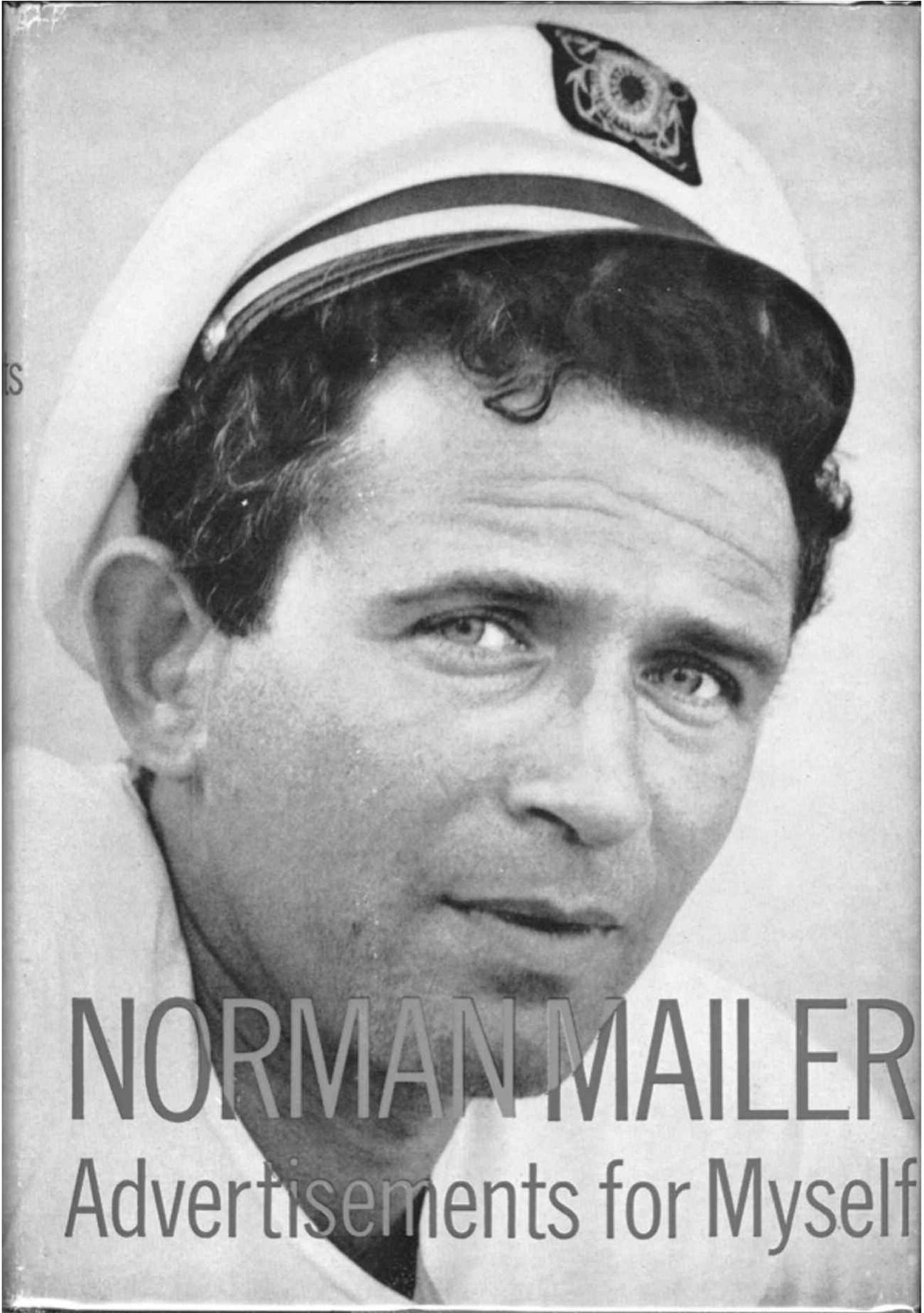
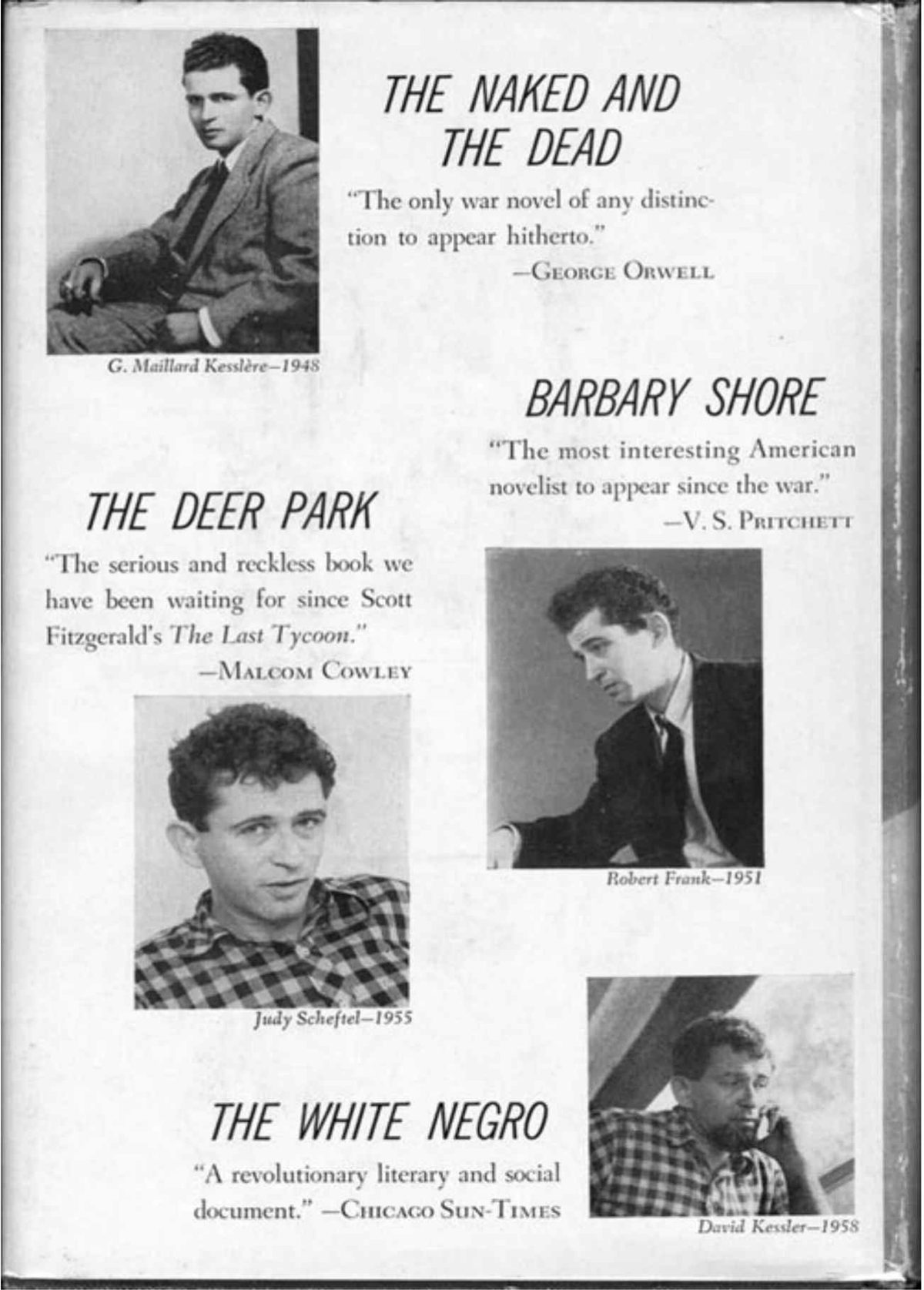
Just as the text of Norman Mailer’s Advertisements for Myself is an attempt to let the reader in on a range of aspects of Norman Mailer’s writing life, the paratext of the original 1959 edition is remarkable for its efforts to show the consumer detailed facets of Mailer’s image. The cover shows him smiling seductively into the camera, in a white t-shirt and yacht cap, playfully upper-class clothing that resonates with images of Mailer’s own existential hero, presidential hopeful Senator John F. Kennedy, who was frequently photographed at the Hyannis Port Yacht Club (Fig. 1). The back cover of the book shows the author in four different poses: in the first, Mailer is the young and brooding author of The Naked and the Dead; in the second, he is the more mature intellectual behind Barbary Shore; the third captures him in a checkered shirt, looking casual and cool, the real-life model for Sergius O’Shaugnessy in The Deer Park; and the fourth portrays him as a bearded beatnik, a middle-aged white hipster with his head resting pensively on his hand (Fig. 2). Showing Mailer from every angle, Advertisements for Myself offers up “the real” Mailer for the reader’s entertainment.
A meditation on both self-expression and self-promotion, Advertisements for Myself anthologizes Mailer’s existential quest for authenticity at the same time as it reveals his performative approach to celebrity authorship. Depicting himself as the authentic author, unfettered by the need to maintain a carefully crafted image, take on false airs, or play a public role, Mailer presents himself as immune to the demands of his critics, his readers, and, most importantly, the market—a strange thing to do in a text entitled “Advertisements for Myself.” Featuring the notorious essay “The White Negro,” in which Mailer envisions the black hipster as a natural Method actor, Advertisements piggy-backs onto the paradoxical association that it delineates between the black subject as authentic and the black subject as performer in order to open up a space between reality and fantasy that Mailer can use to both political and profitable ends. Honing his ability to take on a variety of roles in the public eye as his celebrity grew in the 1960s, Mailer inspired the BBC documentary Will the Real Norman Mailer Please Stand Up? (1968) and inspired Laura Adams to comment that “it would appear that [Mailer’s] only consistency has been in deviating from commonly accepted literary manners” (4) in the introduction to her 1974 anthology of the same name.
Meeting direct cinema filmmaker Don Pennebaker in the middle of the decade, Mailer began testing the individual’s ability to seem authentic and keep “cool” in the sights of the film camera. Making and starring in his third film, Maidstone (1968), Mailer finally got a chance to turn the cameras on the countercultural agenda for which he had recently become a figurehead. Creating a record of the creative and often violent authority that always exists behind the image of “the real,” Maidstone reveals the ways in which the counterculture’s utopian vision of reality is just another ideological construct that, unfortunately, often emulates the mainstream social hierarchies it claims to oppose. But in the end, Maidstone is most memorable for what it tells us about Mailer himself. Finally showing audiences what seems to “really” be the “real” Mailer—a Mailer who seems anything but cool—Maidstone manifests Mailer’s own masterful manipulation of the fine line between representation and reality that made his authorial career a media success. Locating both individual freedom and political power in the ability to pass the real off as simulation and simulation off as the real, Maidstone reminds us that Mailer matters because he used his celebrity to demonstrate the individual’s potential for resisting authority and redefining reality—even if this potential could only be practically realized by an elite few.
Black Brando as Existential Hero: “The White Negro” and the Method Actor
Longtime friends with famous Method actors Marlon Brando and Montgomery Clift, Mailer started attending a playwright’s group at the Actors Studio in 1957 in order to work on transforming his novel The Deer Park into a stage production (Dearborn 135). Developed by the Russian actor Konstantin Stanislavsky and brought to the United States by Lee Strasberg, the founder of the Actors Studio, Method acting provided a technique for connecting with the unconscious desires and emotions that capitalist culture repressed, allowing the actor to get in touch with his “authentic” self. Encouraging actors to resist “social pressures that impose standards appropriate merely to [a character’s] external identity” (Krasner 27), Method acting, as cultural historian Krin Gabbard argues, became increasingly popular during the 1960s as a growing fascination with unearthing a real human nature, uninhibited by social convention or cultural constraint, became more prevalent, and it was often associated with the black subject, whose marginalized social existence seemed to make freedom from social conventions possible (24). With Marlon Brando as the exemplary Method actor who, as Gabbard argues, frequently used gestures and postures stereotypically tied to black masculinity in his portrayal of white masculine characters, Method acting, in an ideological reversal of historical reality, made the authentic seem accessible and acceptable via the performance of the liberated and performative “black” self inside the repressed white subject.
The same year that he joined the Actors Studio, Mailer wrote “The White Negro.” As cultural historian Eric Lott argues in his essay “White Like Me,” “The White Negro” participates in a long tradition of blackface minstrelsy that goes back to the eighteenth century, in which white men both appropriate and perform black masculinity as a means of fulfilling their own repressed, sexual desires (475). “The White Negro” updates that tradition by reinterpreting black masculinity as the ultimate symbol not only of sexuality but of self-reproduction and reinvention. Unafraid “to swing with the rhythms of another” in hopes of “making the new habit, unearthing the new talent” (Advertisements 350–51), Mailer’s Negro is depicted as both a kind of natural-born Method actor and a symbol of the radical creative freedom that Mailer was searching to represent in his own work. Detailing the ways in which the Negro seems to be able to take on the philosophical outlook, tone, and even the dialect of whomever he is talking to—the most prescient example is the anecdote that Mailer tells about a black man imitating the affected accent of a young white co-ed in order to sleep with her (350)—Mailer represents the Negro-as-Method-actor as the ultimate master of performance, self-invention, and existential freedom. Attributing “that muted animal voice which shivered the national attention when first used by Marlon Brando” to the hipster in “Hipster and Beatnik: A Footnote to ‘The White Negro’” (373), Mailer makes the association between the Negro, the hipster, and the Method actor clear.
Republishing “The White Negro” in the 1959 anthology Advertisements for Myself, Mailer began to represent himself as both a white Negro and a professional performer, an authentic author-as-actor, who “keeps it real” while also always keeping his own performativity in play. In the opening “First Advertisement” of the anthology, Mailer acknowledges that modernist authors had to carefully maintain their public images in order to be successful, but he also seems to instinctively understand that a new breed of what we might retrospectively call “postmodern” authors are most successful when they manifest a willingness to perform outside of and in contradiction to cultural convention and consumer demand. As Mailer writes:
I, in my turn, would love to be one of the colorful old men of American letters, but I have a changeable personality, a sullen disposition, and a calculating mind . . . Perhaps I should hire a public relations man to grease my career, but I do not know if I can afford him (not with the size of the job he would have to do for me), and moreover I would be obliged sooner or later to spoil his work. While there would be hardly a limit to how lovable he could make me in the public eye it would be exhausting for me to pretend to be nicer than I really am. Indeed, it would be downright debilitating to the best of my creative energies. (21–22)
In a book entitled “Advertisements for Myself,” it is hard to know how to take this rejection of commercial advertising except as a tongue-in-cheek acknowledgment of Mailer’s own awareness that what sells best in America at the start of the 1960s is the posture of nonconformity, of reality itself. Unlike the modernist author who worked hard to present a consistent and polished public face to his adoring fans, the postmodern author must advertise his existential potential, his freedom of self-expression, and his refusal to bow down to any but his own authentic desires—in other words, his “realness.” Selling his books by advertising both his own changeability (the entire text of Advertisements is an index of Mailer’s personal ups and downs, his literary coups and his literary blowouts) and his own uncivilized authenticity, both of which are constantly belied by Mailer’s fairly consistent and distinguished style and highly-educated prose, Mailer associates himself with authenticity but also performance, giving himself room to declare his own writing sincere or a set-up at any moment.
Consequently, though “The White Negro” has often been read as a racist treatise that reveals Mailer’s own failure to recognize the kind of damage that an association of an abstract black subject with primal and uncivilized desire inflicts upon real, black individuals, it may also be possible to read “The White Negro” as an attempt to open up a performative space for both “white negroes” and black subjects to use at their own discretion. In other words, by depicting the black subject as ambiguously suspended between the real and the performative, between authenticity and acting, much as he depicts himself, Mailer opens up a gap through which the power of the subject to define which aspects of his or her existence are real and which are performed can emerge. But in his response to Mailer’s essay entitled “The Black Boy Looks at the White Boy,” James Baldwin astutely points out the problem with this tactic:
The roles that we construct are constructed because we feel that they will help us to survive and also, of course, because they ful-fill something in our personalities; and one does not, therefore, cease playing a role simply because one has begun to understand it. All roles are dangerous. The world tends to trap and immobilize you in the role you play; and it is not always easy—in fact, it is always extremely hard—to maintain a kind of watchful, mocking distance between oneself as one appears to be and oneself as one actually is. (270–71)
Here, Baldwin calls Mailer out for pandering to a market obsessed with commodifying the “authenticity” of the repressed at the expense of any awareness of the “real” material and historical inequalities that shape the experience of racial subjects, and he acknowledges the violence with which the largely white, mainstream media, of which Mailer is a part, traps marginalized subjects in static and stereotypical roles. Realizing that Mailer’s writing on black experience is part of a larger attempt to figure out “how power works” (279), Baldwin acknowledges the black subject and, as he puts it, “the middle-class Jew[’s]” shared interest in cultural and political resistance (269), but he also acknowledges Mailer’s superior cultural agency and more fluid social mobility that make roles easier to exchange and reality easier to manipulate.
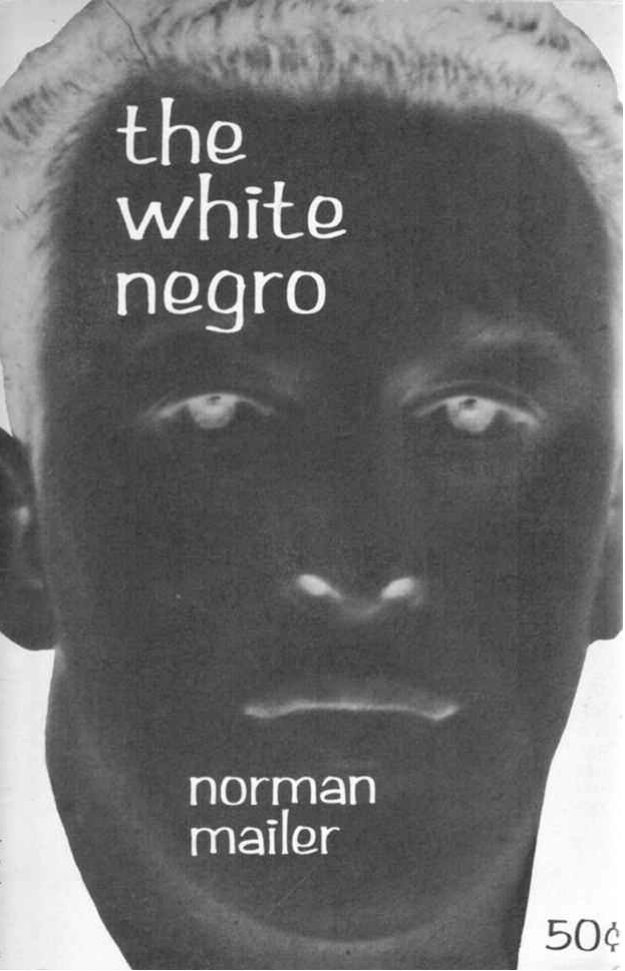
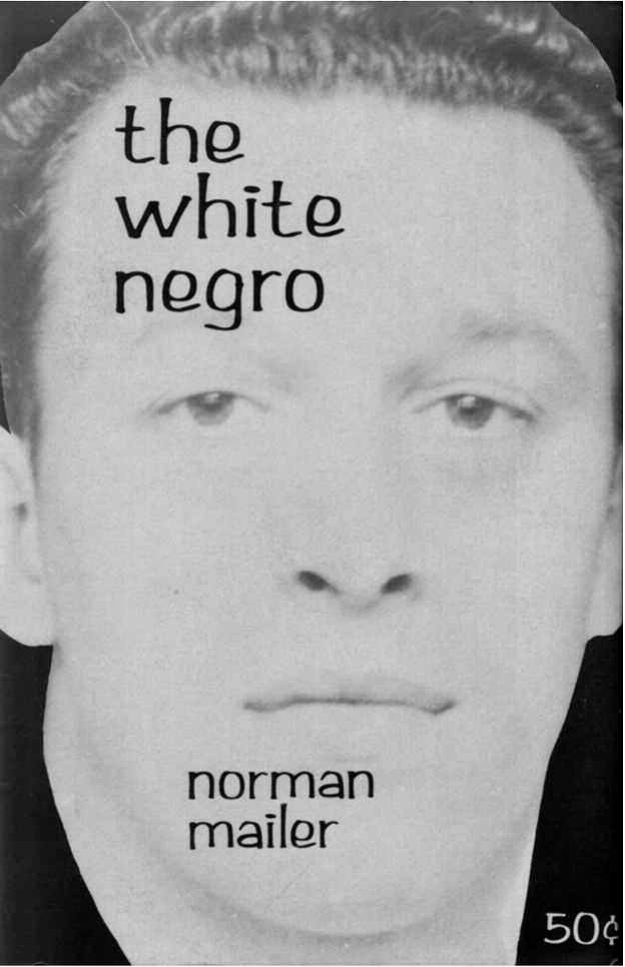
In 1960, Mailer partnered with City Lights to release a paperback printing of “The White Negro.” On the cover is a photographic negative, the inverted image of a white man whose skin is an uncanny black and whose hair is a gleaming white (Fig. 3). Revealing the white man’s unconscious desires for blackness, the image is an almost too perfect example of the link between what Marxist scholar and philosopher Walter Benjamin calls “the optical unconscious,” that “[other] nature which speaks to the camera as opposed to the eye” (117) and the psychological unconscious. Revealing the white artist’s repressed desire for black authenticity, the negative uses the inverted image of the white subject to bring both repressed visions and repressed desires to the surface of the reader’s consciousness. Though this cover photograph is sometimes confused with an image of Mailer himself, the photographic negative is actually a self-portrait of Harry Redl, a famous photojournalist of the 1960s (Fig. 4). Seeming to present a portrait of himself to his readers, Mailer once again hides behind a façade and, this time, it is the white photographer, the subject conventionally held responsible for differentiating the “real” image from the fictional one that he chooses as his mask. Reflecting the cultural agency required to be able to consistently reorient the public indices of fiction and reality to meet one’s own needs, the black negative of the white photographer also illuminates a symbolic system in which the black subject is given no choice, no control over how he or she is represented.
Reality Testing: The Violence of the Cinematic Apparatus and the Resistance of the Film Actor
In addition to theorizing the optical unconscious of the camera, Benjamin theorized the violence of cinematic technology. Declaring that, “Magician is to surgeon as painting is to cinematographer” (115), Benjamin argues that the cinematic apparatus penetrates its subject in order to see inside of it, revealing the uncannily constructed nature of reality, at the very same time as the malleability of cinematic film enables its reconstruction and representation in the editing room. Pointing out the ideological function of the film editor, who constructs reality out of disparate images in order to suit his or her own purposes, Benjamin emphasizes the camera’s ability to seem to provide unmediated access to the real at the very moment in which the real is mediated and, in fact, violated most thoroughly. Violently reconstructing, the cinematic apparatus also violently tests its subjects, challenging their ability to maintain their own humanity in the face of the technological apparatus. As Benjamin writes:
Film makes test performances capable of being exhibited, by turning that ability itself into a test . . . To perform in the glare of arc lamps while simultaneously meeting the demands of the microphone is a test performance of the highest order. To accomplish it is to preserve one’s humanity in the face of the apparatus. (111)
Recording the actor’s ability to maintain a sense of his or her own “humanity,” or authentic, subjective agency, even when confronted by the demands of the camera, film captures the actor’s ability or inability to resist the piercing eye of the camera and maintain control over his or her own self-representation.
In the 1960s, the introduction of new editing technologies, like the tape splicer and the ability to print frameline markers and arrowheads on an editor’s workprints, made it easier for film editors to easily differentiate and recombine shots to create new sequences of images (Monaco 88) and resulted in a new kind of documentary film editing that called attention to its own violent reconstruction of reality. Slashing long shots, fracturing narrative continuity, and decimating the bodies of the most famous feature-film couple of the decade—Bonnie and Clyde (1967)—the new Hollywood cinema of the 1960s was not only more violent than the cinema of the 1950s but also more interested in conveying the visceral experience of violence to its viewers by editing the image in unconventional and non-narrative ways (184–86). Violating the continuity of the film body just as the violation of the human one was being played out on screen, the new Hollywood cinema was unmasking both the artificiality of historical narrative and the unified perspective of the individual human subject, bringing the constructed nature of the real to the screen’s surface.
Meanwhile, the documentary film genre was undergoing similar transformations. Influenced by the French New Wave and cinéma vérité, direct cinema used new editing technologies, newly portable cameras, and new synch-sound recording equipment to create self-reflexive films that emphasized the role of the film editor as well as the cameraman and sound crew in the film production process. Established by Robert Drew, a photography editor at Life Magazine, direct cinema initially made its debut in The Living Camera, a series of made-for-television documentary films produced by Time, Inc. Using editing to impose what Drew called “a crisis-structure” on to the indexical footage of reality, direct cinema created entertaining and suspenseful narratives out of everyday events through a choppy editing style that called attention to the act of editing itself. Reveling in the grainy image, imperfect sound, and unpredictable occurrences that come when shooting outside the controlled environment of the film studio and often including images of the cameraman and sound crew within the final version of the film, direct cinema attempted to woo audiences by providing a behind-the-scenes look at the violent construction of documentary film itself (Barsam 303).
Mailer was introduced to Don Pennebaker, a budding celebrity filmmaker who had worked with Robert Drew on The Living Camera series, in the mid-1960s. Willing to put up $1,500 in order to purchase film stock, Mailer was quickly able to persuade Pennebaker to donate his services free of charge to the making of Mailer’s first film, Wild 90. Like Mailer’s two films that would follow, Wild 90 relied on the self-reflexive aesthetic techniques of direct cinema to convey a loose, fictional narrative plot fleshed out by Method acting-inspired improvisation. This combination of documentary aesthetics and fictional performance was a result of Mailer’s understanding of the performativity of social existence and social reality. In his essay “Some Dirt in the Talk,” Mailer writes, “Acting is not only the preserve and torture rack of the professional actor, but is also what we do when we enter into new relations with man, mate, associate, or child” (116). For Mailer, most middle-class, white Americans were confined to monotonous roles that they were compelled to perform day in and day out. Mailer believed that the free improvisation of the Method actor, which he had advocated in “The White Negro,” might help subjects to get in touch with their authentic humanity, their true existential potential, allowing them to be more “real” than they would be if they were asked to “play” themselves in a conventional documentary film.
In essence then, Mailer uses the improvisational fictional film as a kind of social psychology experiment, not unlike those of Stanley Milgram and Philip Zimbardo that bookended the decade. Conducting a series of experiments in which test subjects were asked to administer electric shocks to fellow test subjects (who were actually plants) on the command of an authoritative administrator, Stanley Milgram famously demonstrated how hard it was for individuals to resist authority, even when it contradicted their personal, ethical values, in 1960. Similarly, Philip Zimbardo’s 1971 Stanford Prison Experiment would impressively reveal how quickly individuals adapt to roles—in this case, those of prisoners and prison guards—even when those roles violate the subjects’ own sense of self. Using theatrical staging and dramatic manipulation to generate insight into social reality, Milgram and Zimbardo used hidden cameras to record what their experiments revealed and often found that test subjects were unable to maintain a sense of self when confronted by the authoritative pressure to perform and conform in certain ways. Inspired by the Eichmann trial and the Nazi atrocities of World War II (Franklin 211–213), these experiments revealed how easily previously nonviolent German citizens might have been converted to violence by the power of social authority alone.1
Unfortunately, if Mailer’s films attempt to test his cast members’ abilities to resist authority and exert individual agency, the cast members usually fail. In his first two films, it is Mailer the authoritarian director who manages to not only take over the film but to cow his fellow cast mates into submission. In Wild 90, Mailer and his actor friends Buzz Farber and Mickey Knox play mafia hit men hiding out in a small New York apartment for three days in order to escape the police. Inspired by a game of gangster play-pretend that Mailer shared over drinks with Farber and Knox, Wild 90 was designed to be the collective project of three drinking buddies, a communal artwork in which power was equally distributed and democratically shared. Giving Farber and Knox equal leeway to improvise and direct the plot in whatever way they saw fit, Mailer, nevertheless, ends up exerting an unfair influence over the other actors when on screen and over the film’s editing in post-production. While Wild 90 sets out as an experiment in democratic creativity, the film actually reveals Mailer’s authority over a supposedly shared artistic project and the cast members’ inability to resist his commands.
In his second film Beyond the Law (1967), Mailer takes the concept of “experimental cinema” literally, developing a narrative scenario that more explicitly puts himself and his cast to the test. Anticipating Zimbardo’s Prison Experiment, Mailer broke his cast of friends and family members into two groups—half the cast played arrested criminals and half the cast played cops—and hired Pennebaker and Leacock to record what would ensue. Like the Stanford prison simulation which had to be called off because the subjects playing prison guards were becoming so domineering and sadistic that they were starting to cause actual trauma to the subjects playing prisoners, Beyond the Law, as its name suggests, shows how quickly violent behavior can arise in previously nonviolent subjects when social (and in this case, directorial) authority commands it. As a short interview at the end of the 2007 CineMalta DVD release of the film shows, even Mailer was not immune to the effects of the simulation he had constructed. Sharing what seems to be a somewhat painful memory, Mailer recounts his decision to cast a friend he had always suspected of being secretly gay as a criminal brought up on charges of male prostitution:
There was one fellow, I remember, who had spent his life not being homosexual . . . You could tell that the drama of his life was that he did not want to become a homosexual, had succeeded in not being a homosexual. And, with the real cruelty of a director, I decided that he would be arrested that night for having solicited in a men’s restroom in a subway. I didn’t tell him this until he was in the scene, and he was so furious at me. I remember that I was [playing] the interrogating detective, and at a certain point, he tried to lay his hands on me. At which point, I slapped him with my hat, or was about to, I don’t recall now. What I clearly remember was the impulse that I had—this was a good friend!—to hit him with the felt hat that I was wearing on my head, to take it off and slap his face with it because he had dared to touch me as a cop.
In this instance, Mailer’s own acting performance reveals an underlying desire to assert his own authority over those around him that overcomes and overwhelms his desire to create a democratic, communal performance. While Mailer had pitched Beyond the Law as a democratic project in which cast and crew would work cooperatively to create a collective final product, Mailer’s “cop” brings his own conformity to social authority and social suggestion to the screen’s surface, and shows that even one of America’s most innovative authors could not always “keep it real” when confronted by the power of social authority and the penetrating eye of the camera.
Mailer’s Maidstone: “A Commando Raid on the Nature of Reality”
By the time the filming of Maidstone began in 1968, Martin Luther King, Jr. and Bobby Kennedy had already been assassinated. Shot on a hotel balcony in Memphis, Tennessee, the night before he was to lead a march in support of a sanitation workers’ strike, King died within an hour of the assassin’s bullet piercing his face and neck. Shot three times at the Ambassador Hotel in Los Angeles just after winning California’s democratic presidential primary, Bobby Kennedy was hit once in the head and twice in the back within feet of news reporters and cameramen. On August 10, 1968 media studies superstar Marshall McLuhan published an article in The Saturday Evening Post in response to Bobby Kennedy’s death. For McLuhan, Kennedy’s assassination left a gaping hole in the political field, as all of the other presidential hopefuls were too “hot” for the new electronic medium. For McLuhan, television is a “cool” medium that instigates an interest in the cool candidate, capable of maintaining his composure in any situation and resisting or, at least, seeming to resist the demands of the public—in other words, a candidate who could pass a screen test with flying colors and maintain his reality or “humanity,” as Benjamin might have said, in the firing line of the camera. Declaring that, “In merely media terms, a Negro in the White House would have the most soothing and cooling effect on both national and international politics” (34), McLuhan fingers the existential hero, the “white” Negro, that Mailer had written about a decade earlier, as the perfect presidential candidate for the electronic age.
Preceding McLuhan’s article by about a month, Mailer’s third film takes inspiration from the star power of Bobby Kennedy in order to set Mailer himself up as the nation’s next cool political candidate and to explore the reality of the counterculture’s dreams of a superman that could survive the test of the camera. But in contradiction to Mailer’s earlier films, Maidstone is less of an attempt to record the resistance of the screen actor on film than to represent the inevitable destruction of the performing subject under the persistent gaze of the camera eye. Watching the news of Kennedy’s death on television, Mailer claimed to feel a sense of guilt “from years of living with Kennedy jibes and making some of them himself ” (“A Course” 143). For Mailer, the violent impetus manifested by the Kennedy’s assassination was a result of American culture’s obsession with testing the hero and cracking the celebrity façade, an activity in which Mailer’s own journalism was complicit. A madcap adventure in which Mailer runs the risk of being assassinated in real life while playing a character who is almost assassinated on film, Maidstone is a film that was inspired by the string of assassinations that took place both on and off screen during the 1960s, and it attempts to demonstrate the violence of both media representations and those who have the cultural authority and technological power to shape them.
And yet, Maidstone is not only a test of Mailer’s own star power. It is also a test of the counterculture’s ideology, an attempt to see whether or not the political equality and social freedoms that the counterculture seemed to promise could actually hold up under the spotlights. “A commando raid on the nature of reality,” as Mailer dubbed it, Maidstone tests the objectives of the New Left counterculture by putting them into practice. Though in previous films Mailer had given his actors free reign to improvise lines and plot twists, here Mailer takes his efforts to create a democratic artistic process to a new level. Naming four cast members co-directors, Mailer assigns each of his co-directors a camera crew and soundman so that they can perform and shoot their scenes without his input or awareness (Mailer, Maidstone 159). A film about the rise of the counterculture and its utopian visions of participatory democracy, Maidstone is Mailer’s attempt to put those visions into action. Similarly, in the films within films that makeup Maidstone’s complex narrative, the contemporary power structure of America is reversed giving both blacks and women equality to if not authority over white men. Such a reversal is meant to test the countercultural hypothesis that, like the individual human subject, power hierarchies and social structures are flexible and alterable. With black men supposedly functioning as a powerful political faction in Kingsley’s campaign and women supposedly asserting both economic and sexual dominance over men at the brothel, Maidstone is a cinematic experiment that puts the counterculture’s own potential to the test.
In brief, the central plot of Maidstone is as follows: celebrated author and budding film director Norman Mailer stars in a documentary film about the making of a fictional, improvisational film in which he plays the role of Norman T. Kingsley. Kingsley, an eccentric avant-garde film director with a “‘melting pot’ background” (29), is the hipster hero from Mailer’s “The White Negro” come to life. Producing, directing, and starring in his own sexploitation film about a male brothel with a female clientele, Kingsley is preparing to play the brothel’s male madam. Caught up in the trials and tribulations of movie production, Kingsley is also trying to decide whether or not he should embark on a campaign to become the next President of the United States. And of course, since Kingsley is a presidential candidate based on the late Kennedys, he is susceptible to numerous assassination attempts from any of his many friends, relatives, employees, and lobbyists. Whether or not assassination will actually be attempted and whether or not an assassination attempt will actually be successful is left up to the improvising actors to work out in the heat of the dramatic moment.
Scenes in which Kingsley interacts with female actors and black lobbyists reveal how the counterculture’s dreams of race and gender equality fail to fully account for the complex problems of political and cultural representation. In the process of casting his film, Kingsley denigrates female actors’ appearances, mocks their professional acting ambitions, and demands that they be willing to take their clothes off at a moment’s notice if they want to be given the chance to participate in his film. Part of Mailer’s “fictional” performance, Kingsley’s comments on the imperfections of the female actors’ bodies and acting skills could easily have been painful in real life and demonstrate the cost to women of participating in both Kingsley’s film and Mailer’s. Similarly, when talking with potential black voters about his presidential candidacy, Kingsley acknowledges that he has little understanding of poverty or marginalization, but he reminds the young black voter that he is talking to them, “I’m saying that I think I can do as much for you as the next white man. Until you people have the power to have a black man for President, you have to consider whether you want to vote at all for any white man at all” (67). Though Kingsley is set up as the “White Negro” candidate, even he has to acknowledge that are problems with electing a seemingly white filmmaker as a representative of the black populace when his electability results from an excess of the very cultural authority that black subjects lack. Even in the countercultural utopia of Maidstone in which women and blacks seem to be given equal access to representational technology and screen time, it is really always Kingsley/Mailer, the media manipulator and celebrity candidate, who maintains ultimate control.
The source of suspense in Maidstone is the possibility of Kingsley’s assassination and, due to the nested narratives that confuse the “real” Norman Mailer with Kingsley and, in turn, Kingsley with his own performance of a male madam, it seems possible that a fictional assassination attempt could morph into a real one. The suspense over Kingsley’s potential assassination peaks in a scene in which Kingsley/Mailer stands on stage in front of a large audience of revelers, courting both fake and real assassination attempts. This potentially revolutionary and potentially deadly conflation of fact and fiction comes to an abrupt halt when a black male actor portraying a potential assassin makes an attempt on Kingsley’s life, but this unnamed actor is quickly apprehended, and the audience never hears from him again. As a result of the editing of the film, audiences are given no backstory on this actor, no information about what happens to him after his assassination attempt, and even the attempt itself is hardly visible. The lack of footage of this black actor resonates with a power structure that exists outside the film and a television media that is only galvanized to report on the black community when it is responsible for violently rupturing the placid surface of the consumer spectacle.
Although it is a black cast member who takes it upon himself to improvise an assassination attempt on Kingsley’s life, it is finally and, not surprisingly, Rip Torn who gives Mailer his due after the debriefing session is over. Having played Kingsley’s potentially jealous brother Raoul Rey O’Houlihan throughout the film, Torn is clearly set up to function as Kingsley’s double. In the final scene in Maidstone, Torn attacks Mailer after film production has supposedly concluded but while the cameras are still rolling. Wearing his “male madame” costume, consisting of leather vest, leather cap, and tight cut-off dungarees, giving the whole scene a slightly erotic undertone (Fig. 5), Mailer appears unaware of Torn until he is too close to be deterred. Entering the shot from off camera and striking Mailer on the head with a hammer violently enough to draw blood, Torn declares: “You’re supposed to die, Mr. Kingsley. You must die, not Mailer, I don’t want to kill Mailer, but I must kill Kingsley in this picture” (121). With Mailer’s family standing only feet away, Mailer and Torn wrestle to the ground, clawing at each other as the cameras continue to roll (Fig. 6).
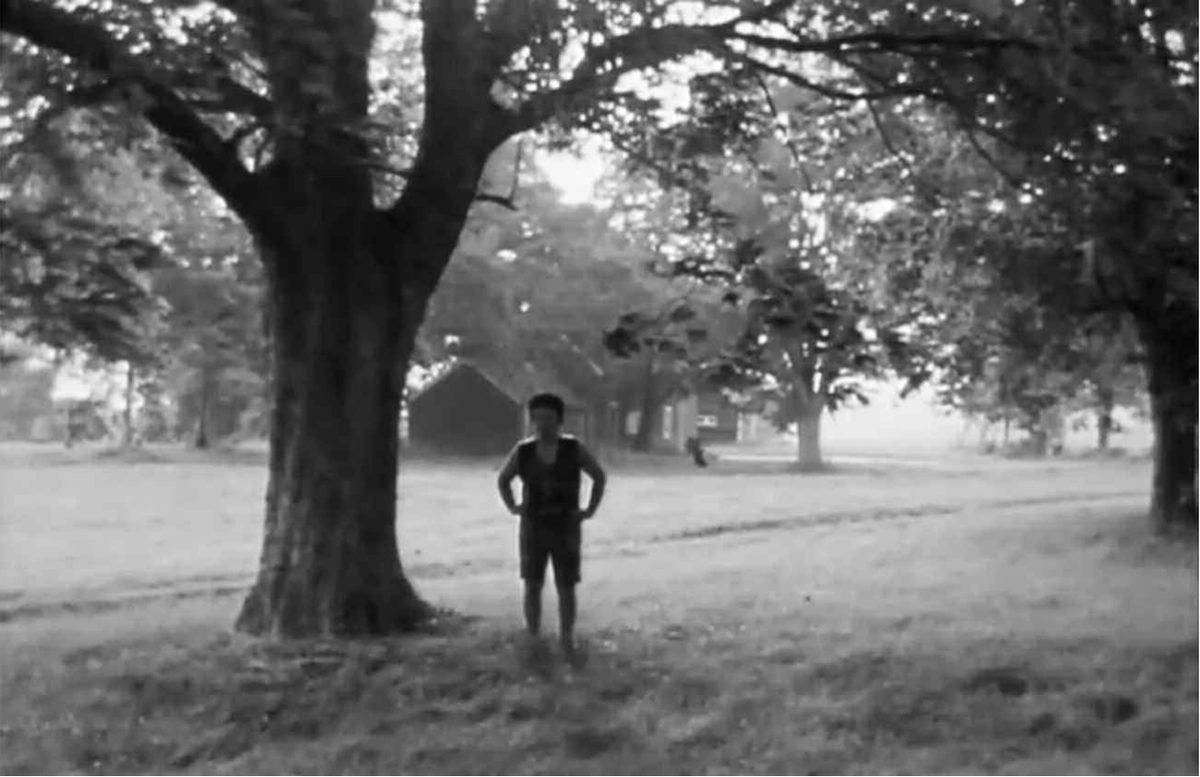
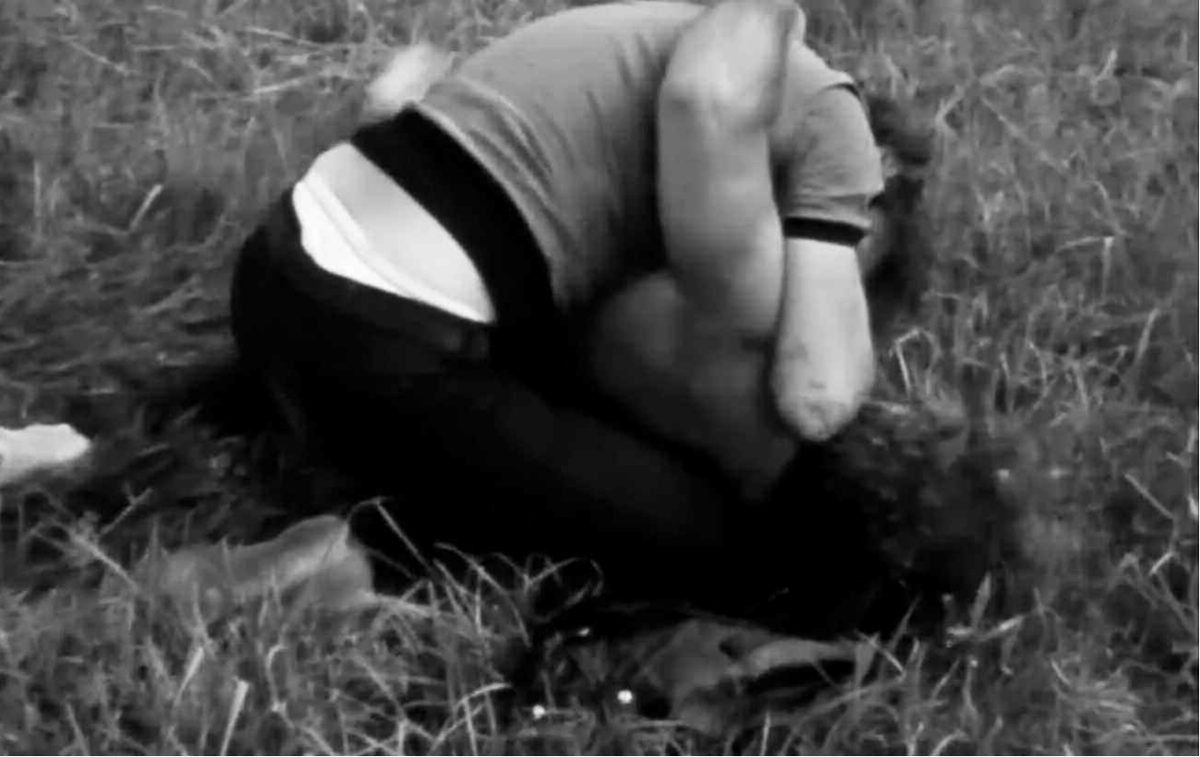
By the end of the fight, brought about by the physical intervention and blood-curdling screams of Mailer’s wife Beverly Bentley, Mailer is bleeding from the hammer-hit to the head,2 Torn is bleeding from the ear—Mailer bit him—and the Mailer children are screaming and crying in fear for their father’s life. The scene ends with Mailer and Torn arguing and calling each other names. Torn pleads that he was acting for the benefit of the film and never meant to kill Mailer but only to realistically fake Kingsley’s assassination. Mailer shouts back, in characteristic Mailer fashion, “It was my picture, and I knew what I was doing with it, and what makes sense, and what don’t” (127). Interestingly, Mailer seems most upset, not about his head wound, but about having had his wife defend him and his children witness his loss of authoritative control and physical prowess.The scene ends with Mailer and Torn exchanging profanities until Mailer regains power over his picture and figuratively assassinates his would-be assassin by directing the cameras not to shoot. But, before he does so, Mailer is recorded decisively declaring that this footage will never make it into the film’s final cut.
Though Mailer could easily have edited this section of footage out of the final cut of the film, he chooses to leave it in. Revealing both Mailer’s own vulnerability and the vulnerability of participatory democracy to authoritarian leaders and dictatorial editing, Maidstone unmasks the utopian fantasies of the counterculture by illuminating the social complexities the New Left has yet to resolve. Just as Mailer and his editorial team failed to cut a film that focuses on the storyline of the black assassin, the white youth movement, like Students for a Democratic Society and the Yippies, drew attention to their own political agendas and their own sense of alienation, often overshadowing the very race-based civil rights movements they were hoping to help in the first place (Rossinow 15–16). Similarly, shamed by Torn’s uprising that transforms Mailer the celebrity author and budding film director into Mailer the victim, Mailer hopes to cut Torn’s image out of the film entirely. Revealing the power dynamics at play in the editing, collation, and public distribution of information, Maidstone holds up a mirror to the American media as well as the counterculture, revealing its hidden tactics for creating an image of “reality” that suits its own ideological needs.
With its title gesturing towards the myth of the Medusa, Maidstone seems to enact the existential interpretation of the gorgon’s petrifying power that Sartre makes in Being and Nothingness: “The Other by rising up confers on the for-itself a being-in-itself—in-the-midst-of-the-world as a thing among things. This petrification in in-itself is the profound meaning of the myth of Medusa” (555). As Sartre scholar Hazel Barnes suggests, this passage demonstrates the power of the Other to dehumanize and objectify the subject, robbing him of his performative agency. As Barnes explains:
For Sartre, my realization of the Other’s existence as an independent subjectivity beyond my reach occurs simultaneously with my discovery that I, who am always and solely a free subject so long as I live nonreflectively, can be turned into an object for another and viewed from the outside . . . Worse yet, insofar as I have been in the habit of assigning to other people their place in the world of my mind and emotions, so I find that I am made part of the furnishings of the Other’s world. The Look of the Other, which reveals to me my object side, judges me, categorizes me . . . It threatens, by ignoring my free subjectivity, to reduce me to the status of a thing in the world. In short, it reveals my physical and my psychic vulnerability. (125–26)
In the editing room, Mailer finally catches a glimpse of himself outside himself: he is a piece of footage, a material object helpless to resist the sharp edge of the editing scissors. With his indexical image functioning like a second hammer hit to the head, Mailer suddenly sees the cultural disparities that give him almost unrivaled control over his public image and finally realizes, as Baldwin had put it years ago, that “All roles are dangerous . . . and it is not always easy—in fact, it is always extremely hard—to maintain a kind of watchful, mocking distance between oneself as one appears to be and oneself as one actually is” (270–71). Finally understanding that, in a media-saturated society, one’s identity is defined by the way others see it and is not, finally, a self-determined product, Maidstone chips away at Mailer’s dreams of social resistance and individual authenticity by showing him the power of authority to remake the real in the editing room and, perhaps, makes him reconsider the politics of both Method acting and “The White Negro” in the process.
As a Jewish-American, Mailer too voiced concern about the conformity of the average American citizen and his or her inability to resist social authority, and he did so most memorably in “The White Negro” itself: “The Second World War presented a mirror to the human condition which blinded anyone who looked into it . . . One could hardly maintain the courage to be individual, to speak with one’s own voice, for the years in which one could complacently accept one’s self as part of an elite by being a radical were forever gone. A man knew that when he dissented, he gave a note upon his life which could be called in any year of overt crisis. No wonder then that these years have been the years of conformity and depression” (338).↩︎
In Advertisements for Myself, Mailer claims to have already “been hit on the head by a hammer” (22). In many ways, Advertisements seems to set up and foresee Maidstone, functioning as the literary doppelganger that belies its realism.↩︎
Works Cited
Adams, Laura. “Introduction.” Will the Real Norman Mailer Please Stand Up? Port Washington, NY: Kennikat Press, 1974. 3–9. Print.
Baldwin, James. “The Black Boy Looks at the White Boy.” James Baldwin: Collected Essays. New York: Literary Classics of the United States, Inc., 1998. 269–85. Print.
Barnes, Hazel E. “Sartre and the Existentialist Medusa.” The Medusa Reader. Eds. Marjorie Garber and Nancy J. Vickers. New York: Routledge, 2003. 124–27. Print.
Barsam, Richard M. Nonfiction Film: A Critical History, Revised and Expanded. Bloomington: Indiana University Press, 1973. Print.
Barthes, Roland. “The Death of the Author.” Image, Music, Text. Trans. Stephen Heath. New York: Hill and Wang, 1978. 142–148. Print.
Benjamin, Walter. “The Work of Art in the Age of its Technological Reproducibility, Second Version.” Walter Benjamin: Selected Writings, Volume 3, 1935–1938. Eds. Howard Eiland and Michael W. Jennings. Cambridge, Massachusetts: The Belknap Press of Harvard UP, 2002. 101–136. Print.
Beyond the Law. 1968. Dir. Norman Mailer. CineMalta, 2005. DVD.
Bosworth, Patricia. “Mailer’s Movie Madness.” Vanity Fair.com March 2008. 9 Jan. 2009 . Web.
Dearborn, Mary V. Mailer: A Biography. Boston: Houghton Mifflin Company, 1999. Print.
Foucault, Michel. “What is an Author?” The Foucault Reader. Ed. Paul Rabinow. New York: Pantheon Books, 1984. 101–120. Print.
Franklin, Ruth. A Thousand Darknesses: Lies and Truth in Holocaust Fiction. New York: Oxford UP, 2010. Print.
Gabbard, Krin. Black Magic: White Hollywood and African American Culture. New Brunswick: Rut-gers UP, 2004. Print.
Krasner, David. “I Hate Strasberg: Method Acting in the Academy.” Method Acting Reconsidered: Theory, Practice, Future. New York: St. Martin’s Press, 2000. Print.
Lott, Eric. “White Like Me.” Cultures of United States Imperialism. Eds. Amy Kaplan and Donald E. Pease. Durham: Duke UP, 1993. 474–498. Print.
Maidstone. 1970. Dir. Norman Mailer. CineMalta, 2005. DVD.
Mailer, Norman. Advertisements for Myself. New York: G.P. Putnam’s Sons, 1959. Print.
——— . Maidstone: A Mystery. New York: Signet Books, 1971. Print.
——— . “Some Dirt in the Talk.” Existential Errands. Boston: Little, Brown, and Company, 1972. Print.
——— . The White Negro. New York: City Lights, 1960. Print.
McLuhan, Marshall. “All of the Candidates Are Asleep.” Saturday Evening Post 10 Aug. 1968. 34–36. Print.
Monaco, Paul. History of the American Cinema: The Sixties, 1960–1969, Vol. 8. Berkeley: U of California P, 2001. Print.
Rossinow, Doug. The Politics of Authenticity: Liberalism, Christianity, and the New Left in America. New York: Columbia UP, 1998. Print.
Sartre, Jean-Paul. Being and Nothingness. Trans. Hazel E. Barnes. New York: Washington Square Press, 1984. Print.
Wild 90. 1968. Dir. Norman Mailer. CineMalta, 2005. DVD.